BMR Calculator
Basal metabolic rate — the calories your body burns at complete rest.
Quick answer
- BMR is the energy your body burns at complete rest, before any activity is added — it is the starting point for TDEE and calorie planning.
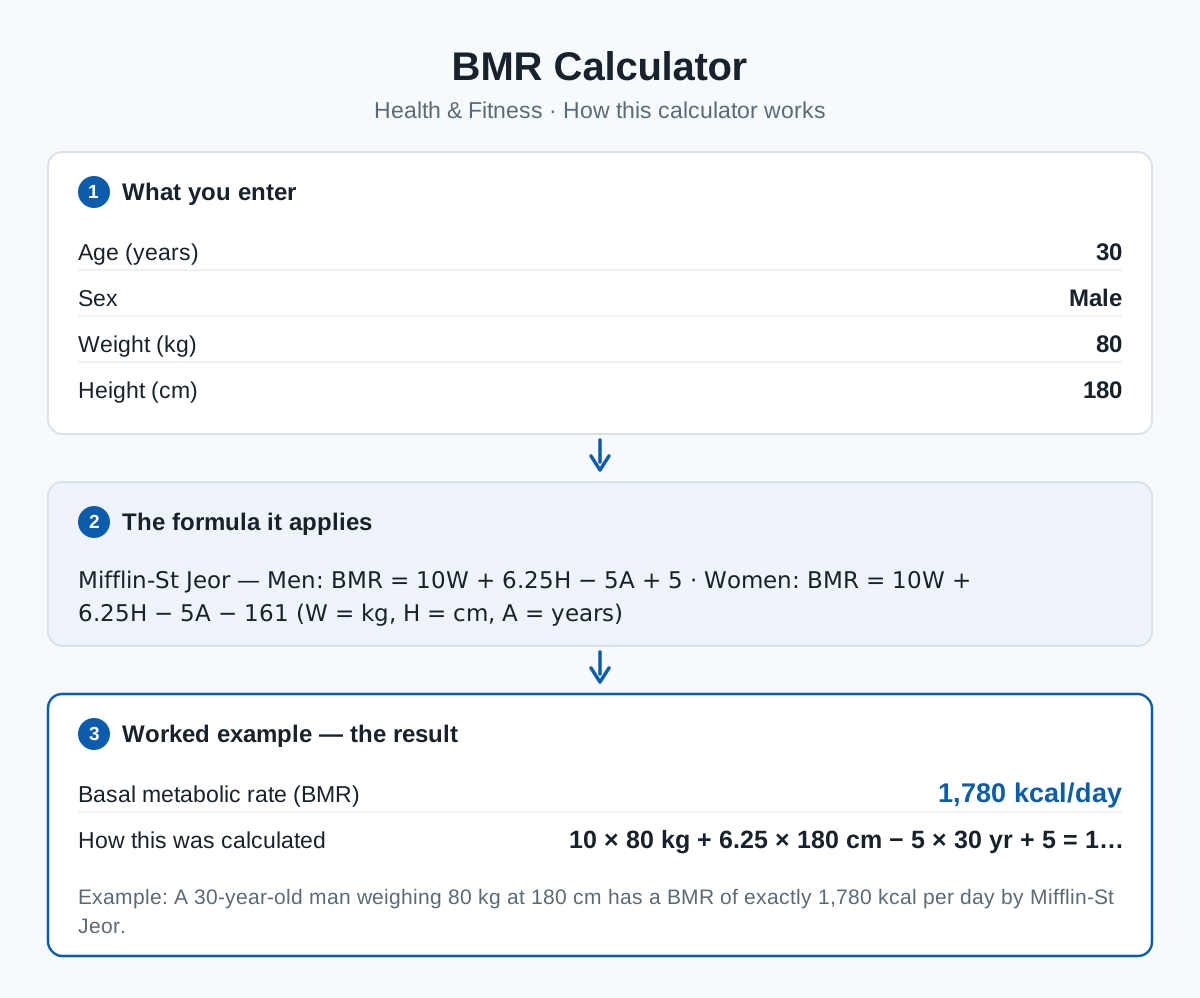
- This calculator uses the Mifflin-St Jeor equation: 10 × weight (kg) + 6.25 × height (cm) − 5 × age (years), then + 5 for men or − 161 for women.
- The 'How this was calculated' result shows your own numbers substituted into that equation step by step, so you can check the arithmetic yourself.
- Worked example — Basal metabolic rate (BMR): 1,780 kcal/day (full example below).
BMR Calculator
| Basal metabolic rate (BMR) | 1,780 kcal/day |
| How this was calculated | 10 × 80 kg + 6.25 × 180 cm − 5 × 30 yr + 5 = 1,780 kcal/day |
A 30-year-old man weighing 80 kg at 180 cm has a BMR of exactly 1,780 kcal per day by Mifflin-St Jeor.
Your basal metabolic rate (BMR) is the energy your body needs each day just to keep vital functions running — breathing, circulation, cell production — before any activity is added. This calculator uses the Mifflin-St Jeor equation (1990), which research reviews have found to be the most accurate of the common prediction equations for healthy adults.
BMR is an estimate, not a measurement: individual values can differ by roughly 10% because of body composition and other factors. It is the starting point for TDEE and calorie planning, not medical advice.
The formula
Worked example
A 30-year-old man weighing 80 kg at 180 cm has a BMR of exactly 1,780 kcal per day by Mifflin-St Jeor.
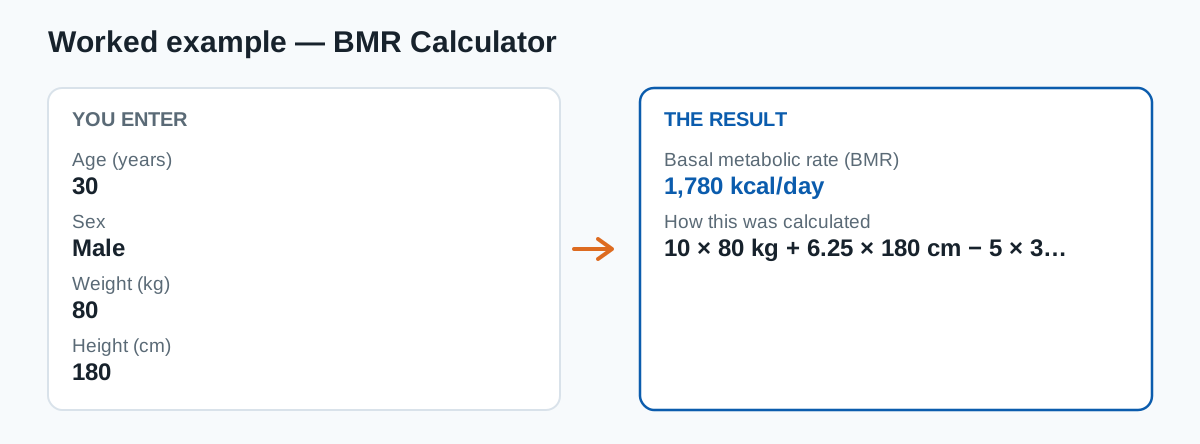
The example is pre-loaded in the result panel — press Calculate with your own numbers to replace it.
Frequently asked questions
How is BMR different from TDEE?
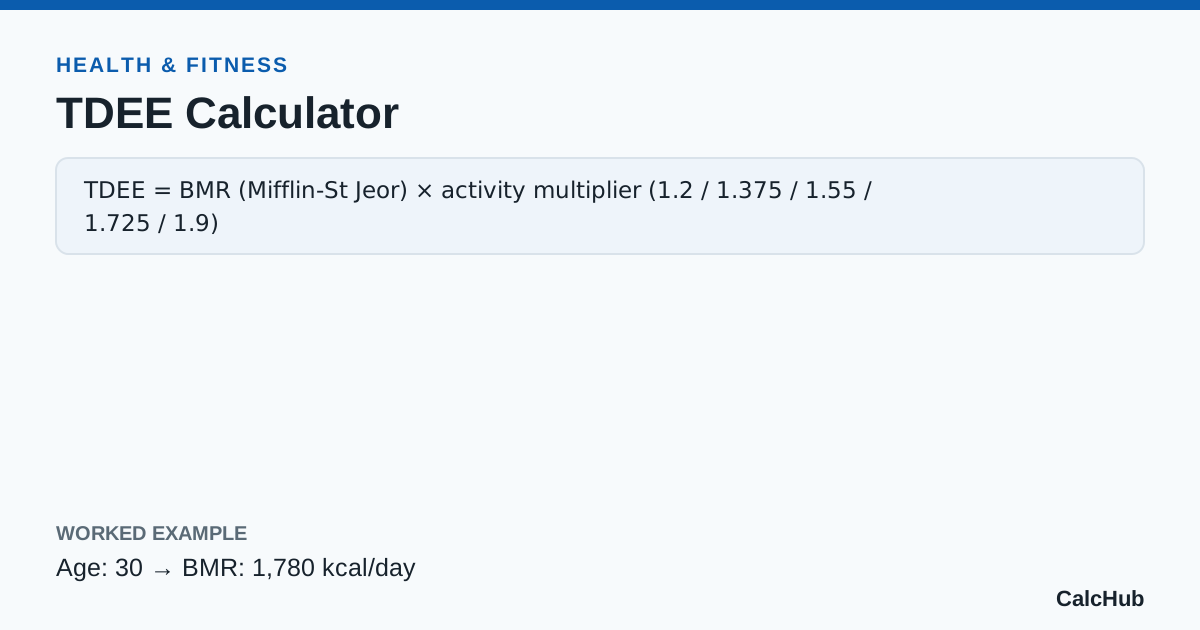
BMR covers resting functions only. TDEE (total daily energy expenditure) multiplies BMR by an activity factor to include movement, exercise and work — use the TDEE calculator for a full maintenance figure.
Why does the formula differ for men and women?
On average, men carry more lean mass and less body fat at the same weight and height, which raises resting energy use. The −161 / +5 constants in Mifflin-St Jeor capture that average difference.
Can I raise my BMR?
Yes, modestly — building muscle increases lean mass, which burns more energy at rest than fat tissue. Crash dieting does the opposite: sustained severe restriction can suppress BMR.
Category: Health & Fitness calculators
Sources & methodology
This calculator applies the formula shown on this page exactly as written, using the standard definitions for its inputs. Results are computed from the values you enter — no data is stored — and are rounded only for display.
Content last reviewed by CalcHub Editorial.
Embed this calculator on your site
Free to use with attribution — paste the snippet below and the calculator appears on your page, with a link back to CalcHub.