Mortgage CalculatorLoan CalculatorAuto Loan CalculatorCompound Interest CalculatorSimple Interest CalculatorSavings CalculatorRetirement CalculatorROI CalculatorCAGR CalculatorPresent Value CalculatorFuture Value CalculatorAnnuity CalculatorAPR CalculatorCredit Card Payoff CalculatorDebt-to-Income Ratio CalculatorIncome Tax Calculator (US Federal)Salary to Hourly Wage CalculatorTip CalculatorDiscount CalculatorSales Tax CalculatorProfit Margin CalculatorMarkup CalculatorBreak-Even CalculatorInflation CalculatorSavings Goal CalculatorExchange Rate CalculatorPercentage CalculatorPercentage Change CalculatorFraction CalculatorAverage CalculatorMean, Median & Mode CalculatorStandard Deviation CalculatorRatio CalculatorProportion CalculatorExponent CalculatorLogarithm CalculatorSquare Root CalculatorFactorial CalculatorGCD & LCM CalculatorPythagorean Theorem CalculatorQuadratic Equation CalculatorSlope CalculatorArea CalculatorPerimeter CalculatorVolume CalculatorCircle CalculatorTriangle CalculatorRandom Number Range AnalyzerScientific Notation CalculatorRounding CalculatorBMI CalculatorBMR CalculatorTDEE CalculatorCalorie CalculatorBody Fat CalculatorIdeal Weight CalculatorMacro CalculatorProtein CalculatorWater Intake CalculatorOvulation CalculatorPregnancy Due Date CalculatorConception CalculatorPeriod CalculatorPace CalculatorHeart Rate Zones CalculatorVO2 Max CalculatorOne Rep Max CalculatorSleep CalculatorBlood Alcohol Calculator (BAC)Lean Body Mass CalculatorCalories Burned CalculatorPregnancy Weight Gain CalculatorAge CalculatorDate Duration CalculatorDays Between Dates CalculatorAdd Days to Date CalculatorBusiness Days CalculatorWork Hours CalculatorTime Duration CalculatorTime Zone ConverterWeek Number CalculatorDay of Week CalculatorLeap Year CalculatorUnix Timestamp ConverterTime Add / Subtract CalculatorDays Until CalculatorZodiac Sign CalculatorChinese Zodiac CalculatorRetirement Date CalculatorQuarter CalculatorLength ConverterWeight ConverterTemperature ConverterVolume ConverterArea ConverterSpeed ConverterTime ConverterData Storage ConverterPressure ConverterEnergy ConverterPower ConverterForce ConverterTorque ConverterAngle ConverterFuel Consumption ConverterCooking ConverterShoe Size ConverterDensity ConverterFrequency ConverterHeight ConverterFlow Rate ConverterNumber to Words ConverterRoman Numeral ConverterBeaufort Scale ConverterScreen Size CalculatorDecibel ConverterConcrete CalculatorTile CalculatorPaint CalculatorFlooring CalculatorDrywall CalculatorBrick CalculatorGravel CalculatorMulch CalculatorDeck CalculatorFence CalculatorRoof Pitch CalculatorRoofing Material CalculatorStairs CalculatorSquare Footage CalculatorCubic Yard CalculatorBoard Feet CalculatorInsulation CalculatorWallpaper CalculatorOhm's Law CalculatorParallel Resistor CalculatorVelocity CalculatorAcceleration CalculatorKinetic Energy CalculatorPotential Energy CalculatorForce CalculatorMomentum CalculatorFriction CalculatorProjectile Range CalculatorPendulum CalculatorWavelength CalculatorpH CalculatorMolarity CalculatorDilution CalculatorIdeal Gas CalculatorBoyle's Law CalculatorHalf-Life CalculatorGPA CalculatorGrade CalculatorFinal Grade CalculatorWeighted Grade CalculatorDog Age CalculatorCat Age CalculatorElectricity Cost CalculatorFuel Cost CalculatorSplit Bill CalculatorUnit Price CalculatorReading Time CalculatorSubnet CalculatorDownload Time CalculatorProbability CalculatorRent Affordability CalculatorSolar Payback CalculatorHousehold Budget CalculatorEmergency Fund Calculator

Scientific Notation Calculator

Convert a decimal number into scientific notation: coefficient × 10^exponent.

Quick answer

  • Scientific notation keeps the coefficient between 1 and 10; E-notation is the same value typed for calculators and code (4.2E5 = 4.2 × 10^5).
  • Engineering notation forces the exponent to a multiple of 3 so it matches SI prefixes (kilo, mega, milli, micro), with the mantissa between 1 and 1,000.
  • The exponent alone tells you the order of magnitude — compare exponents first, coefficients second.
  • Worked example — Scientific notation: 4.2 × 10^5 (full example below).

Scientific Notation Calculator

Worked example result
Scientific notation4.2 × 10^5
Coefficient4.200000
Exponent5
E-notation4.2E5
Engineering notation420 × 10^3

420,000 = 4.2 × 10^5: move the decimal point 5 places left to get a coefficient of 4.2, and those 5 moves become the exponent.
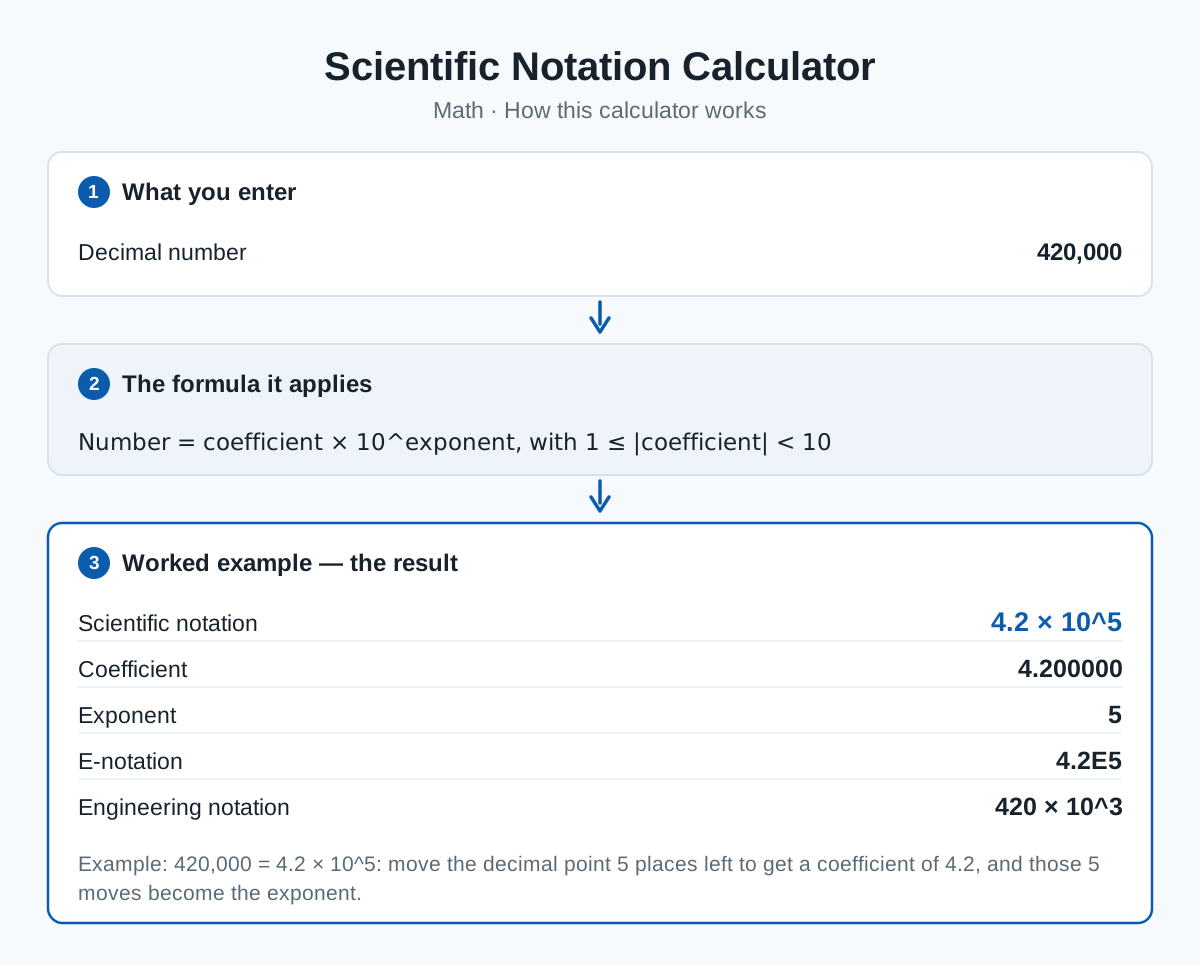
Diagram: how the Scientific Notation Calculator works — you enter Decimal number; it applies the formula Number = coefficient × 10^exponent, with 1 ≤ |coefficient| < 10; and the worked example gives Scientific notation: 4.2 × 10^5.
How the Scientific Notation Calculator works — the inputs, the formula, and a worked example (Scientific notation: 4.2 × 10^5).

Scientific notation writes very large and very small numbers compactly as a coefficient between 1 and 10 multiplied by a power of ten: 420,000 becomes 4.2 × 10^5, and 0.00056 becomes 5.6 × 10^−4.

Enter any decimal number. The calculator splits it into its coefficient (also called the mantissa), its exponent, and the full written form, so you can copy it into homework, lab reports or code.

The formula

Number = coefficient × 10^exponent, with 1 ≤ |coefficient| < 10

Worked example

420,000 = 4.2 × 10^5: move the decimal point 5 places left to get a coefficient of 4.2, and those 5 moves become the exponent.
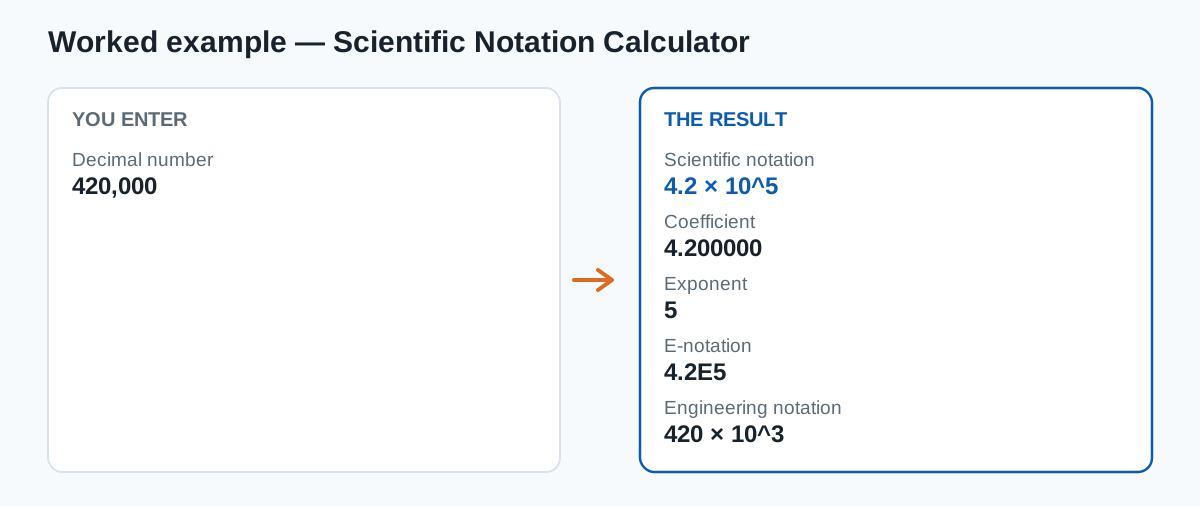
Worked example for the Scientific Notation Calculator: with Decimal number 420,000, the result is Scientific notation: 4.2 × 10^5; Coefficient: 4.200000.
The worked example, with the example values entered and the results they give.

The example is pre-loaded in the result panel — press Calculate with your own numbers to replace it.

Notation equivalents

Standard formScientific notationE-notationEngineering notation
42,000,0004.2 × 10^74.2E742 × 10^6
0.000424.2 × 10^-44.2E-4420 × 10^-6

Every row is the same number written four ways; each cell was produced by this calculator's own formula for that input.

Frequently asked questions

How do I convert back from scientific notation?

Move the decimal point in the coefficient by the exponent: right for a positive exponent, left for a negative one. 5.6 × 10^−4 means moving 4 places left: 0.00056.

Is 42 × 10^4 valid scientific notation?

It equals the right number, but by convention the coefficient must be at least 1 and less than 10, so the standard form is 4.2 × 10^5. Following the convention lets you compare magnitudes at a glance from the exponent alone.

Where is scientific notation used?

Anywhere numbers span huge ranges: distances in astronomy (the Sun is about 1.5 × 10^8 km away), masses of particles, and computer floating-point formats, which are essentially binary scientific notation.

What is the difference between E-notation and engineering notation?

E-notation is the calculator/computer spelling of scientific notation — 4.2E5 means 4.2 × 10^5. Engineering notation keeps the same idea but forces the exponent to a multiple of 3 (…, −6, −3, 0, 3, 6, …) so it lines up with SI prefixes like kilo (10^3) and milli (10^−3); the mantissa then sits between 1 and 1,000 instead of 1 and 10, so 420,000 is written 420 × 10^3.

Category: Math calculators

Sources & methodology

The exponent is floor(log₁₀|x|) and the coefficient is x ÷ 10^exponent, giving 1 ≤ |coefficient| < 10. Engineering notation rounds the exponent down to the nearest multiple of 3 and rescales the mantissa into [1, 1000). E-notation prints the scientific form as coefficient + "E" + exponent.

Content last reviewed by CalcHub Editorial.

Embed this calculator on your site

Free to use with attribution — paste the snippet below and the calculator appears on your page, with a link back to CalcHub.

<iframe src="https://calc-hub-63e.pages.dev/embed/scientific-notation-calculator" width="100%" height="640" style="border:1px solid #d9e2ea;border-radius:12px" loading="lazy" title="Scientific Notation Calculator — CalcHub"></iframe>

Open the embed version →