
Calorie Calculator
Daily calorie target for losing, maintaining or gaining weight.
Quick answer
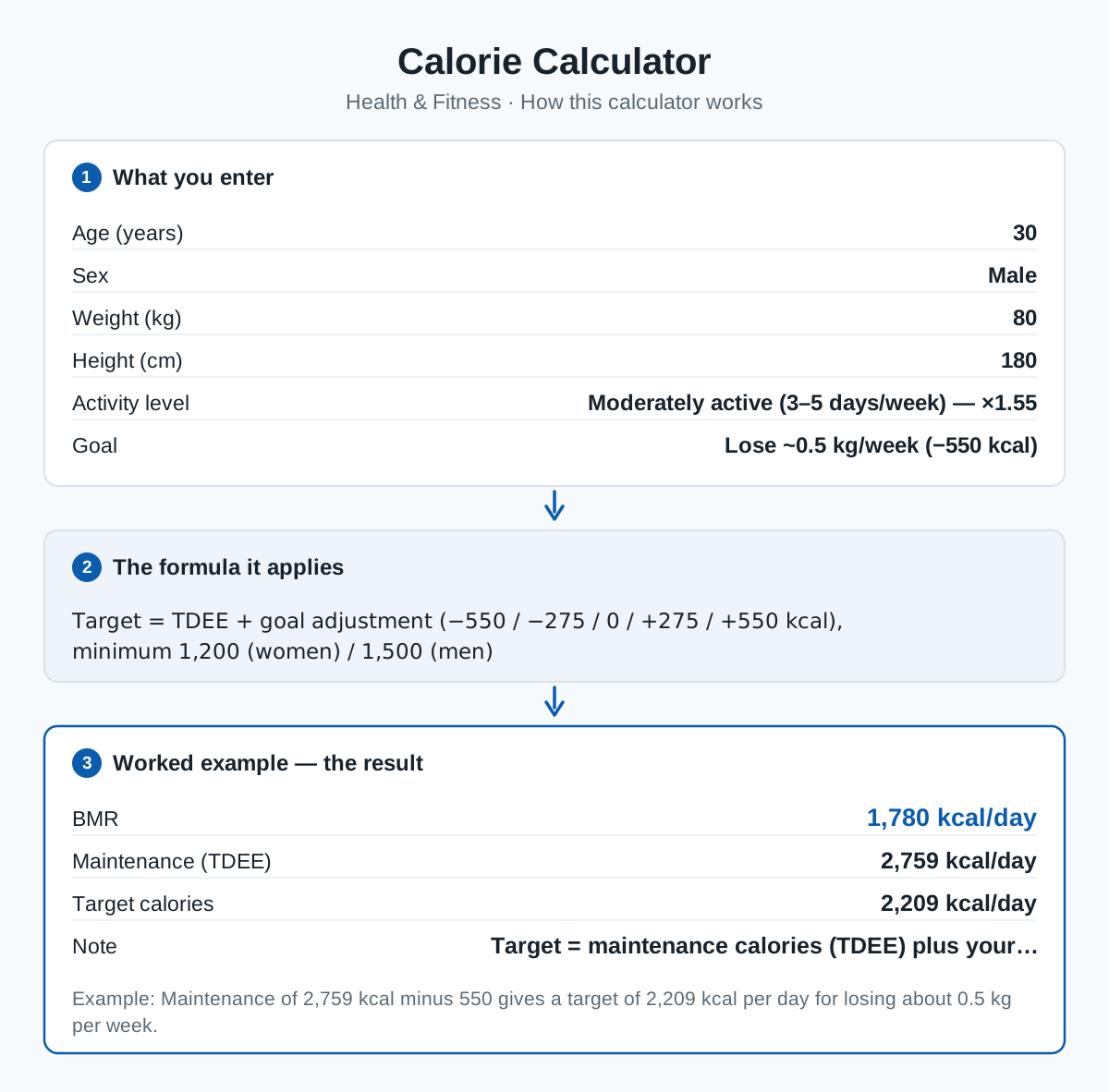
- Formula: Target = TDEE + goal adjustment (−550 / −275 / 0 / +275 / +550 kcal), minimum 1,200 (women) / 1,500 (men)
- Worked example — BMR: 1,780 kcal/day (full example below).
Calorie Calculator
| BMR | 1,780 kcal/day |
| Maintenance (TDEE) | 2,759 kcal/day |
| Target calories | 2,209 kcal/day |
| Note | Target = maintenance calories (TDEE) plus your goal adjustment. |
Maintenance of 2,759 kcal minus 550 gives a target of 2,209 kcal per day for losing about 0.5 kg per week.
This calculator starts from your maintenance calories — Mifflin-St Jeor BMR multiplied by a Harris-Benedict activity factor — then adjusts for your goal. Losing about 0.25 kg per week needs roughly a 275 kcal daily deficit and 0.5 kg per week about 550 kcal, based on the approximation that 1 kg of body fat stores about 7,700 kcal.
Targets are never set below widely used safety floors of 1,200 kcal/day for women and 1,500 kcal/day for men; if your goal would go lower, the result is clamped and flagged. These are general educational estimates, not medical advice — very low intakes belong under professional supervision.
The formula
Worked example
Maintenance of 2,759 kcal minus 550 gives a target of 2,209 kcal per day for losing about 0.5 kg per week.
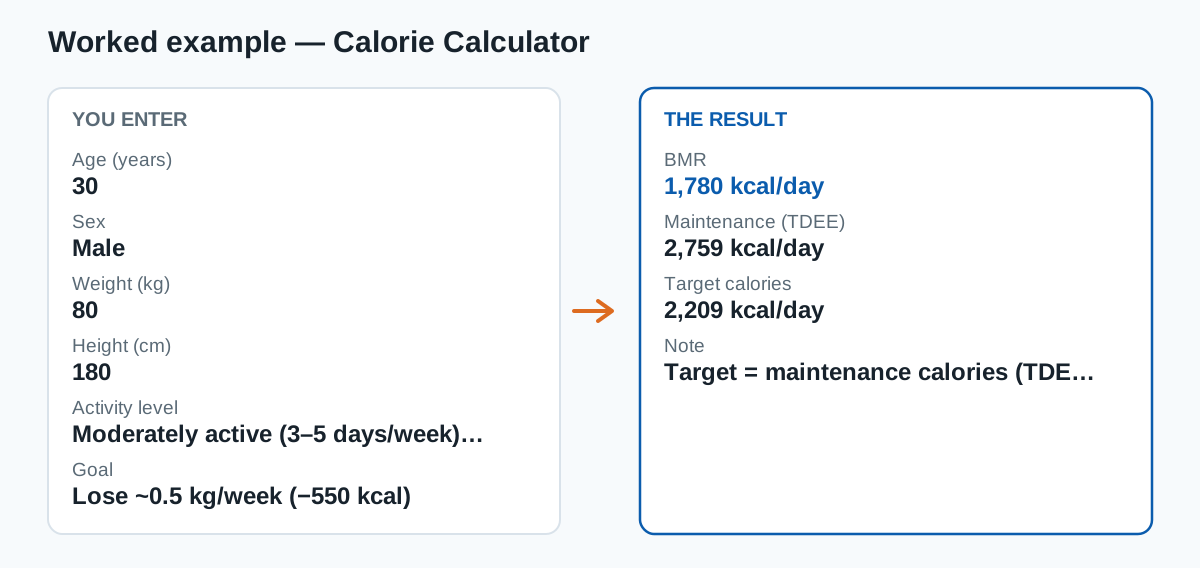
The example is pre-loaded in the result panel — press Calculate with your own numbers to replace it.
Activity factors used by this calculator
| Activity level | Multiplier | Typical pattern |
|---|---|---|
| Sedentary | ×1.2 | Little or no exercise |
| Lightly active | ×1.375 | Exercise 1–3 days/week |
| Moderately active | ×1.55 | Exercise 3–5 days/week |
| Very active | ×1.725 | Exercise 6–7 days/week |
| Athlete / physical job | ×1.9 | Hard daily training or a physical job |
Maintenance calories = BMR × the multiplier for the activity level you select — these are exactly the factors the formula above uses.
When this estimate may be wrong
- Safe floor: targets below about 1,200 kcal/day for women or 1,500 kcal/day for men should only be followed under medical supervision — this calculator clamps targets at those floors and flags it in the result note when it does.
- The activity multiplier is an estimate of your whole day, not just your workouts — picking one level too high is the most common reason a calculated target misses.
- Mifflin-St Jeor predicts BMR from weight, height, age and sex only, so your true maintenance can differ from the estimate; validate any target against 2–3 weeks of real weight trend and adjust in small steps.
Frequently asked questions
Why is there a minimum calorie floor?
Below about 1,200 kcal (women) or 1,500 kcal (men) it becomes very hard to cover essential nutrients, and muscle loss and side effects rise. The calculator clamps targets at those floors and tells you when it does.
How fast should I expect to lose weight?
The 7,700 kcal-per-kg rule is a rough average — early weeks include water shifts, and the body adapts over time. Judge progress by the 3–4 week trend, not single weigh-ins.
Should I eat back exercise calories?
Your activity multiplier already includes typical exercise. Adding gym calories on top usually double-counts them and stalls fat loss.
Why does this calculator's target differ from other calorie calculators?
Two choices explain almost all of the disagreement: the activity level selected (each step changes the multiplier — for example from ×1.375 to ×1.55 — and most people overestimate their activity) and the BMR formula used (Mifflin-St Jeor here; others use Harris-Benedict or Katch-McArdle, which can differ by a few percent on the same inputs), before any goal adjustment or safety floor is applied. Our planned guide 'How accurate are TDEE calculators' will break down both sources of difference in detail.
Category: Health & Fitness calculators
Sources & methodology
This calculator applies the formula shown on this page exactly as written, using the standard definitions for its inputs. Results are computed from the values you enter — no data is stored — and are rounded only for display.
- Mifflin et al. (1990) — A new predictive equation for resting energy expenditure in healthy individuals (PubMed)
- NIH National Institute of Diabetes and Digestive and Kidney Diseases (NIDDK)
Content last reviewed by CalcHub Editorial.
Embed this calculator on your site
Free to use with attribution — paste the snippet below and the calculator appears on your page, with a link back to CalcHub.
Related calculators
TDEE Calculator
Total daily energy expenditure — your true maintenance calories.
Macro Calculator
Split daily calories into grams of carbohydrate, protein and fat.
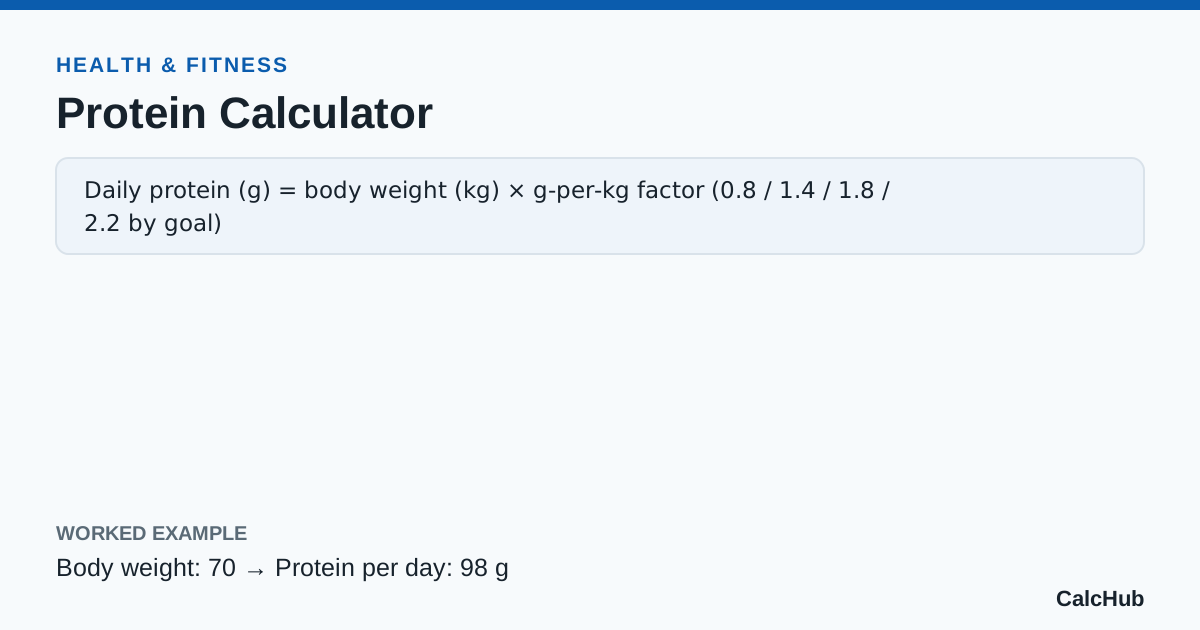
Protein Calculator
Daily protein target in grams, scaled to your body weight and goal.
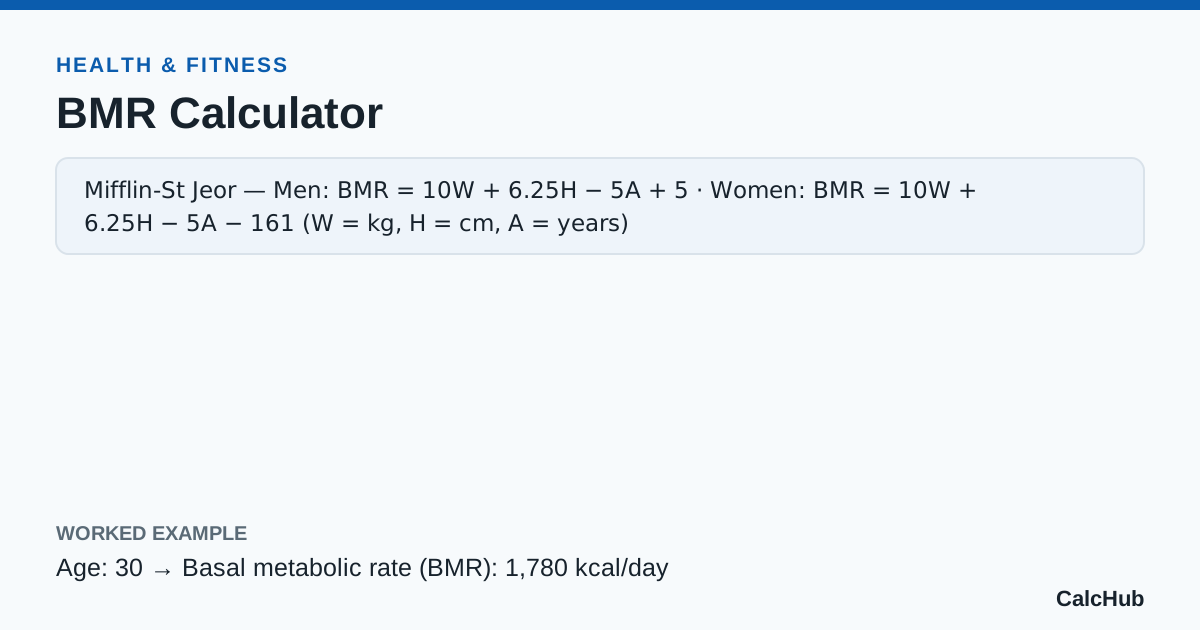
BMR Calculator
Basal metabolic rate — the calories your body burns at complete rest.