One Rep Max Calculator
Estimate your 1RM from a submaximal set — Epley and Brzycki formulas.
Quick answer
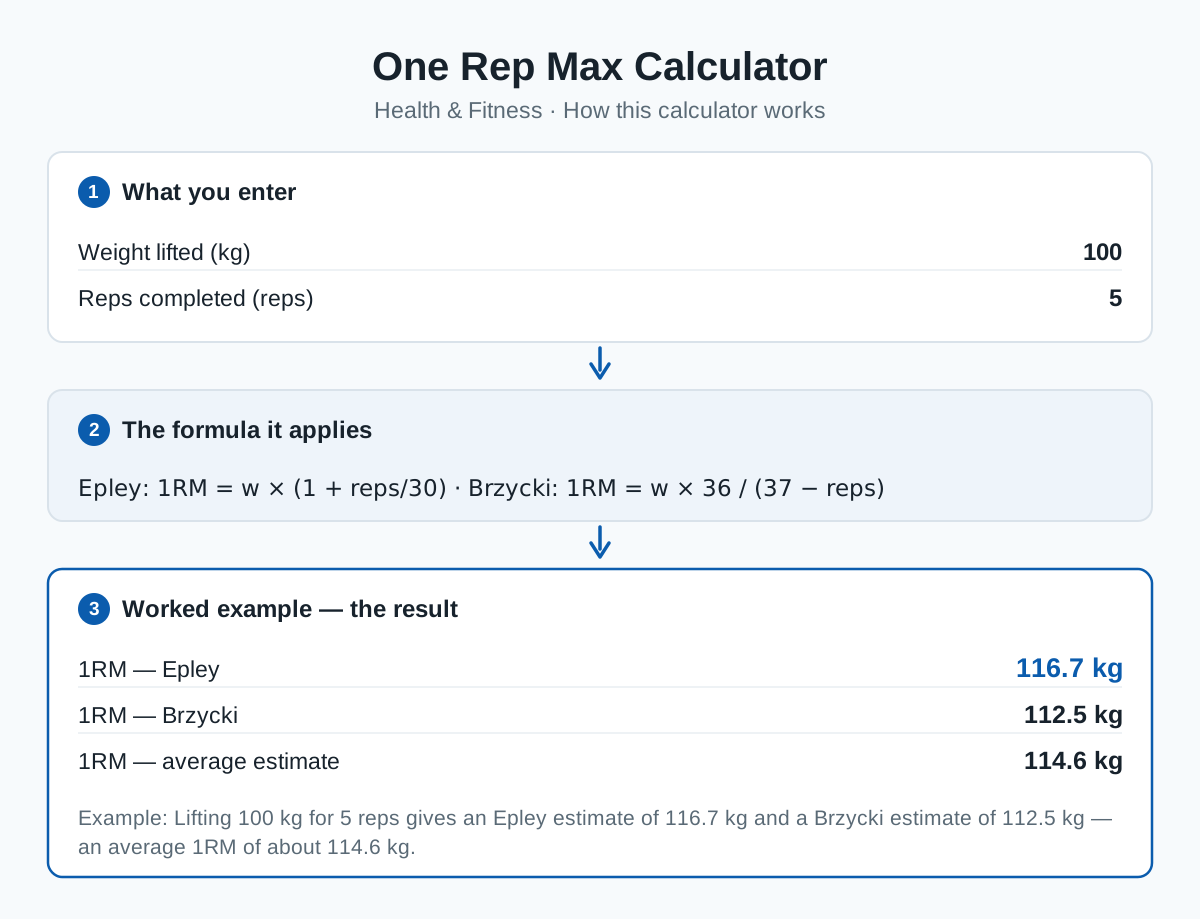
- Formula: Epley: 1RM = w × (1 + reps/30) · Brzycki: 1RM = w × 36 / (37 − reps)
- Worked example — 1RM — Epley: 116.7 kg (full example below).
One Rep Max Calculator
| 1RM — Epley | 116.7 kg |
| 1RM — Brzycki | 112.5 kg |
| 1RM — average estimate | 114.6 kg |
Lifting 100 kg for 5 reps gives an Epley estimate of 116.7 kg and a Brzycki estimate of 112.5 kg — an average 1RM of about 114.6 kg.
Your one-rep max (1RM) is the heaviest load you can lift once with good form. Rather than testing it directly, lifters estimate it from a set of reps to failure: the Epley formula (1RM = weight × (1 + reps/30)) and the Brzycki formula (1RM = weight × 36/(37 − reps)) are the two most widely used, and this calculator shows both plus their average.
Estimates are most accurate from sets of 2–10 reps; beyond that, endurance rather than strength dominates. Warm up thoroughly, use a spotter, and treat the numbers as training guides — not medical advice.
The formula
Worked example
Lifting 100 kg for 5 reps gives an Epley estimate of 116.7 kg and a Brzycki estimate of 112.5 kg — an average 1RM of about 114.6 kg.
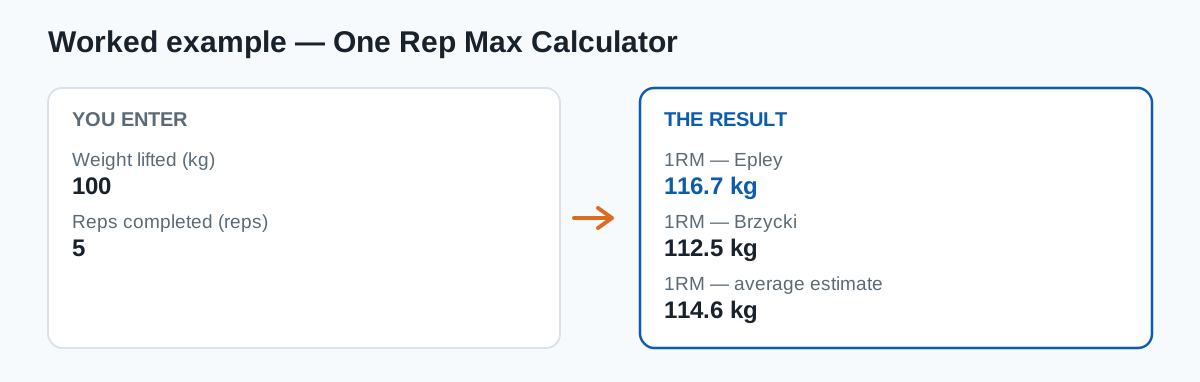
The example is pre-loaded in the result panel — press Calculate with your own numbers to replace it.
Frequently asked questions
Which formula is more accurate?
Both are within a few percent for low-rep sets. Brzycki tends to run lower at 5+ reps, Epley slightly higher; averaging them hedges the error. For sets of 10 they agree closely.
How do I use my 1RM in training?
Programmes prescribe percentages: roughly 85% for strength sets of 5, 75–80% for hypertrophy sets of 8–12, and 60–70% for technique and volume work.
Why can't I enter 37+ reps?
Brzycki's formula divides by (37 − reps), which reaches zero at 37 reps — and long before that, high-rep sets measure endurance, so any 1RM estimate is meaningless.
Category: Health & Fitness calculators
Sources & methodology
This calculator applies the formula shown on this page exactly as written, using the standard definitions for its inputs. Results are computed from the values you enter — no data is stored — and are rounded only for display.
Content last reviewed by CalcHub Editorial.
Embed this calculator on your site
Free to use with attribution — paste the snippet below and the calculator appears on your page, with a link back to CalcHub.