
Concrete Calculator
Cubic yards, cubic feet and bags of concrete for a slab, footing or post hole pad.
Quick answer
- A 10 × 10 ft slab at 4 in thick is 1.235 cu yd (33.3 cu ft) of concrete before waste.
- With the standard 10% waste allowance, order 1.358 cu yd — or 62 bags of 80-lb pre-mix if you mix it yourself.
- One cubic yard takes about 45 bags of 80-lb mix (60 bags of 60-lb, 90 bags of 40-lb), so at roughly 1 cu yd and above a ready-mix truck usually beats bags on effort.
- Bag counts are always rounded UP to whole bags — you cannot buy part of a bag.
Concrete Calculator
| Volume (exact) | 33.3 cu ft |
| Volume (exact) | 1.235 cu yd |
| Order volume (with waste) | 1.358 cu yd |
| Pre-mix bags needed (with waste) | 62 |
A 10 × 10 ft slab, 4 inches thick, is 33.3 cu ft = 1.235 cu yd before waste; with 10% waste you order 1.358 cu yd, or 62 bags of 80-lb pre-mix.
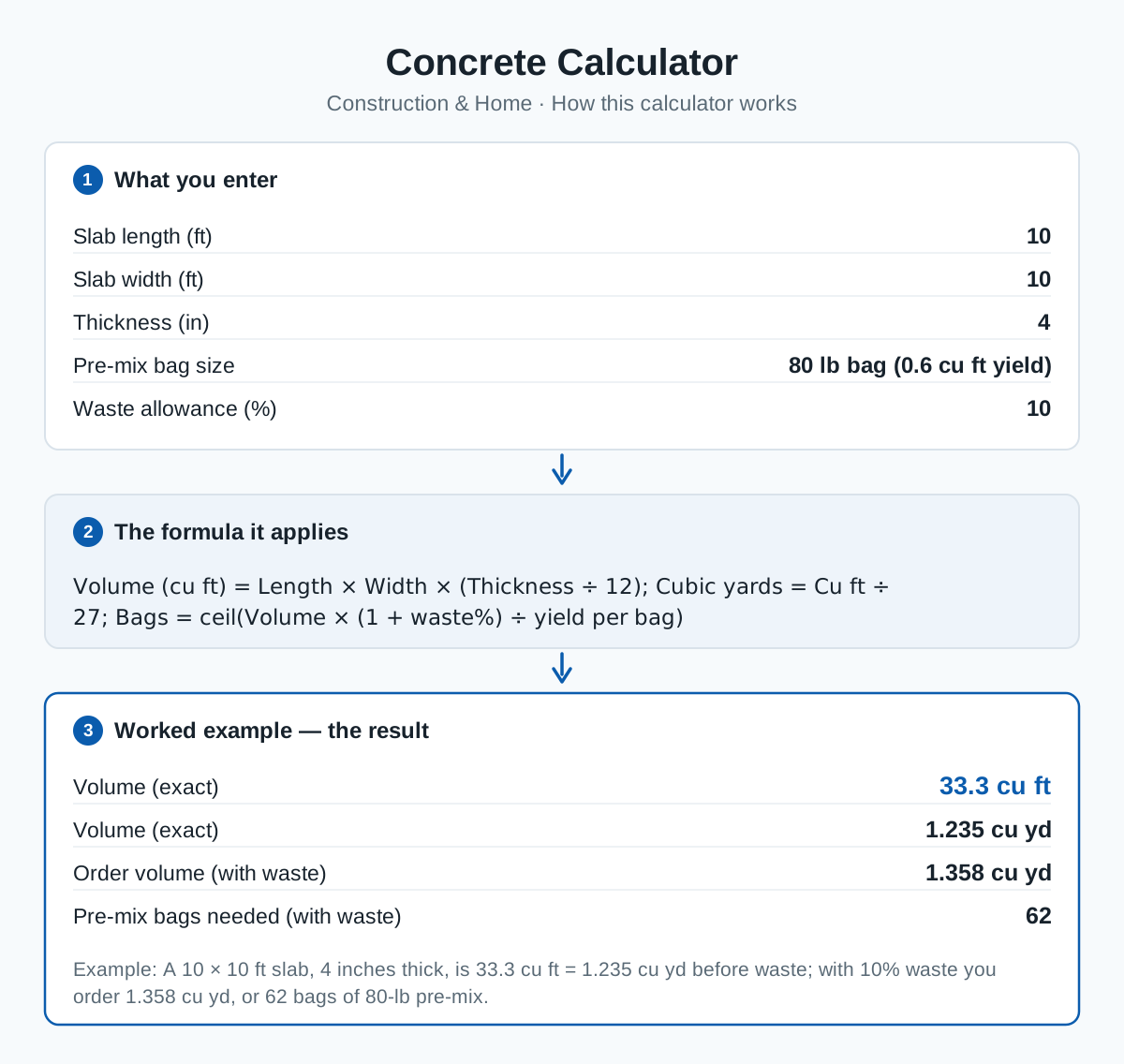
Enter the length, width and thickness of your slab to get the exact concrete volume in cubic yards and cubic feet — plus how many pre-mix bags you need if you are mixing it yourself instead of ordering a truck.
Bag counts use the standard published yields for pre-mix concrete: one 80-lb bag makes about 0.6 cubic feet and one 60-lb bag about 0.45 cubic feet. Always add waste (10% is the usual allowance) for spillage, uneven ground and a slightly thicker-than-planned slab, and note that bag counts are always rounded UP to whole bags — you cannot buy part of a bag.
The formula
Worked example
A 10 × 10 ft slab, 4 inches thick, is 33.3 cu ft = 1.235 cu yd before waste; with 10% waste you order 1.358 cu yd, or 62 bags of 80-lb pre-mix.
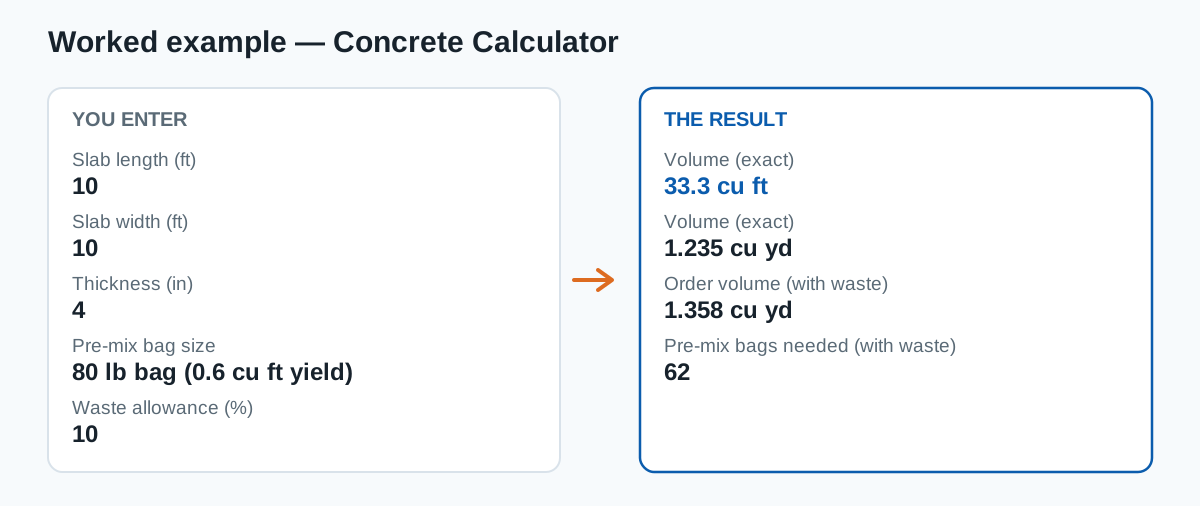
The example is pre-loaded in the result panel — press Calculate with your own numbers to replace it.
Concrete formulas by shape
| Shape | Volume formula |
|---|---|
| Slab / pad | Length × Width × (Thickness in inches ÷ 12) |
| Footing / strip | Length × Width × Depth (all in feet) |
| Round hole / column | π × Radius² × Depth (all in feet) |
| Steps | Sum of each step: Length × Width × Height (all in feet) |
This calculator works the rectangular slab case; for every shape, divide cubic feet by 27 to get cubic yards.
Pre-mix bag yields
| Bag size | Yield per bag | Bags per cubic yard |
|---|---|---|
| 40 lb | 0.30 cu ft | 90 |
| 60 lb | 0.45 cu ft | 60 |
| 80 lb | 0.60 cu ft | 45 |
Yields are the manufacturers' published figures. Bags per cubic yard are this calculator's counts for 27 cu ft with no waste allowance.
Common slab sizes at 4 in thick
| Slab size | Volume (cu yd) | 80-lb bags (exact) | 80-lb bags (with 10% waste) |
|---|---|---|---|
| 8 × 8 ft | 0.79 | 36 | 40 |
| 10 × 10 ft | 1.235 | 56 | 62 |
| 10 × 12 ft | 1.481 | 67 | 74 |
| 12 × 12 ft | 1.778 | 80 | 89 |
| 16 × 20 ft | 3.951 | 178 | 196 |
| 20 × 20 ft | 4.938 | 223 | 245 |
Volumes and bag counts are this calculator's outputs for each size at 4 in thick; bag counts are rounded up to whole bags.
Common mistakes
- Forgetting the waste allowance — subgrade dips, bowed forms and spillage mean the exact volume is rarely enough; 10% is the standard cushion.
- Entering thickness in feet instead of inches (or the reverse) — a 4-inch slab entered as 4 ft multiplies the order by 12.
- Comparing bag counts against truck prices without the yield: one cubic yard is about 45 bags of 80-lb mix, not a handful.
- Mixing bags for a pour above roughly 1 cu yd — the hauling and mixing workload, not the price, is usually what breaks the job.
When this estimate may be wrong
- Bag yields (0.60 cu ft per 80-lb bag, 0.45 per 60-lb bag) are the manufacturers' published figures; actual yield varies slightly with water content and consolidation.
- The estimate assumes a level subgrade at a uniform thickness — an uneven base can add 10% or more to the real volume.
- Ready-mix suppliers often enforce a minimum load and charge short-load fees below it, so the order volume here may not match the billable volume.
Frequently asked questions
How many bags of concrete do I need for a 10×10 slab?
At 4 inches thick that slab is 33.3 cu ft. Dividing by the 0.6 cu ft yield of an 80-lb bag gives 56 bags before waste, or 62 bags with a 10% waste allowance. At that quantity a ready-mix truck (1.36 cu yd) is usually cheaper and far less work.
Why add 10% waste?
Real slabs are never perfect: the subgrade dips, forms bow slightly and some concrete spills. Ordering 5–10% extra is far cheaper than a second delivery or a cold joint partway through the pour.
How thick should a slab be?
4 inches is standard for patios, walkways and sheds. Driveways and garage floors typically use 4–6 inches, often with rebar or wire mesh. Heavy vehicles or poor soil call for 6 inches or more — check local code.
Bags or ready-mix — which is better?
It comes down to volume. One cubic yard of concrete is about 45 bags of 80-lb pre-mix (60 bags of 60-lb), and every one has to be hauled, lifted and mixed — the 10 × 10 ft example slab above works out to 62 bags with a 10% waste allowance. At roughly 1 cubic yard and above, a ready-mix truck usually wins on effort and finish quality; below that, bags avoid delivery minimums. Ready-mix short-load fees for small orders vary by supplier and can narrow the gap, so compare the delivered price both ways.
Category: Construction & Home calculators
Sources & methodology
Volume is length × width × thickness for a rectangular slab, converted at 27 cu ft per cubic yard. Bag counts divide the waste-adjusted volume by the manufacturer's published yield per bag and round up to whole bags.
Content last reviewed by CalcHub Editorial.
Embed this calculator on your site
Free to use with attribution — paste the snippet below and the calculator appears on your page, with a link back to CalcHub.
Related calculators
Cubic Yard Calculator
Convert length × width × depth into cubic yards, cubic feet and cubic meters.
Gravel Calculator
Cubic yards and tons of gravel for a driveway, path or drainage bed.
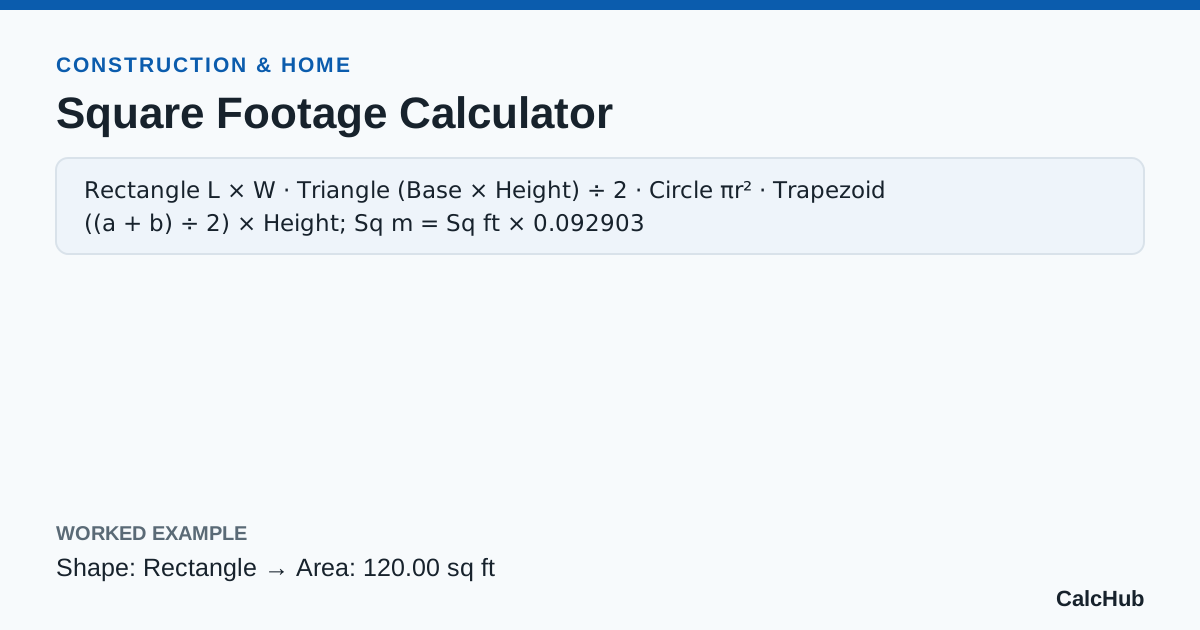
Square Footage Calculator
Area in square feet and square meters for rectangles, triangles, circles and trapezoids.
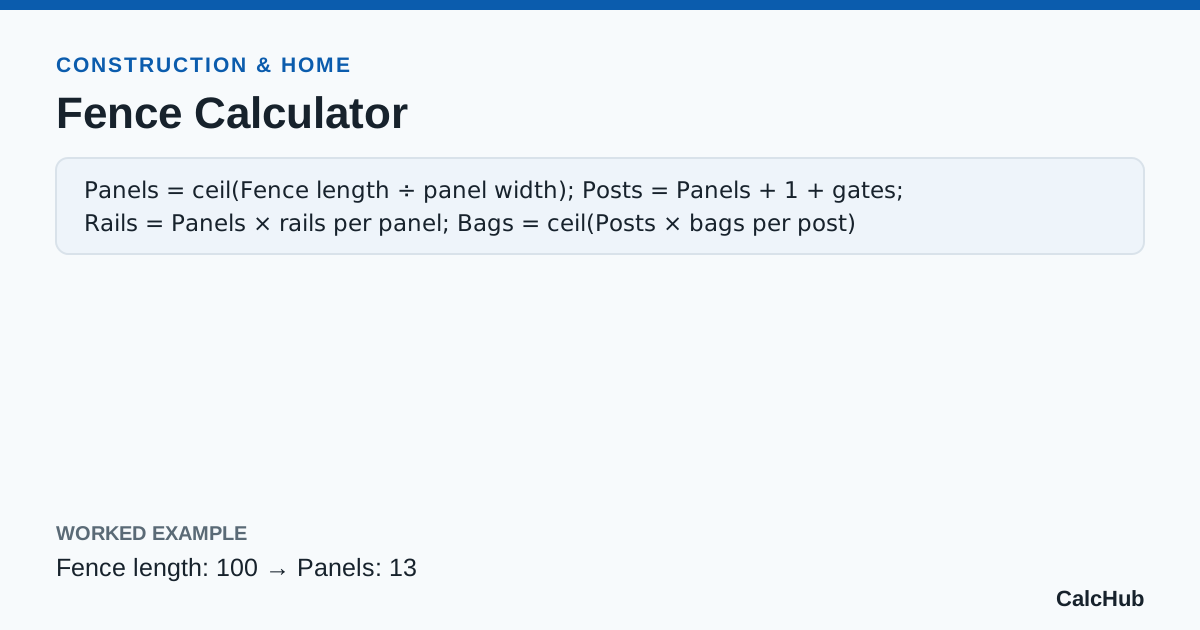
Fence Calculator
Panels, posts, rails and concrete bags for a panel fence run.