
Acceleration Calculator
Acceleration from a change in velocity, plus the distance covered.
Quick answer
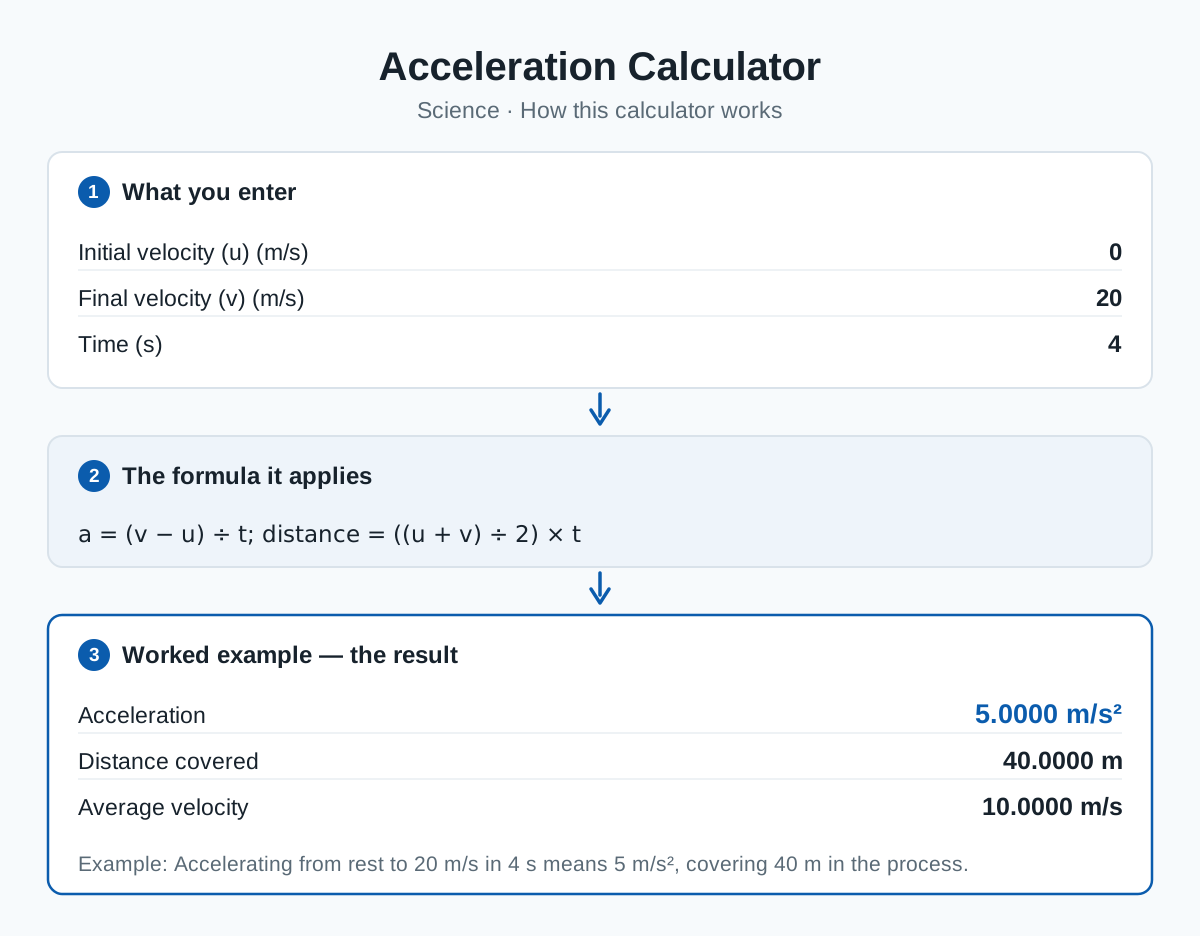
- Formula: a = (v − u) ÷ t; distance = ((u + v) ÷ 2) × t
- Worked example — Acceleration: 5.0000 m/s² (full example below).
Acceleration Calculator
| Acceleration | 5.0000 m/s² |
| Distance covered | 40.0000 m |
| Average velocity | 10.0000 m/s |
Accelerating from rest to 20 m/s in 4 s means 5 m/s², covering 40 m in the process.
Acceleration is the rate at which velocity changes. Given a starting and ending velocity and the time between them, this calculator finds the (average, assumed constant) acceleration.
It also reports the distance covered during that time, using the average of the initial and final velocities — exact when acceleration is constant.
The formula
Worked example
Accelerating from rest to 20 m/s in 4 s means 5 m/s², covering 40 m in the process.
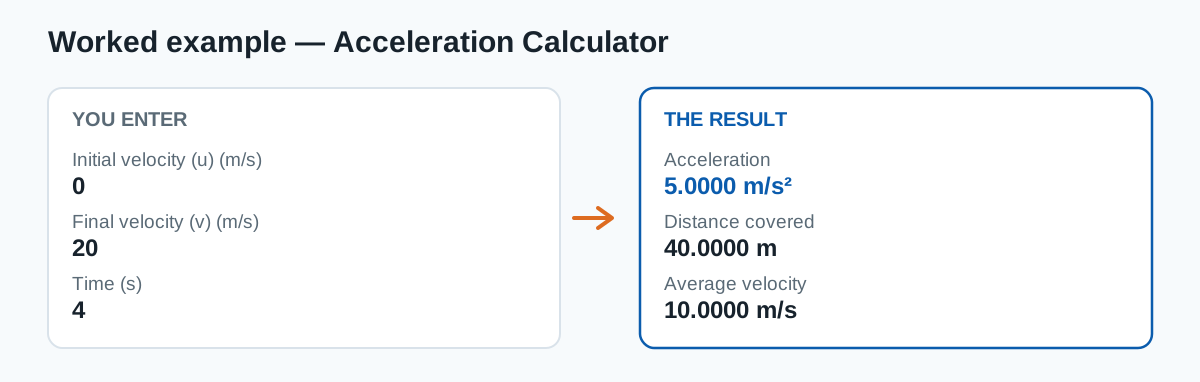
The example is pre-loaded in the result panel — press Calculate with your own numbers to replace it.
Frequently asked questions
Can acceleration be negative?
Yes — a final velocity lower than the initial velocity gives negative acceleration (deceleration), for example −5 m/s² when slowing down.
What acceleration is 0–100 km/h in 5 seconds?
100 km/h is 27.78 m/s, so a = 27.78 ÷ 5 ≈ 5.56 m/s² — a little over half of g (9.81 m/s²).
Category: Science calculators
Sources & methodology
This calculator applies the formula shown on this page exactly as written, using the standard definitions for its inputs. Results are computed from the values you enter — no data is stored — and are rounded only for display.
Content last reviewed by CalcHub Editorial.
Embed this calculator on your site
Free to use with attribution — paste the snippet below and the calculator appears on your page, with a link back to CalcHub.
Related calculators
Velocity Calculator
Find velocity, distance or time from the other two quantities.
Force Calculator
Newton's second law: F = m × a, with weight on Earth as a bonus.
Kinetic Energy Calculator
Energy of a moving object: KE = ½mv².
Momentum Calculator
Linear momentum p = mv, with kinetic energy shown alongside.