
Tile Calculator
Tiles and boxes needed for a floor or wall, including cutting waste.
Quick answer
- A 120 sq ft room with 12×12 in tiles needs 120 tiles before waste — 132 tiles (14 boxes of 10) at the standard 10% allowance.
- Waste depends on the pattern: 10% for straight lay, 15% for diagonal, and 15–20%+ for herringbone and other complex patterns.
- Tile is sold by the box, not the piece — the box count is the number you actually buy and pay for.
- Worked example — Area to tile: 120.0 sq ft (full example below).
Tile Calculator
| Area to tile | 120.0 sq ft |
| Coverage per tile | 1.000 sq ft |
| Tiles needed (incl. waste) | 132 |
| Boxes to buy | 14 |
A 12 × 10 ft room is 120 sq ft. With 12×12 in tiles (1 sq ft each) and 10% waste you need 132 tiles — 14 boxes of 10.
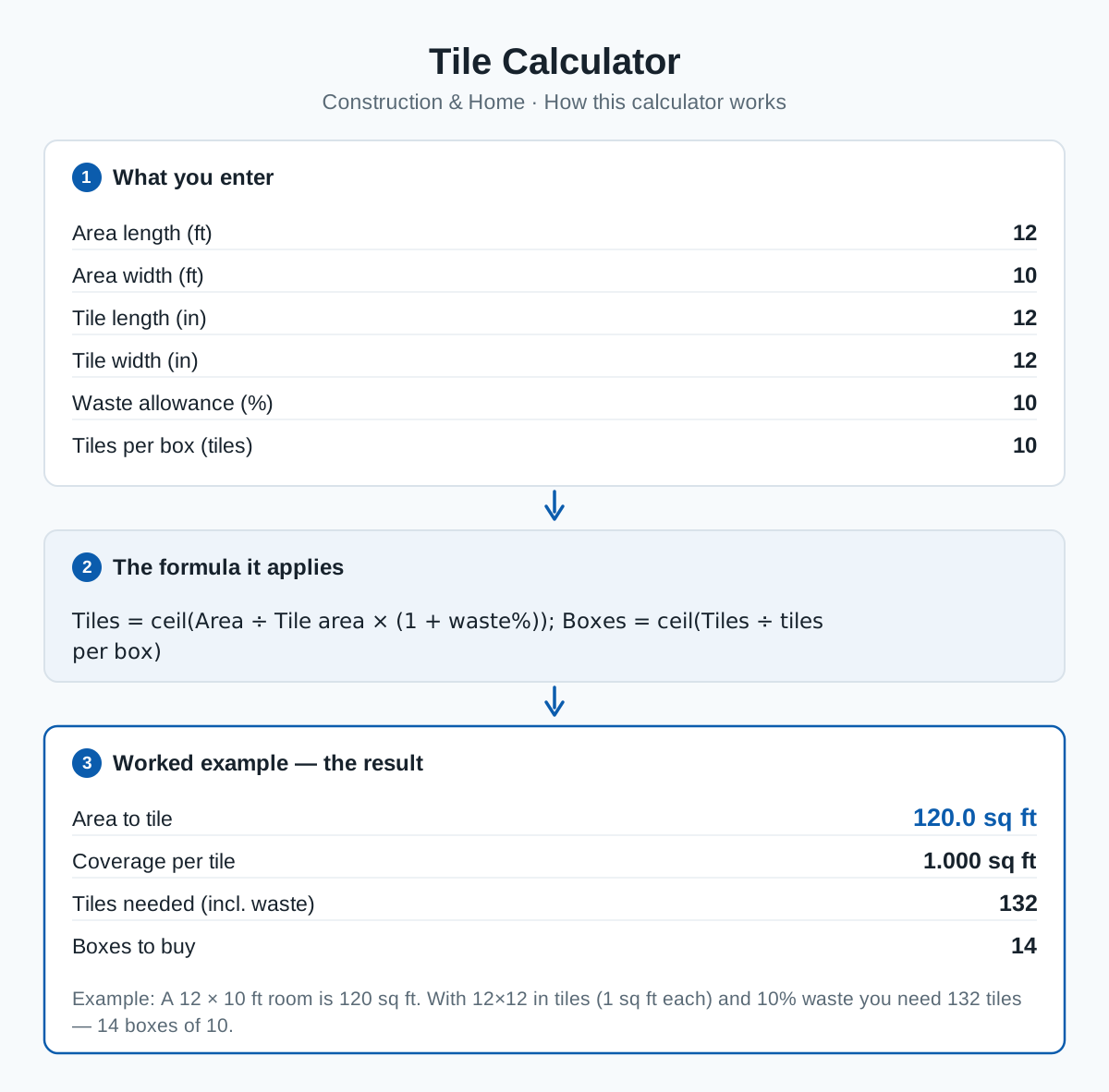
Measure the area in feet, enter your tile size in inches, and this calculator works out how many individual tiles cover the area — then adds your waste allowance for cuts, breakages and future repairs, and rounds up to full boxes.
The waste percentage matters: 10% is standard for straight layouts in rectangular rooms, but diagonal (45°) layouts, large-format tiles and rooms with many corners should use 15–20%. Tile counts and boxes are always rounded UP to whole units.
The formula
Worked example
A 12 × 10 ft room is 120 sq ft. With 12×12 in tiles (1 sq ft each) and 10% waste you need 132 tiles — 14 boxes of 10.
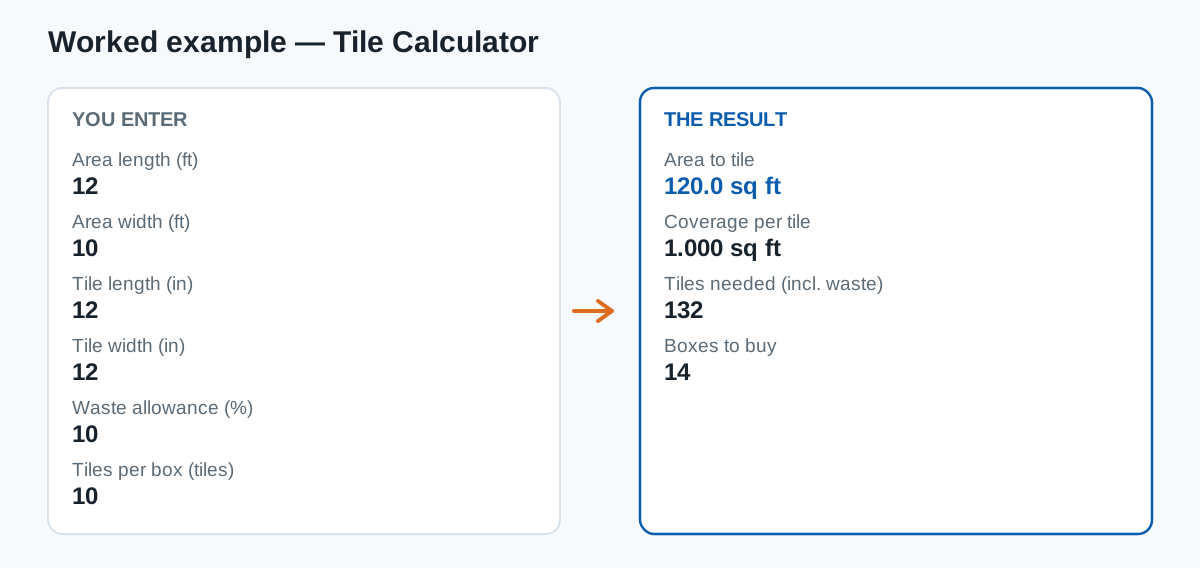
The example is pre-loaded in the result panel — press Calculate with your own numbers to replace it.
Tile waste by layout pattern
| Layout pattern | Recommended waste | Tiles for a 120 sq ft floor (12×12 in tiles) | Boxes of 10 |
|---|---|---|---|
| Straight lay | 10% | 132 | 14 |
| Diagonal (45°) | 15% | 138 | 14 |
| Herringbone / complex patterns | 15–20%+ | 144 | 15 |
Waste allowances follow TCNA-style estimating guidance. Tile and box counts are this calculator's outputs for a 12 × 10 ft room with 12×12 in tiles, with herringbone shown at 20% waste. Complex rooms and large-format tile belong at the top of each range.
Common mistakes
- Forgetting the waste allowance — cuts, breakages and pattern matching consume tile that the raw area count never sees.
- Not accounting for grout joints — joint width shifts the layout grid, so a wall-to-wall plan worked out on tile faces alone can drift by the last row.
- Measuring in mixed units — the room in feet and the tile in inches (or the reverse) without converting; this calculator takes the area in feet and the tile in inches.
- Ordering exactly the computed count — one cracked tile or a dye-lot mismatch mid-job leaves you short. Buy by the full box and keep spares from the same lot.
When this estimate may be wrong
- Tile is bought by the box, not the count: the calculator rounds tiles up to full boxes (the Boxes to buy output), and that box count — not the tile count — is what you pay for.
- Counts use the tile's face area only; grout joints add a small amount of coverage that the waste allowance absorbs.
- Nominal tile sizes can differ from the actual size by a few millimetres; for large-format tile, check the actual size and caliber printed on the box.
Frequently asked questions
How much extra tile should I buy?
10% extra for straight layouts, 15% for diagonal layouts or large tiles, and 20% for complex rooms. Keep a few spare tiles from the same dye lot for future repairs — matching a discontinued tile later is often impossible.
Does the grout gap change the count?
Slightly. This calculator uses the tile face area only, which is the standard estimating method; the grout lines add a small amount of coverage that is absorbed by the waste allowance.
How do I handle an L-shaped room?
Split it into two rectangles, run the calculator for each, and add the tile counts together before dividing by tiles per box.
Can I buy tile by the individual piece?
Usually not — most tile is sold in full boxes only, which is why this calculator rounds the tile count up to a box count. The example room needs 132 tiles, but you buy 14 boxes of 10 (140 tiles); the leftovers are your spares for cuts that go wrong and future repairs from the same dye lot.
Category: Construction & Home calculators
Sources & methodology
Tiles needed = ceiling of (area ÷ tile face area × (1 + waste %)); boxes = ceiling of tiles ÷ tiles per box. Waste allowances by layout pattern follow the TCNA-style guidance in the reference table on this page.
Content last reviewed by CalcHub Editorial.
Embed this calculator on your site
Free to use with attribution — paste the snippet below and the calculator appears on your page, with a link back to CalcHub.
Related calculators
Flooring Calculator
Boxes of laminate, vinyl or engineered flooring for a room, waste included.
Square Footage Calculator
Area in square feet and square meters for rectangles, triangles, circles and trapezoids.
Paint Calculator
Gallons and liters of paint for a room, minus doors and windows, per coat.
Wallpaper Calculator
Rolls of wallpaper for a room, including pattern-repeat waste.