
Present Value Calculator
What a future sum is worth in today's money.
Quick answer
- Present value discounts a future sum back to today: PV = FV / (1 + r/n)^(nt) — a future dollar is worth less than a dollar today.
- Example: $10,000 received in 10 years at a 5% discount rate is worth $6,139.13 today, a discount of $3,860.87.
- For a stream of equal payments, discount each one and add them up: PV of an ordinary annuity = PMT × [(1 − (1+r)^−n) / r]; an annuity due multiplies that by (1+r).
- Worked example — Present value: $6,139.13 (full example below).
Present Value Calculator
| Present value | $6,139.13 |
| Discount (FV − PV) | $3,860.87 |
$10,000 received in 10 years, discounted at 5%, is worth $6,139.13 today.
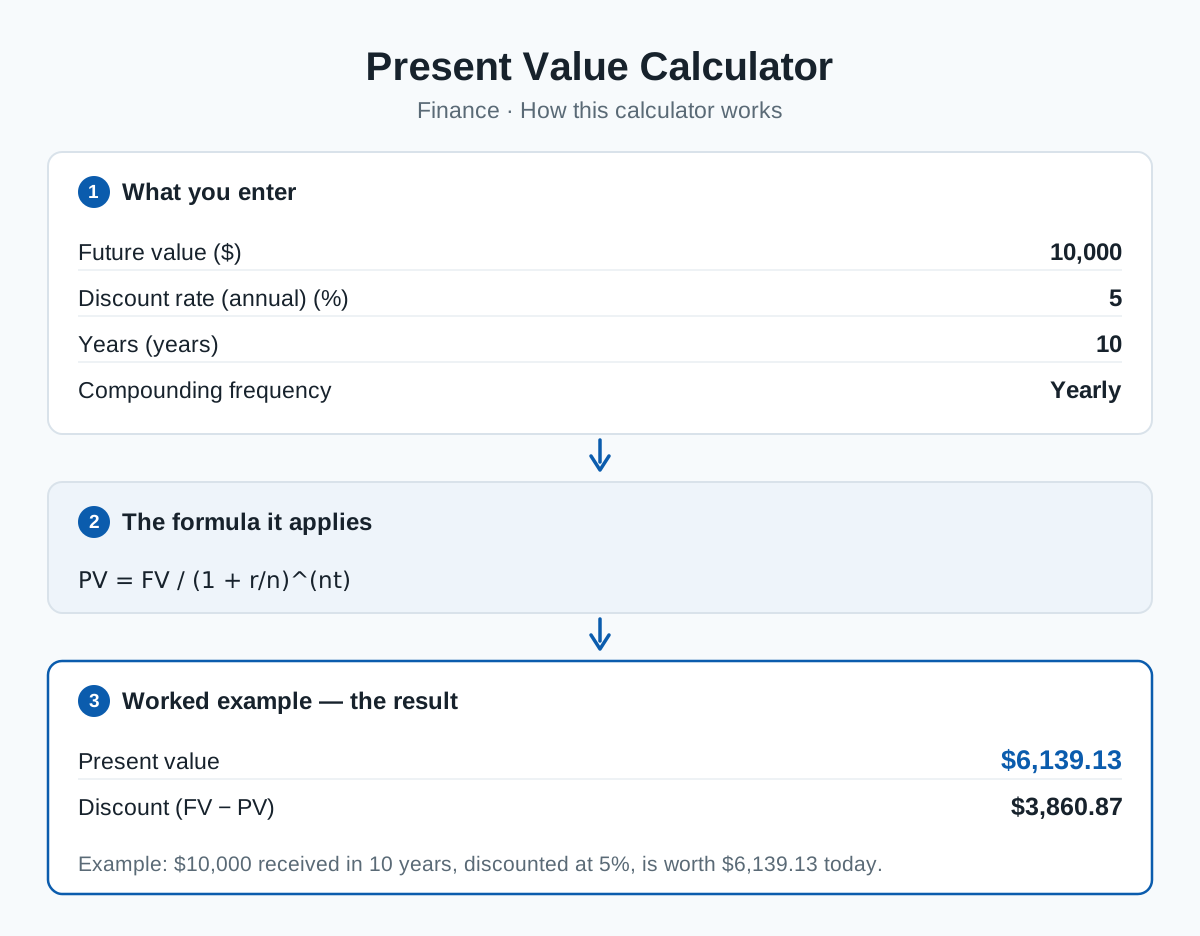
Present value answers: what is a payment you will receive in the future worth right now? Because money can earn interest, a future dollar is worth less than a dollar today.
Enter the future amount, a discount rate and the time to find its present value and the total discount.
The same discounting extends to a series of equal payments — an annuity. Each payment is discounted back to today and the results are added up, which collapses into one formula: the present value of an ordinary annuity (payments at the end of each period) is PMT × [(1 − (1+r)^−n) / r], where r is the rate per period and n the number of payments. If the payments arrive at the start of each period instead (an annuity due), multiply that result by (1+r), because every payment is discounted for one period less. The table below contrasts the two forms.
The formula
Worked example
$10,000 received in 10 years, discounted at 5%, is worth $6,139.13 today.
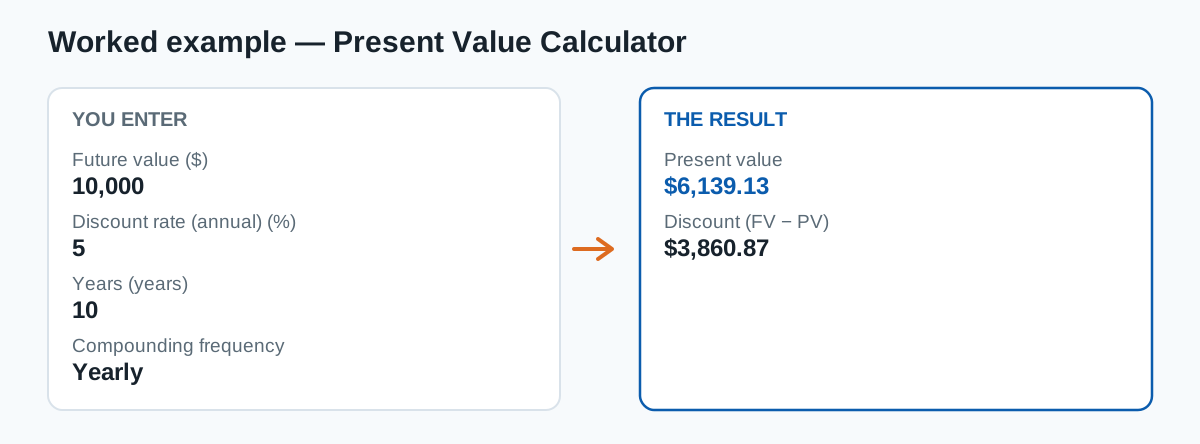
The example is pre-loaded in the result panel — press Calculate with your own numbers to replace it.
Present value of an annuity: ordinary annuity vs annuity due
| Variant | Formula | Payments arrive | Relative value |
|---|---|---|---|
| Ordinary annuity | PV = PMT × [(1 − (1+r)^−n) / r] | End of each period | Baseline |
| Annuity due | PV = PMT × [(1 − (1+r)^−n) / r] × (1+r) | Start of each period | Higher by a factor of (1+r) |
Here r is the interest rate per payment period and n is the number of payments. The annuity-due form is the ordinary form multiplied by (1+r) because every payment is discounted for one period less.
Frequently asked questions
What discount rate should I use?
Use the return you could reliably earn elsewhere (your opportunity cost), or an inflation rate to measure purchasing power.
Why does the rate matter so much?
Discounting is exponential: at 5%, money halves in value roughly every 14 years; at 10%, roughly every 7 years.
How do I find the present value of an annuity — a series of equal payments?
Apply the annuity formula from the table below with r as the rate per payment period. For example, $1,000 a year for 10 years at 5% has a present value of $7,721.73 as an ordinary annuity (payments at each year end); as an annuity due (payments at each year start) it is $7,721.73 × 1.05 = $8,107.82, because each payment is discounted one period less. Both figures are produced by this site's Annuity Calculator, which handles either timing.
Category: Finance calculators
Sources & methodology
This calculator applies the formula shown on this page exactly as written, using the standard definitions for its inputs. Results are computed from the values you enter — no data is stored — and are rounded only for display.
Content last reviewed by CalcHub Editorial.
Embed this calculator on your site
Free to use with attribution — paste the snippet below and the calculator appears on your page, with a link back to CalcHub.
Related calculators
Future Value Calculator
What a sum invested today will grow to.
Annuity Calculator
Future and present value of a series of equal payments.
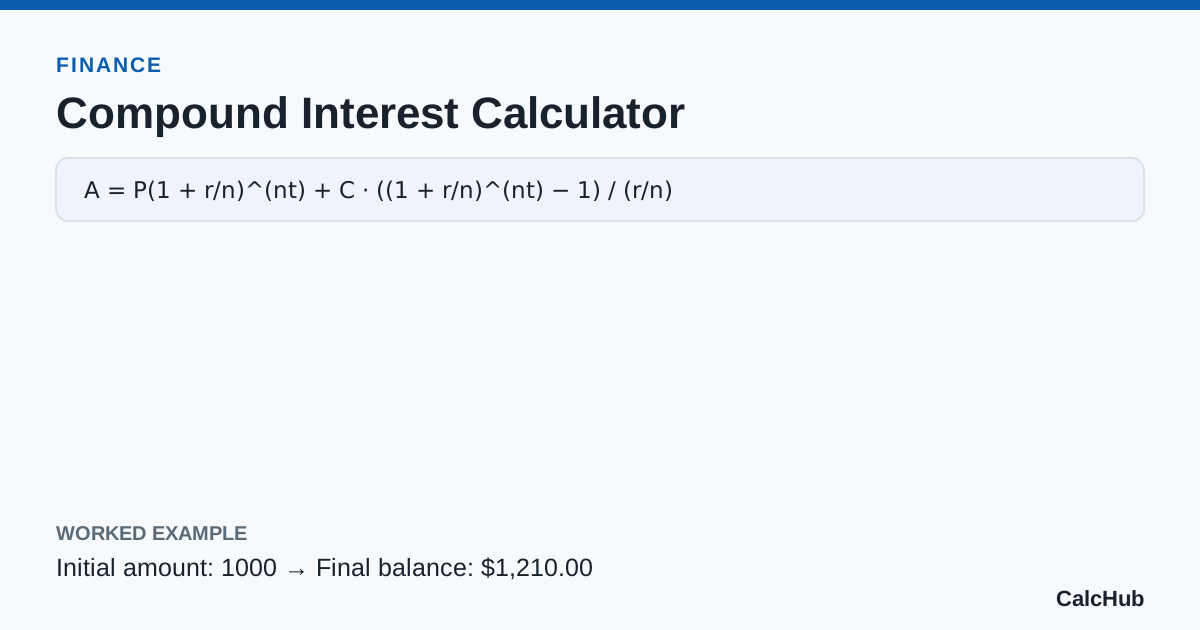
Compound Interest Calculator
How money grows when interest earns interest, with optional regular contributions.
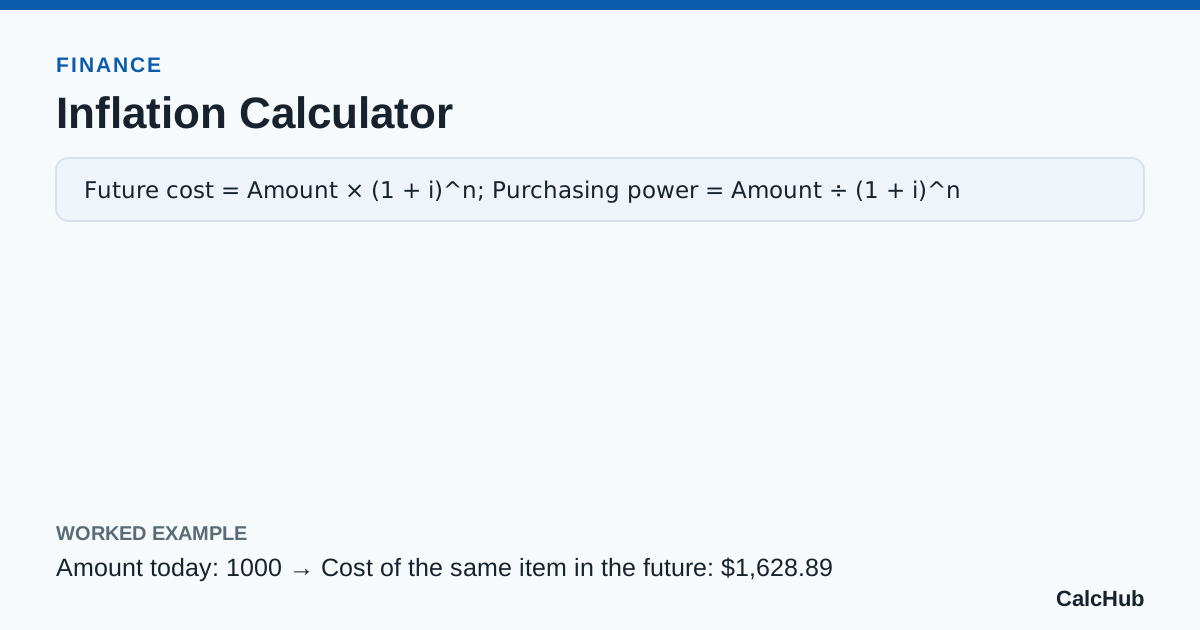
Inflation Calculator
Future prices and the shrinking purchasing power of money.