
Projectile Range Calculator
Range, maximum height and flight time for a projectile on flat ground.
Quick answer
- Formula: Range = v² sin(2θ) ÷ g; Height = (v sinθ)² ÷ 2g; Time = 2v sinθ ÷ g
- Worked example — Range: 40.7886 m (full example below).
Projectile Range Calculator
| Range | 40.7886 m |
| Maximum height | 10.1972 m |
| Flight time | 2.8842 s |
Launched at 20 m/s and 45°, a projectile travels about 40.79 m, peaks at 10.20 m and lands after 2.88 s.
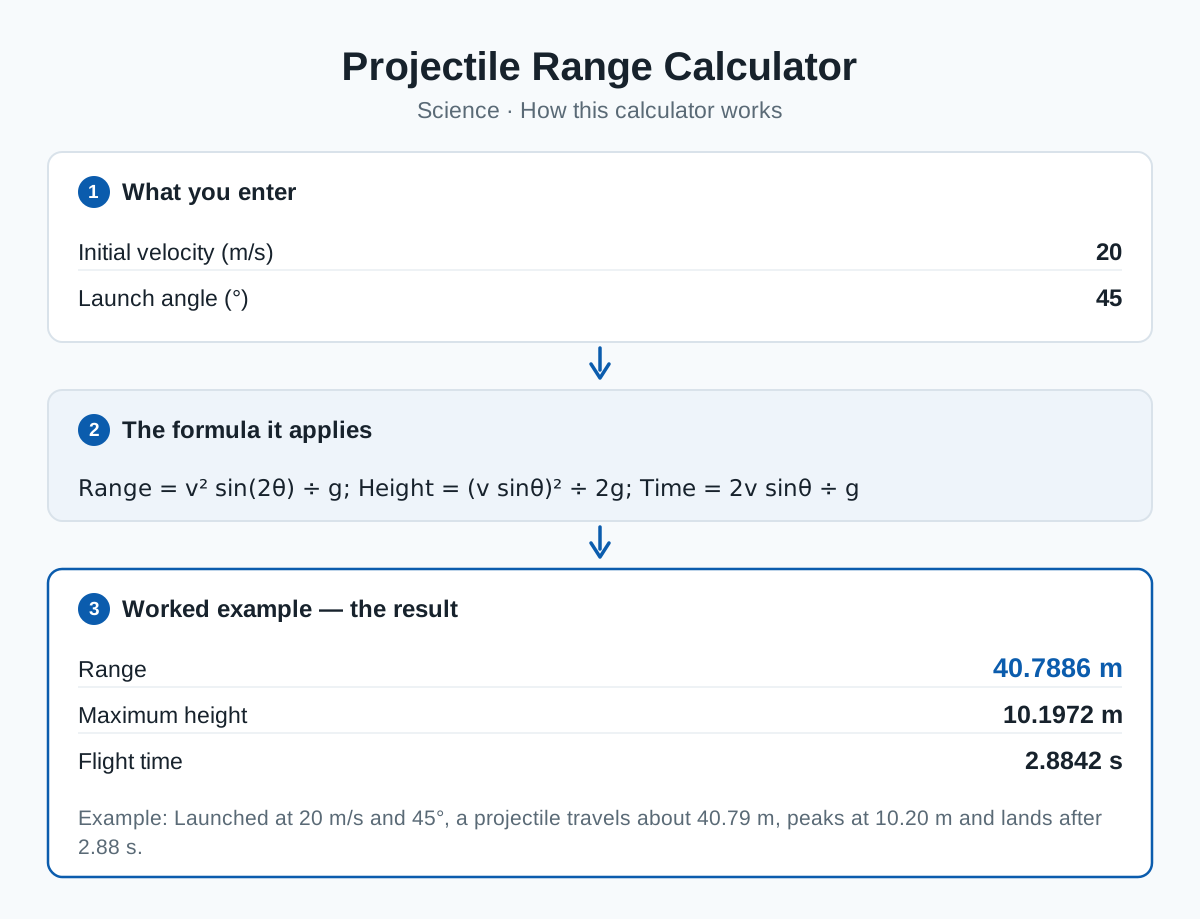
A projectile launched at an angle follows a parabolic path under gravity alone. From the launch speed and angle this calculator finds how far it travels, how high it rises and how long it stays in the air.
Assumptions: flat ground, launch and landing at the same height, no air resistance, and g = 9.80665 m/s². Real objects with drag travel noticeably shorter, especially light or fast ones.
The formula
Worked example
Launched at 20 m/s and 45°, a projectile travels about 40.79 m, peaks at 10.20 m and lands after 2.88 s.
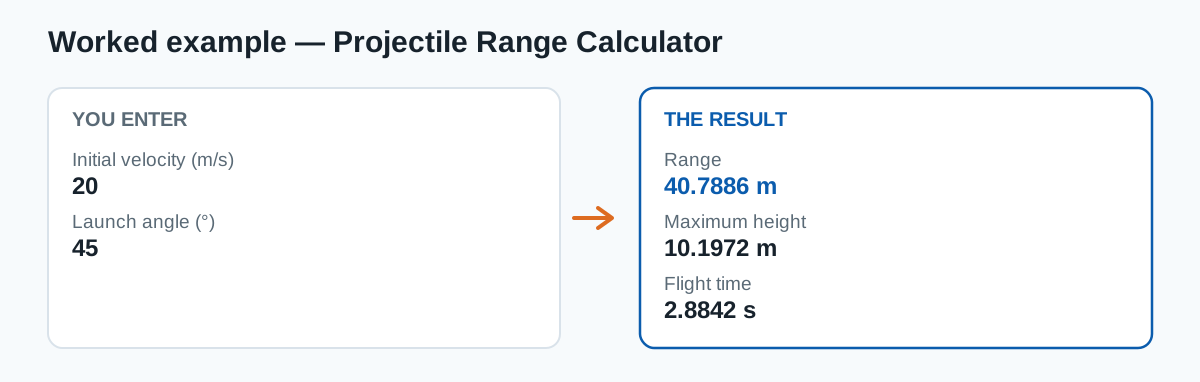
The example is pre-loaded in the result panel — press Calculate with your own numbers to replace it.
Frequently asked questions
Which angle gives the maximum range?
45° on flat ground without air resistance — sin(2θ) peaks at θ = 45°. Angles equally above and below 45° (for example 30° and 60°) give the same range.
Why do real projectiles fall short of this?
Air resistance (drag) opposes the motion and is ignored here. Drag matters more for light, large or very fast objects; for a dense ball at modest speed the vacuum result is a good first estimate.
Category: Science calculators
Sources & methodology
This calculator applies the formula shown on this page exactly as written, using the standard definitions for its inputs. Results are computed from the values you enter — no data is stored — and are rounded only for display.
Content last reviewed by CalcHub Editorial.
Embed this calculator on your site
Free to use with attribution — paste the snippet below and the calculator appears on your page, with a link back to CalcHub.
Related calculators
Velocity Calculator
Find velocity, distance or time from the other two quantities.
Kinetic Energy Calculator
Energy of a moving object: KE = ½mv².
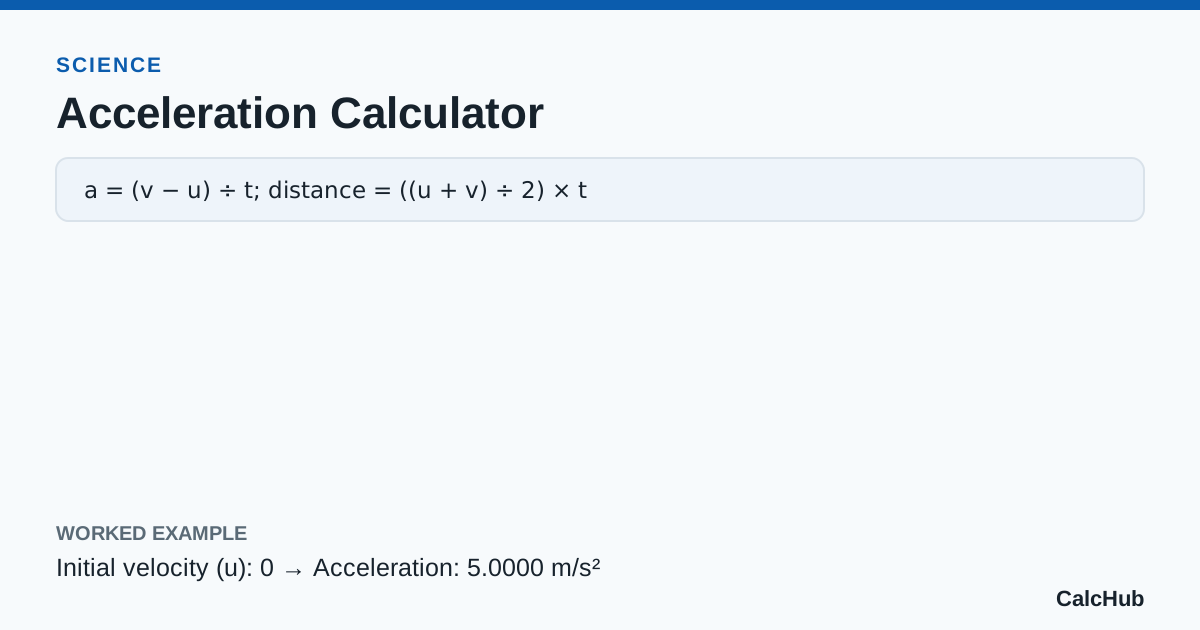
Acceleration Calculator
Acceleration from a change in velocity, plus the distance covered.
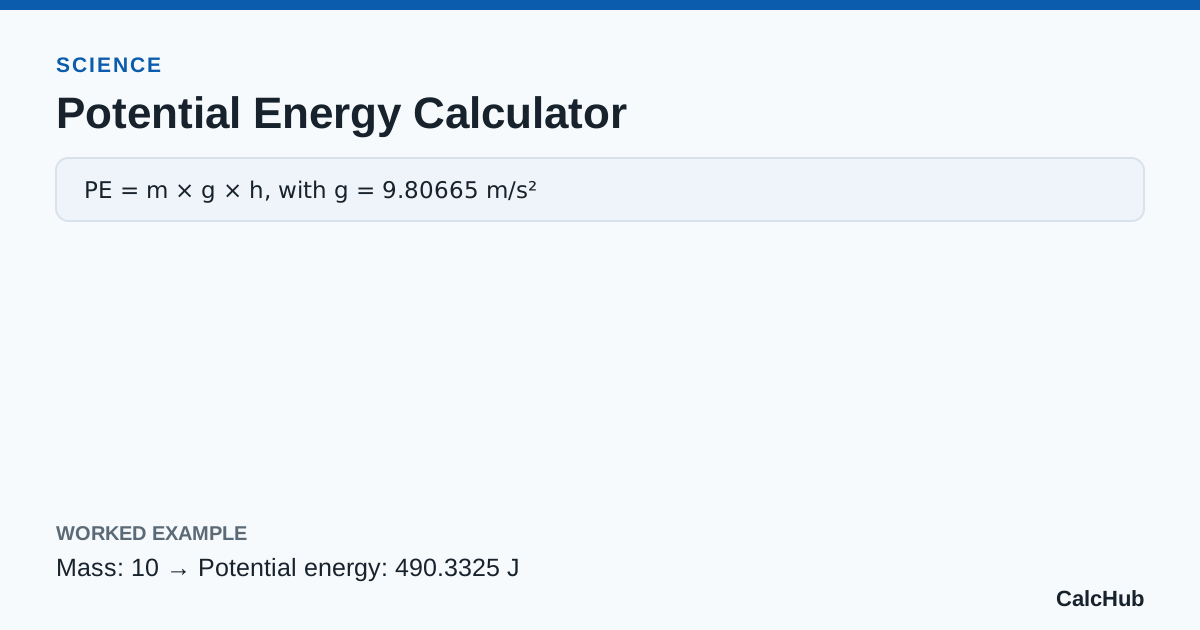
Potential Energy Calculator
Gravitational potential energy near Earth's surface: PE = mgh.