
Future Value Calculator
What a sum invested today will grow to.
Quick answer
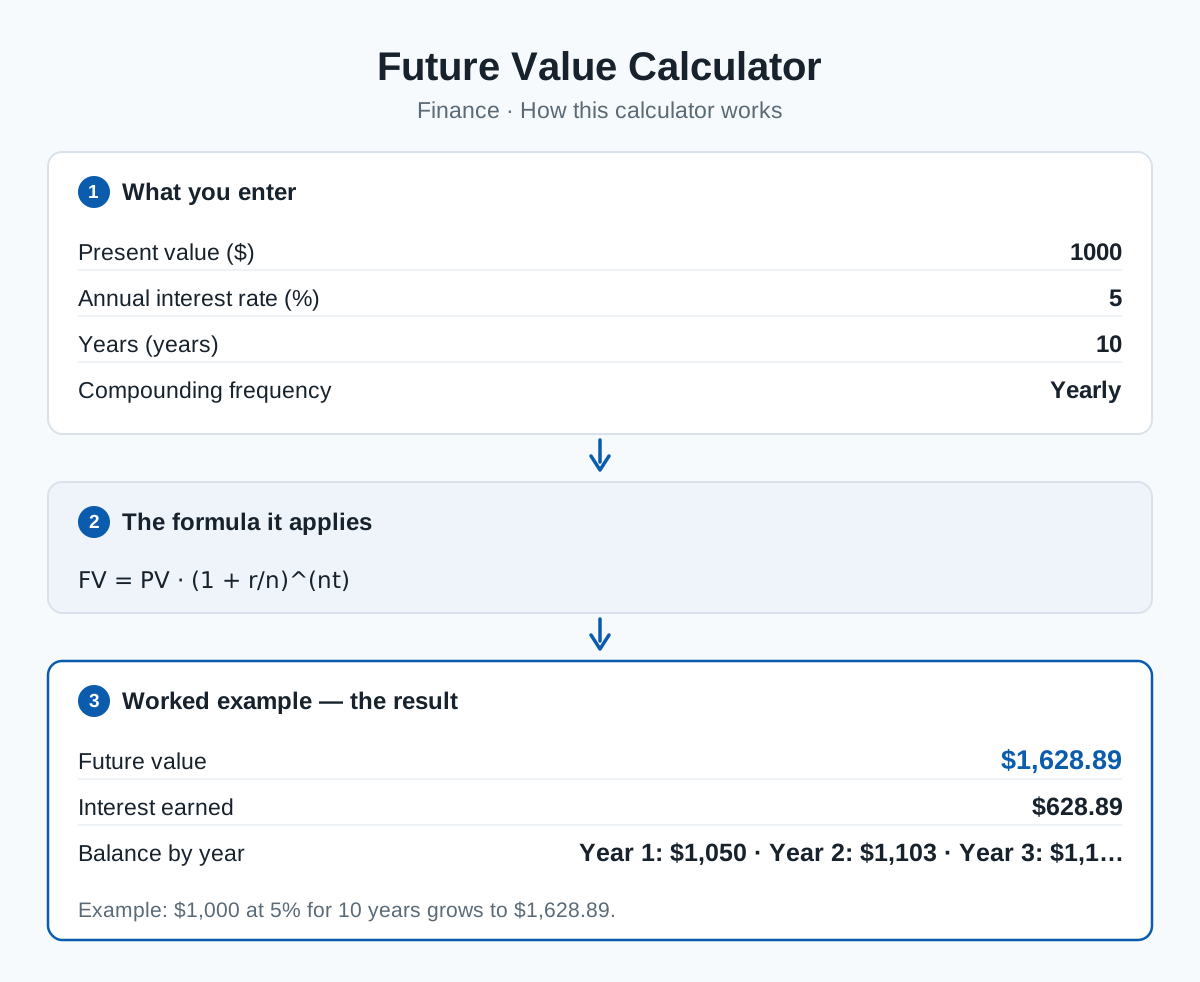
- Future value compounds a sum forward: FV = PV · (1 + r/n)^(nt), the mirror image of present value.
- Example: $1,000 at 5% for 10 years grows to $1,628.89 — $628.89 of it interest (see the year-by-year growth schedule result).
- For a stream of equal deposits, compound each one and add them up: FV of an ordinary annuity = PMT × [((1+r)^n − 1) / r]; an annuity due multiplies that by (1+r).
- Worked example — Future value: $1,628.89 (full example below).
Future Value Calculator
| Future value | $1,628.89 |
| Interest earned | $628.89 |
| Balance by year | Year 1: $1,050 · Year 2: $1,103 · Year 3: $1,158 · Year 4: $1,216 · Year 5: $1,276 · Year 6: $1,340 · Year 7: $1,407 · Year 8: $1,477 · Year 9: $1,551 · Year 10: $1,629 |
$1,000 at 5% for 10 years grows to $1,628.89.
Future value projects today's money forward at a given interest rate. It is the mirror image of present value and the basic building block of savings and investment planning.
The growth schedule result shows the balance at each year end, so you can see compounding accelerate rather than just the final figure.
The same compounding extends to a series of equal deposits — an annuity. Each deposit grows for the time it is invested and the results are added up, which collapses into one formula: the future value of an ordinary annuity (payments at the end of each period) is PMT × [((1+r)^n − 1) / r], where r is the rate per period and n the number of payments. If the payments are made at the start of each period instead (an annuity due), multiply that result by (1+r), because every payment earns one extra period of interest. The table below contrasts the two forms.
The formula
Worked example
$1,000 at 5% for 10 years grows to $1,628.89.
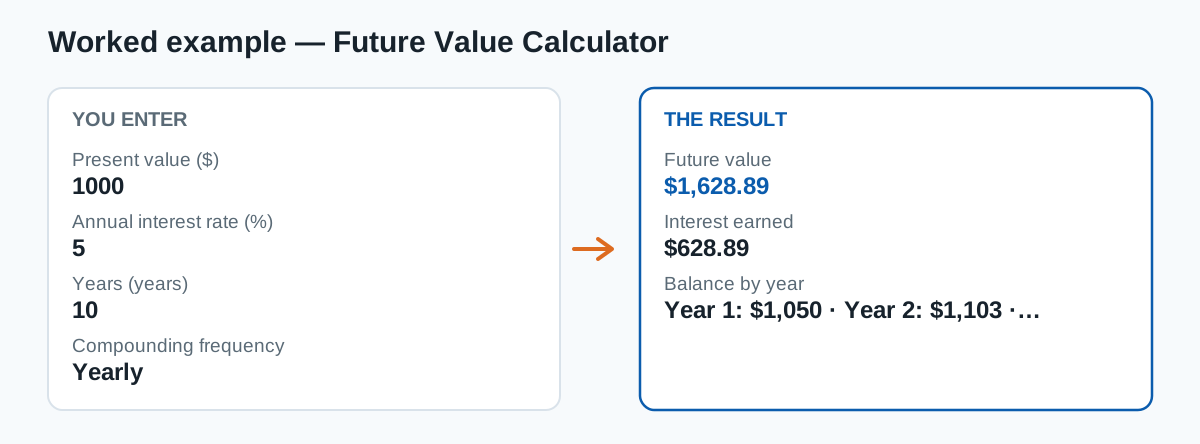
The example is pre-loaded in the result panel — press Calculate with your own numbers to replace it.
Future value of an annuity: ordinary annuity vs annuity due
| Variant | Formula | Payments made | Relative value |
|---|---|---|---|
| Ordinary annuity | FV = PMT × [((1+r)^n − 1) / r] | End of each period | Baseline |
| Annuity due | FV = PMT × [((1+r)^n − 1) / r] × (1+r) | Start of each period | Higher by a factor of (1+r) |
Here r is the interest rate per payment period and n is the number of payments. The annuity-due form is the ordinary form multiplied by (1+r) because every payment earns one extra period of interest.
Frequently asked questions
How is this different from the compound interest calculator?
The math is identical for a single lump sum. The compound interest calculator adds regular contributions; this one is for a single amount with flexible compounding.
What will $10,000 be worth in 20 years at 7%?
About $38,697 compounded annually. Doubling time at 7% is roughly 10 years (Rule of 72: 72 ÷ 7 ≈ 10.3), so in 20 years the money nearly quadruples — compounding accelerates.
How do I find the future value of an annuity — a series of equal deposits?
Apply the annuity formula from the table below with r as the rate per deposit period. For example, depositing $1,000 a year for 10 years at 5% accumulates to $12,577.89 as an ordinary annuity (deposits at each year end); as an annuity due (deposits at each year start) it is $12,577.89 × 1.05 = $13,206.79, because each deposit earns one extra year of interest. Both figures are produced by this site's Annuity Calculator, which handles either timing.
Category: Finance calculators
Sources & methodology
This calculator applies the formula shown on this page exactly as written, using the standard definitions for its inputs. Results are computed from the values you enter — no data is stored — and are rounded only for display.
Content last reviewed by CalcHub Editorial.
Embed this calculator on your site
Free to use with attribution — paste the snippet below and the calculator appears on your page, with a link back to CalcHub.
Related calculators
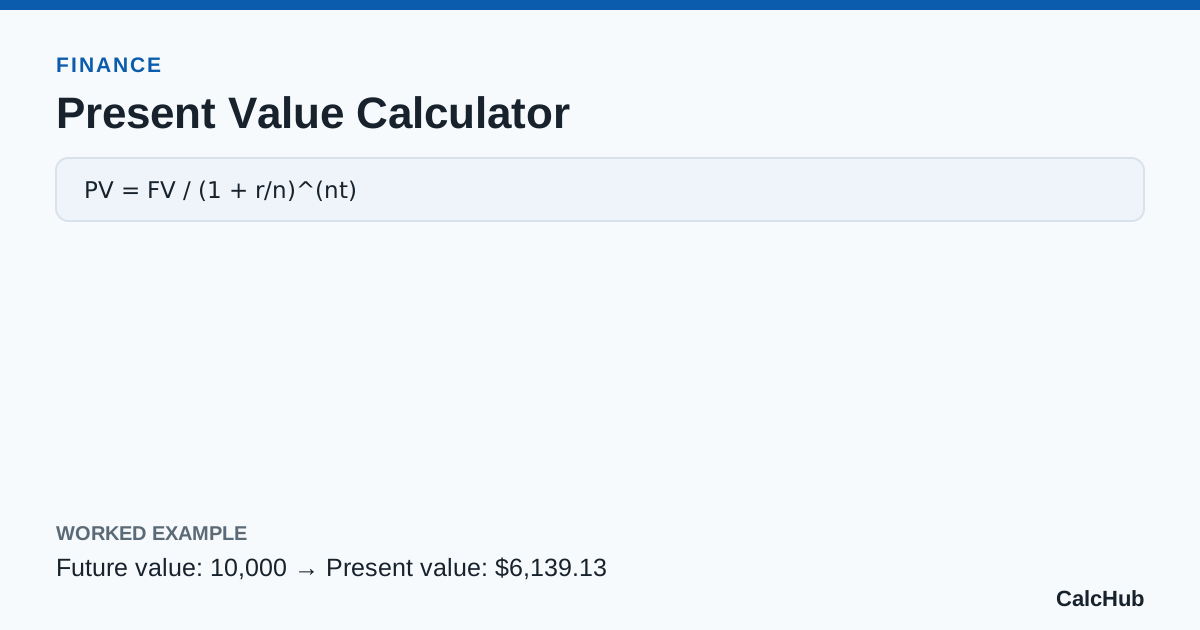
Present Value Calculator
What a future sum is worth in today's money.
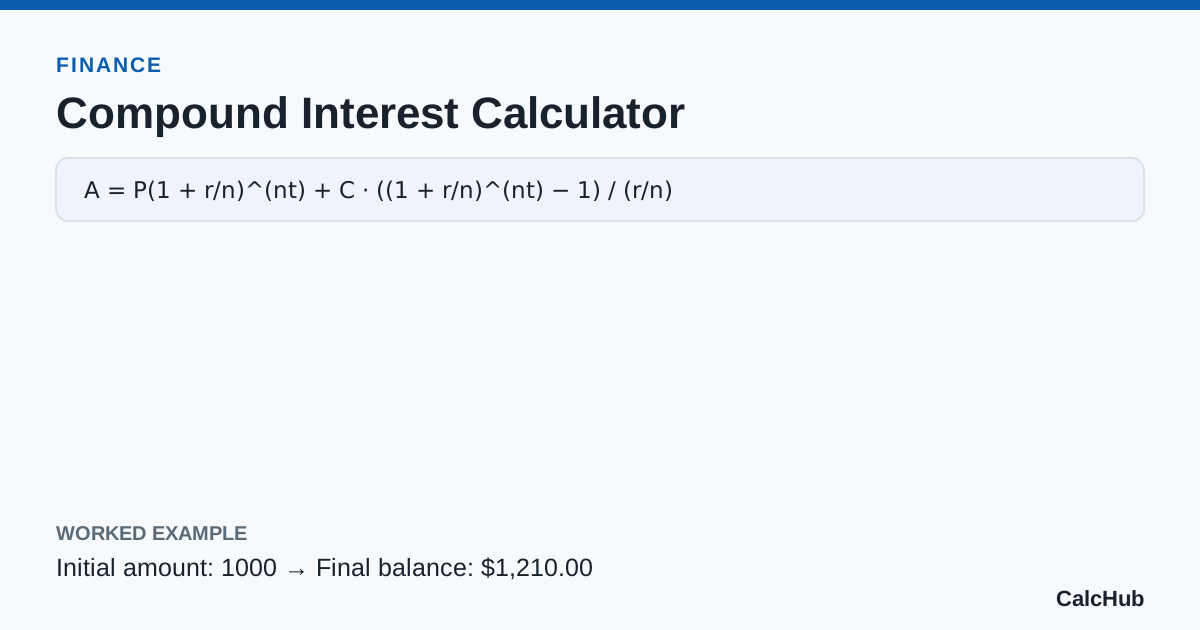
Compound Interest Calculator
How money grows when interest earns interest, with optional regular contributions.
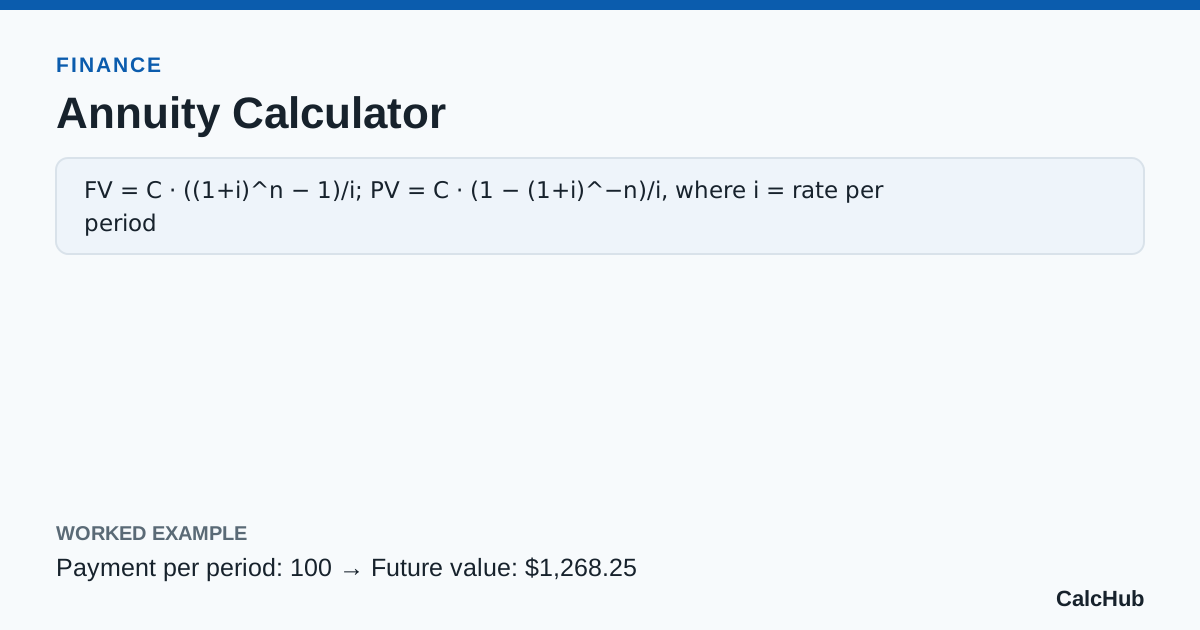
Annuity Calculator
Future and present value of a series of equal payments.
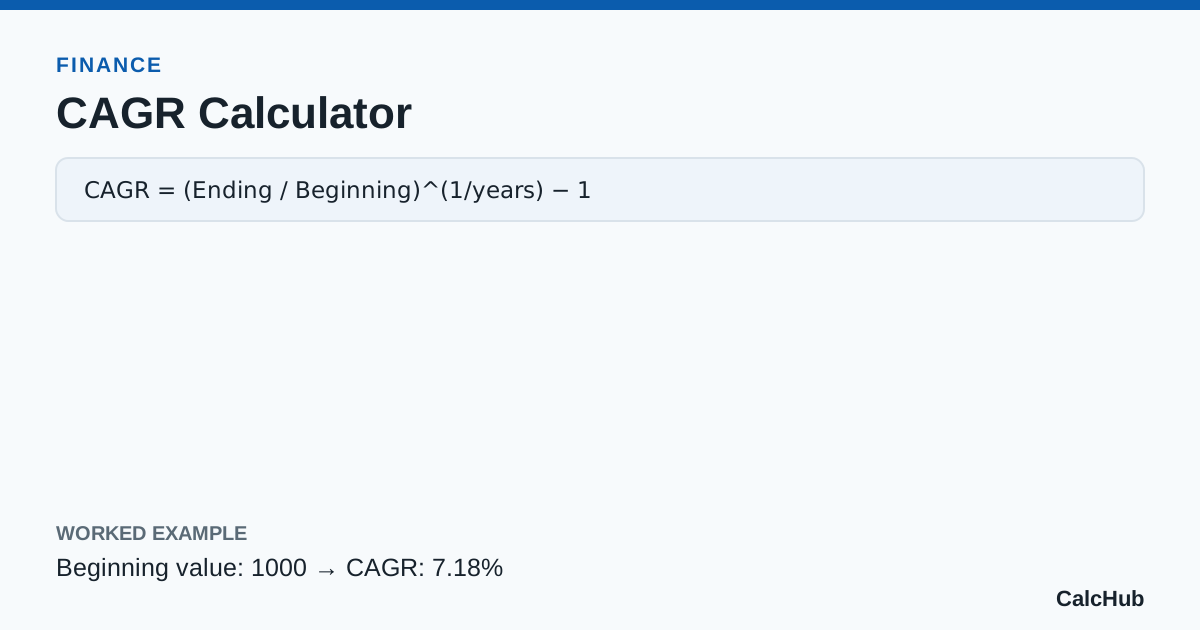
CAGR Calculator
Compound annual growth rate between two values.