
Decibel Converter
Convert power and amplitude ratios to decibels, and decibels back to ratios.
Quick answer
- Formula: Power: dB = 10·log₁₀(P₂/P₁), ratio = 10^(dB/10) · Amplitude: dB = 20·log₁₀(A₂/A₁), ratio = 10^(dB/20)
- Worked example — Result: 20.0000 (full example below).
Decibel Converter
| Result | 20.0000 |
| Summary | Power ratio 100 = 20 dB |
A power ratio of 100 is exactly 20 dB; the same 20 dB as an amplitude ratio would mean only 10× the amplitude.
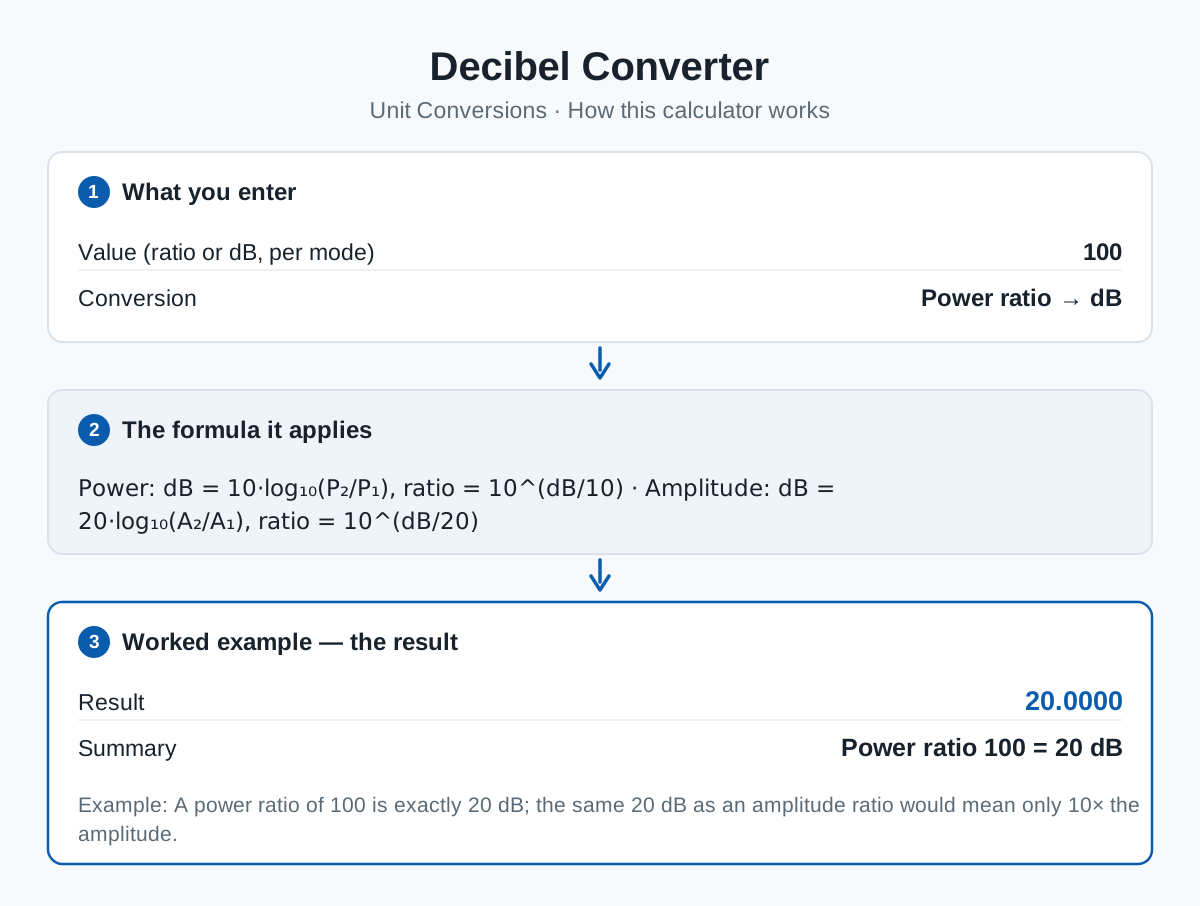
The decibel is a logarithmic ratio, and the multiplier depends on what you are measuring: power ratios use dB = 10 × log₁₀(ratio), while amplitude ratios (voltage, sound pressure) use dB = 20 × log₁₀(ratio) — because power is proportional to amplitude squared.
That is why doubling power is +3 dB but doubling amplitude is +6 dB, and why +10 dB means ten times the power but only about 3.16 times the amplitude. Pick the mode, enter a ratio or a dB value, and convert either way.
The formula
Worked example
A power ratio of 100 is exactly 20 dB; the same 20 dB as an amplitude ratio would mean only 10× the amplitude.
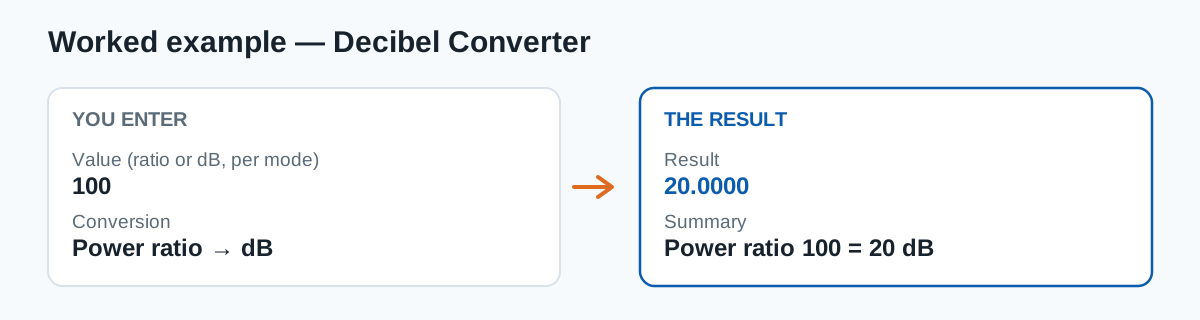
The example is pre-loaded in the result panel — press Calculate with your own numbers to replace it.
Frequently asked questions
Why 10 log for power but 20 log for voltage?
Power is proportional to the square of amplitude (P ∝ V²), and log of a square doubles the log: 10 × log(V²) = 20 × log(V). Both formulas describe the same physical change.
How many dB is a doubling?
Doubling power is +3.01 dB; doubling amplitude is +6.02 dB. Halving power is −3.01 dB — the basis of the '3 dB point' in filter specs.
What does 0 dB mean?
A ratio of exactly 1 — no change. Negative dB means the output is smaller than the reference; dB alone never tells you an absolute level without a reference such as dBm or dB SPL.
Category: Unit Conversions calculators
Sources & methodology
This calculator applies the formula shown on this page exactly as written, using the standard definitions for its inputs. Results are computed from the values you enter — no data is stored — and are rounded only for display.
Content last reviewed by CalcHub Editorial.
Embed this calculator on your site
Free to use with attribution — paste the snippet below and the calculator appears on your page, with a link back to CalcHub.
Related calculators
Logarithm Calculator
Logarithm of a number in base 10, e, 2 or any custom base.
Exponent Calculator
Calculate base raised to any power, plus its square and cube.
Power Converter
Convert watts, kilowatts, megawatts, horsepower (mechanical and metric) and BTU/hr.
Frequency Converter
Convert Hz, kHz, MHz, GHz and RPM, with the period in milliseconds.