
Wilks Calculator
The original Wilks score — compare powerlifting totals across bodyweights.
Quick answer
- Wilks score = your total multiplied by a bodyweight coefficient: lighter lifters get a larger coefficient, heavier lifters a smaller one.
- Rough guide for raw totals: 300 is a solid club lifter, 400 is national level, and 500 is world class — but only compare Wilks scores with other Wilks scores.
- Use kilograms: the polynomial is defined on bodyweight in kg, and the coefficients differ for men and women.
- Worked example — Wilks coefficient: 0.628 (full example below).
Wilks Calculator
| Wilks coefficient | 0.628 |
| Wilks score | 376.9 |
A 93 kg man totalling 600 kg has a Wilks coefficient of about 0.628, giving a Wilks score of about 376.9.
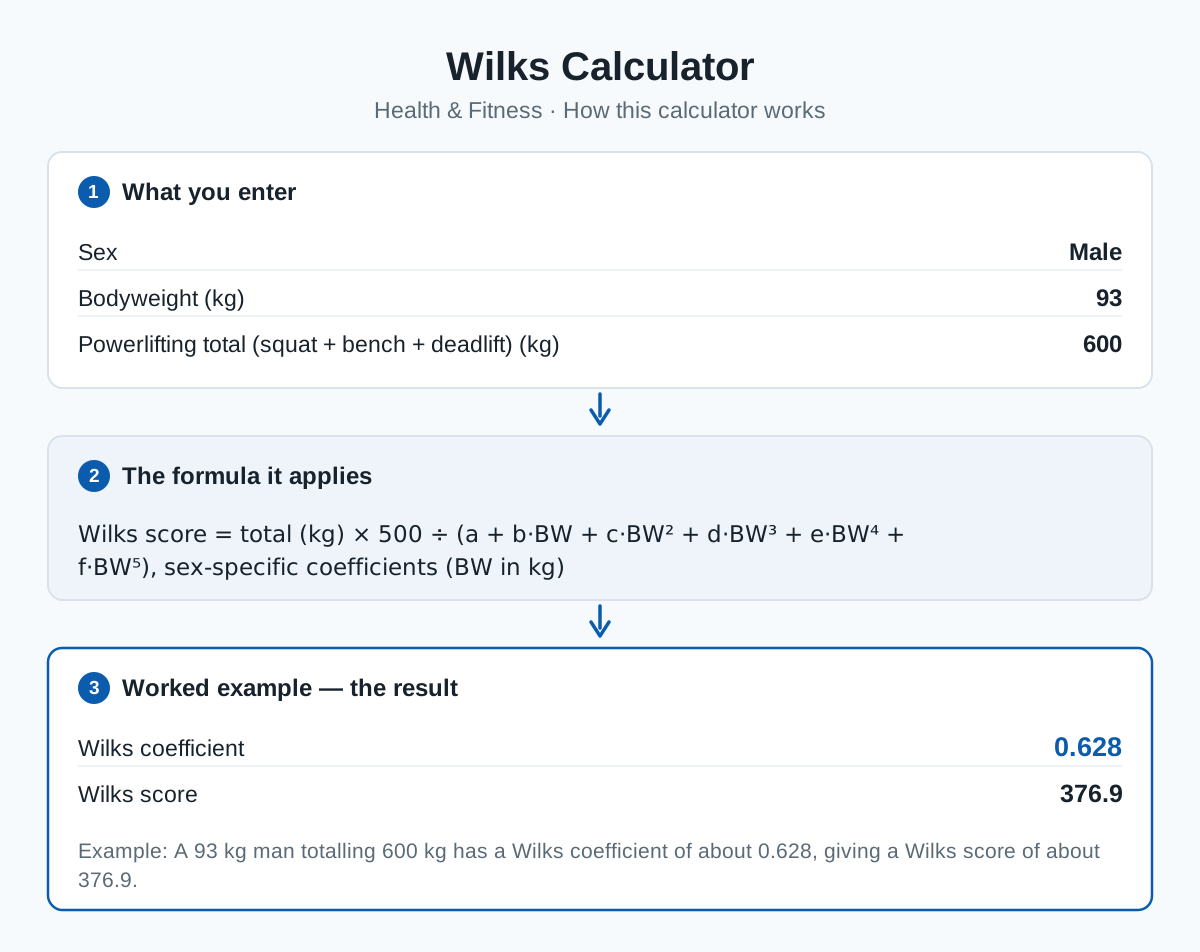
The Wilks formula, created by Robert Wilks of Powerlifting Australia, scores a powerlifting total against bodyweight so lifters in different weight classes can be compared on one scale. It fits a fifth-degree polynomial to the lifter's bodyweight and multiplies the total by 500 divided by that polynomial.
Wilks was the standard best-lifter formula for decades and is still used by many federations and for historical comparisons, even though the IPF replaced it with IPF GL points in 2020 and DOTS was designed to correct some of its biases at extreme bodyweights. Scores are only comparable within the same formula — never mix Wilks, DOTS and IPF GL numbers.
The formula
Worked example
A 93 kg man totalling 600 kg has a Wilks coefficient of about 0.628, giving a Wilks score of about 376.9.
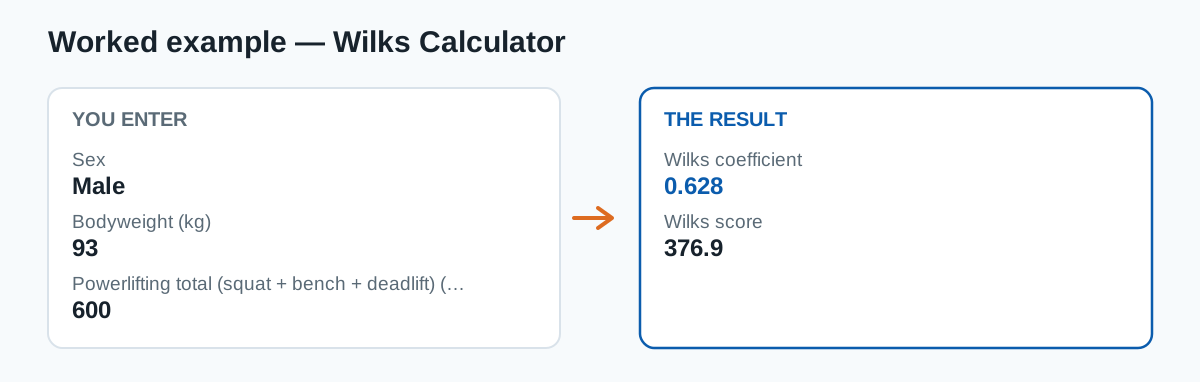
The example is pre-loaded in the result panel — press Calculate with your own numbers to replace it.
Frequently asked questions
What is a good Wilks score?
For raw lifters, around 300 marks a strong club-level total, 400 is national-championship standard, and 500 or more is world class. Equipped scores run higher because suits and shirts add kilos to the total.
What is the difference between Wilks and Wilks-2?
Wilks-2 (2020) rebalanced the coefficients and changed the numerator from 500 to 600, so Wilks-2 scores are not interchangeable with original Wilks scores. This calculator uses the original formula.
Why did the IPF stop using Wilks?
Analysis showed the original polynomial systematically favoured some bodyweight classes over others. The IPF adopted IPF GL points in 2020; DOTS is another modern alternative. Wilks remains useful for comparing against historical results.
Category: Health & Fitness calculators
Sources & methodology
The denominator is the original published fifth-degree Wilks polynomial in bodyweight (kg). Men: a=-216.0475144, b=16.2606339, c=-0.002388645, d=-0.00113732, e=7.01863×10⁻⁶, f=-1.291×10⁻⁸. Women: a=594.31747775582, b=-27.23842536447, c=0.82112226871, d=-0.00930733913, e=4.731582×10⁻⁵, f=-9.054×10⁻⁸. This is the original Wilks scale (500 numerator), not the 2020 Wilks-2 update (600 numerator).
- Wilks coefficient — formula and original coefficients
- Vanderburgh & Batterham — Validation of the Wilks powerlifting formula (Med Sci Sports Exerc, 1999); independent coefficient check
Content last reviewed by CalcHub Editorial.
Embed this calculator on your site
Free to use with attribution — paste the snippet below and the calculator appears on your page, with a link back to CalcHub.
Related calculators
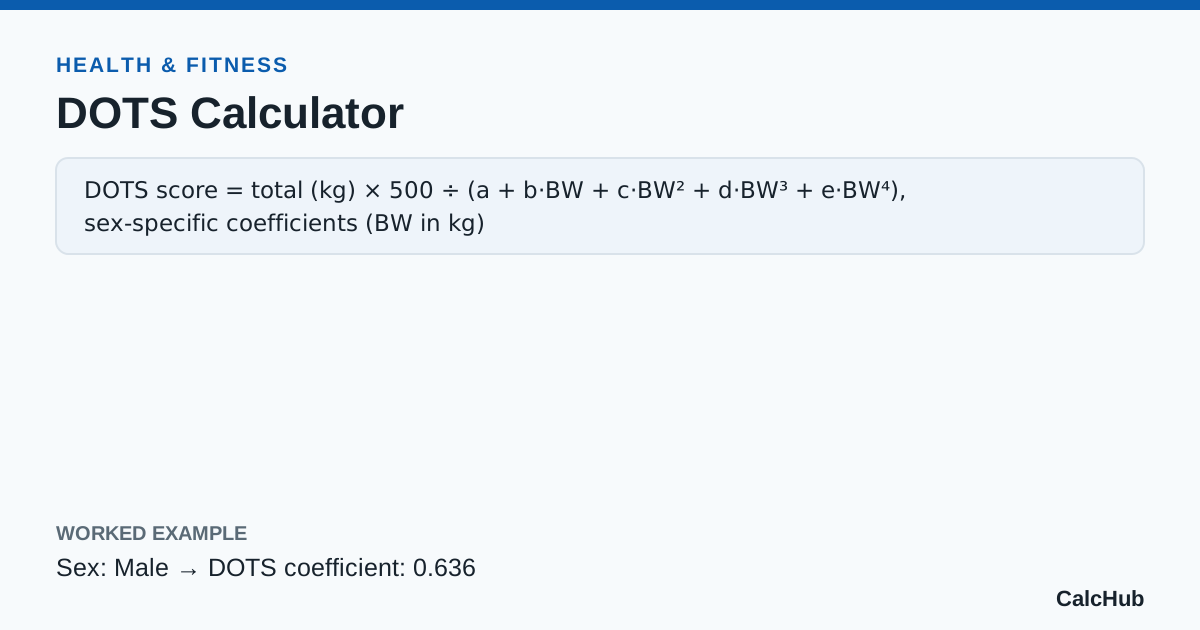
DOTS Calculator
DOTS score — the modern bodyweight-adjusted powerlifting score.
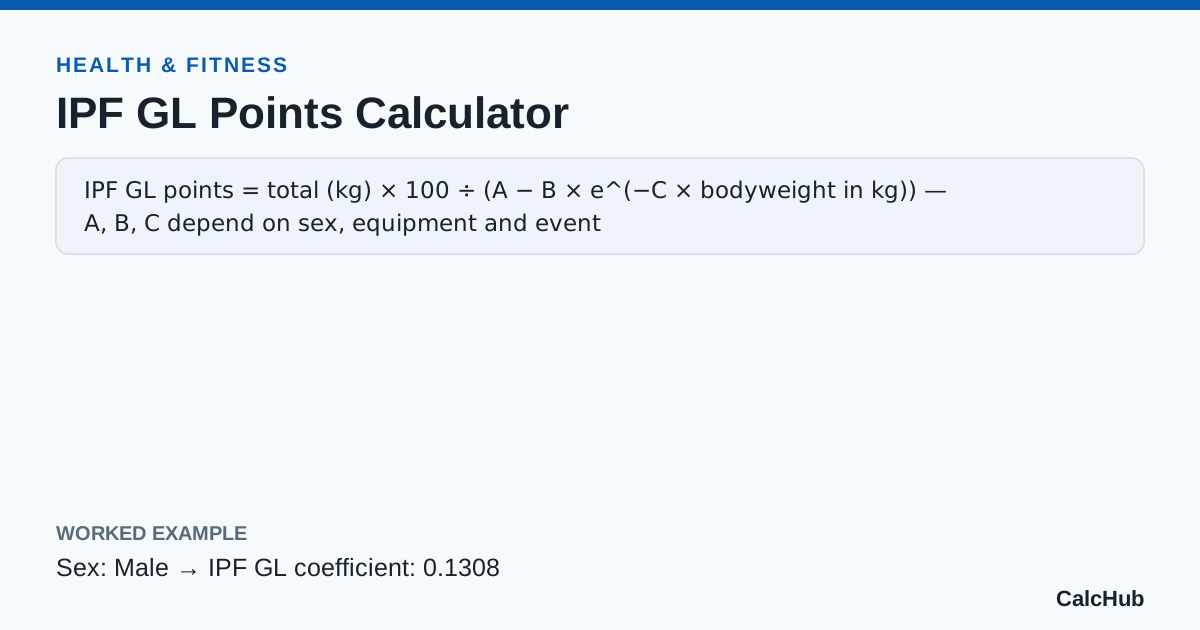
IPF GL Points Calculator
Official IPF Goodlift points for classic and equipped powerlifting and bench press.
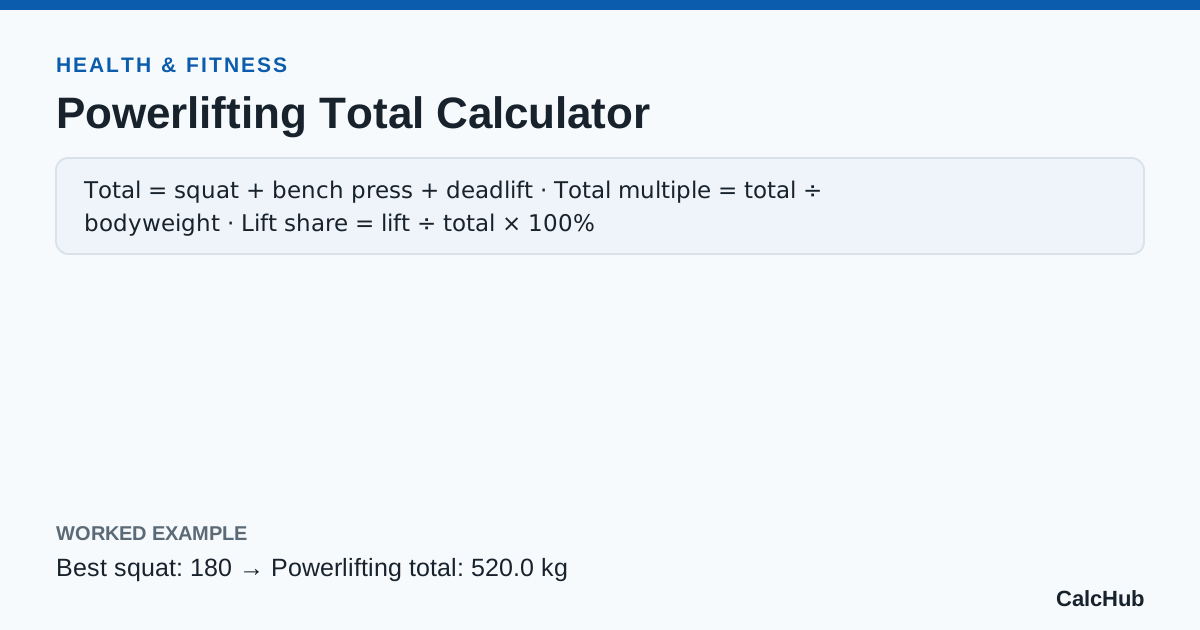
Powerlifting Total Calculator
Add up squat, bench and deadlift — total, bodyweight multiple and lift split.
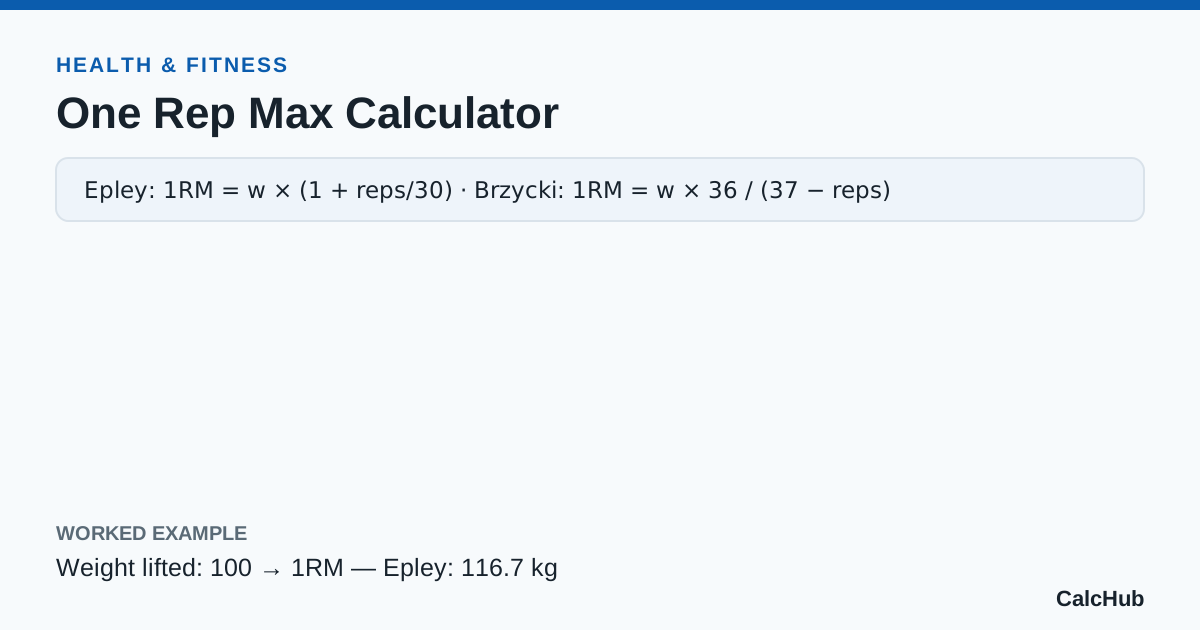
One Rep Max Calculator
Estimate your 1RM from a submaximal set — Epley and Brzycki formulas.