
DOTS Calculator
DOTS score — the modern bodyweight-adjusted powerlifting score.
Quick answer
- DOTS was designed to fix Wilks' bias at very light and very heavy bodyweights, using a fourth-degree polynomial fitted to modern meet data.
- A DOTS of 400 is a strong competitive score for men; elite lifters exceed 500. Women’s elite scores sit somewhat lower on the same scale.
- DOTS does not separate raw from equipped lifting — for equipment-aware scoring use IPF GL points instead.
- Worked example — DOTS coefficient: 0.636 (full example below).
DOTS Calculator
| DOTS coefficient | 0.636 |
| DOTS score | 381.8 |
A 93 kg man totalling 600 kg has a DOTS coefficient of about 0.636, giving a DOTS score of about 381.8 — slightly higher than his Wilks score for the same total.
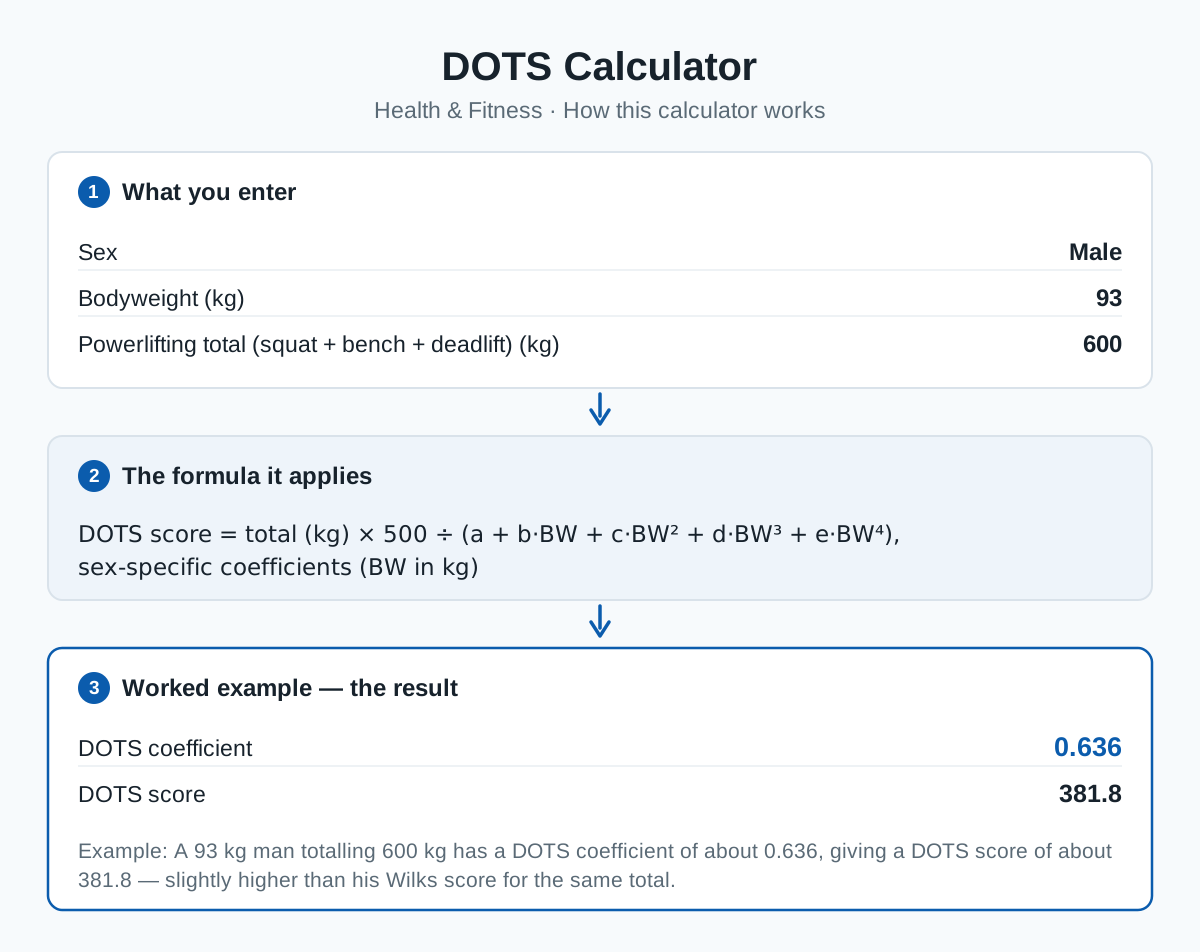
DOTS (Dynamic Objective Team Scoring) was introduced in 2019 by Tim Konertz as a fairer successor to Wilks. It scores a powerlifting total with a fourth-degree polynomial in bodyweight, fitted to a large set of modern competition results so that light and super-heavy lifters are treated more evenly.
Like Wilks, DOTS multiplies your total by 500 divided by a sex-specific bodyweight polynomial. The two systems give similar mid-range scores but diverge at the extremes — track your progress with one system consistently.
The formula
Worked example
A 93 kg man totalling 600 kg has a DOTS coefficient of about 0.636, giving a DOTS score of about 381.8 — slightly higher than his Wilks score for the same total.
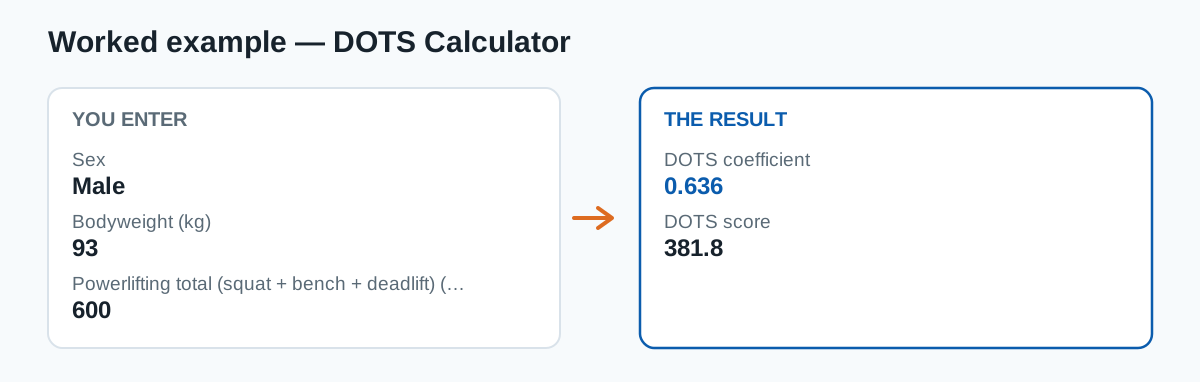
The example is pre-loaded in the result panel — press Calculate with your own numbers to replace it.
Frequently asked questions
What is a good DOTS score?
For men, 300 is a developing competitive lifter, 400 is advanced and competitive at regional level, and 500+ is elite. For women, roughly 275, 375 and 450 mark similar levels.
DOTS vs Wilks — which should I use?
Use whichever your federation or team uses. DOTS generally treats the lightest and heaviest lifters more fairly; Wilks has decades of historical results behind it. Never compare a DOTS score with a Wilks score directly.
Does DOTS adjust for age?
No — DOTS adjusts only for sex and bodyweight. Age-grading is a separate adjustment that some masters competitions apply on top.
Category: Health & Fitness calculators
Sources & methodology
Denominator polynomial (bodyweight in kg). Men: a=-307.75076, b=24.0900756, c=-0.1918759221, d=0.0007391293, e=-0.000001093. Women: a=-57.96288, b=13.6175032, c=-0.1126655495, d=0.0005158568, e=-0.0000010706. Score = total × 500 ÷ denominator. The fit is most reliable for adult competition bodyweights (roughly 40–210 kg men, 40–150 kg women).
Content last reviewed by CalcHub Editorial.
Embed this calculator on your site
Free to use with attribution — paste the snippet below and the calculator appears on your page, with a link back to CalcHub.
Related calculators
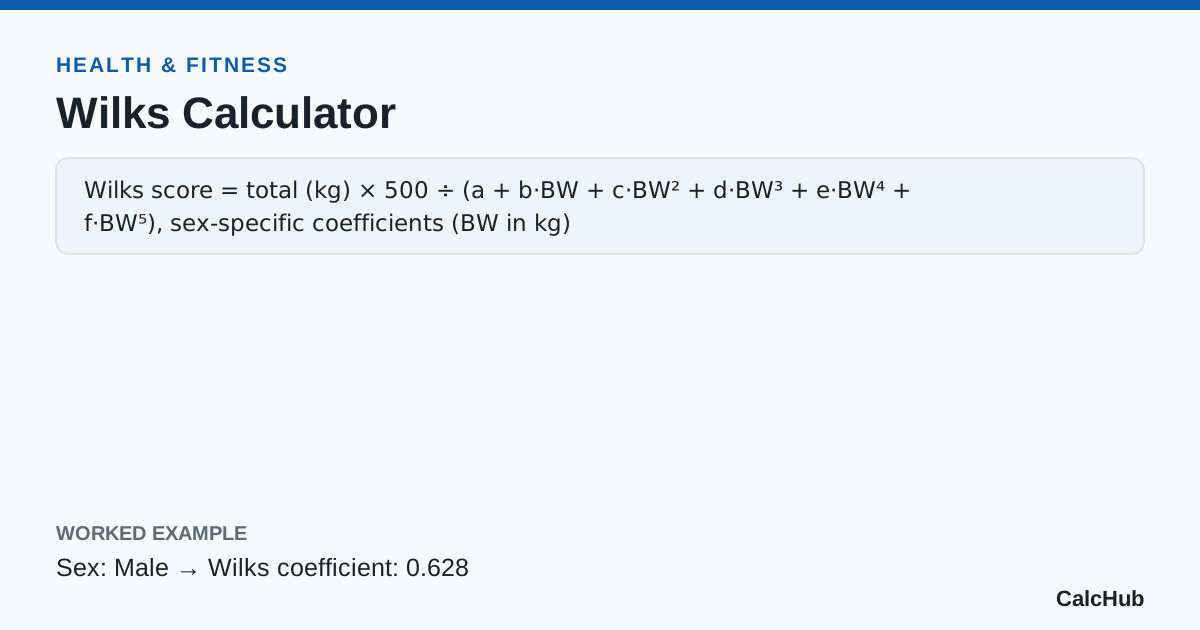
Wilks Calculator
The original Wilks score — compare powerlifting totals across bodyweights.
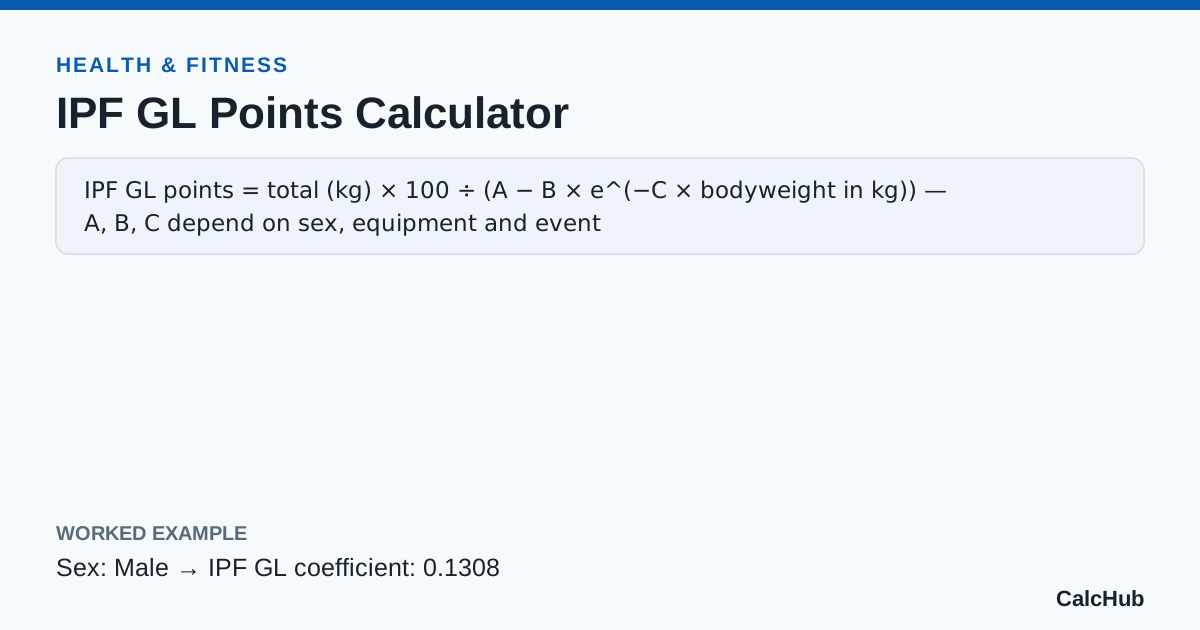
IPF GL Points Calculator
Official IPF Goodlift points for classic and equipped powerlifting and bench press.
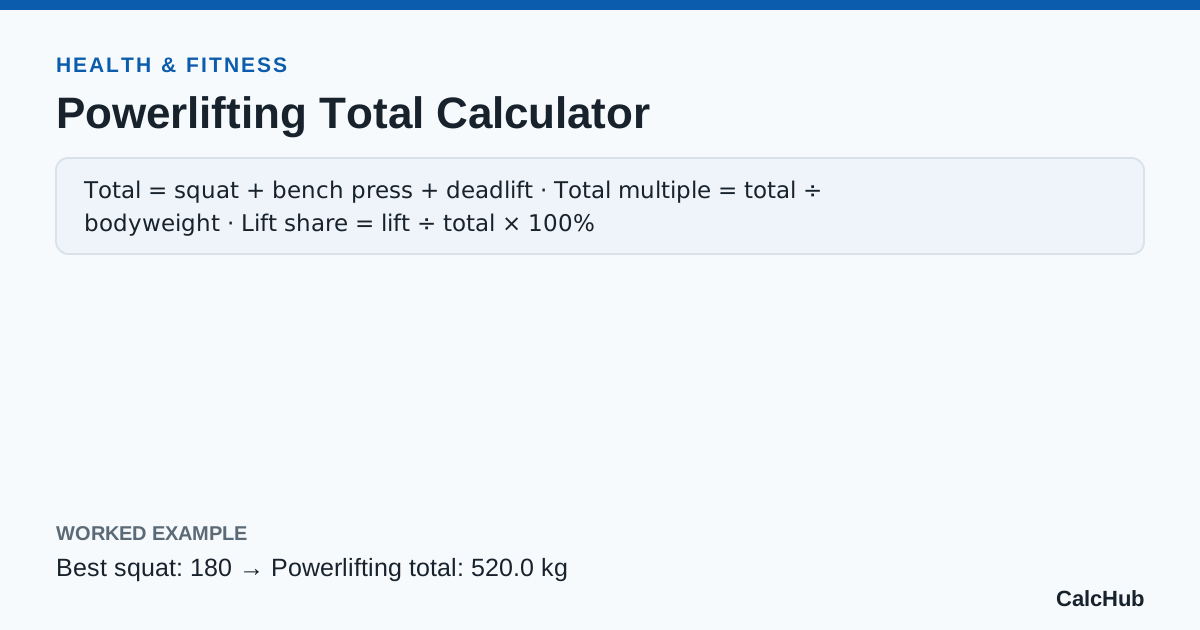
Powerlifting Total Calculator
Add up squat, bench and deadlift — total, bodyweight multiple and lift split.
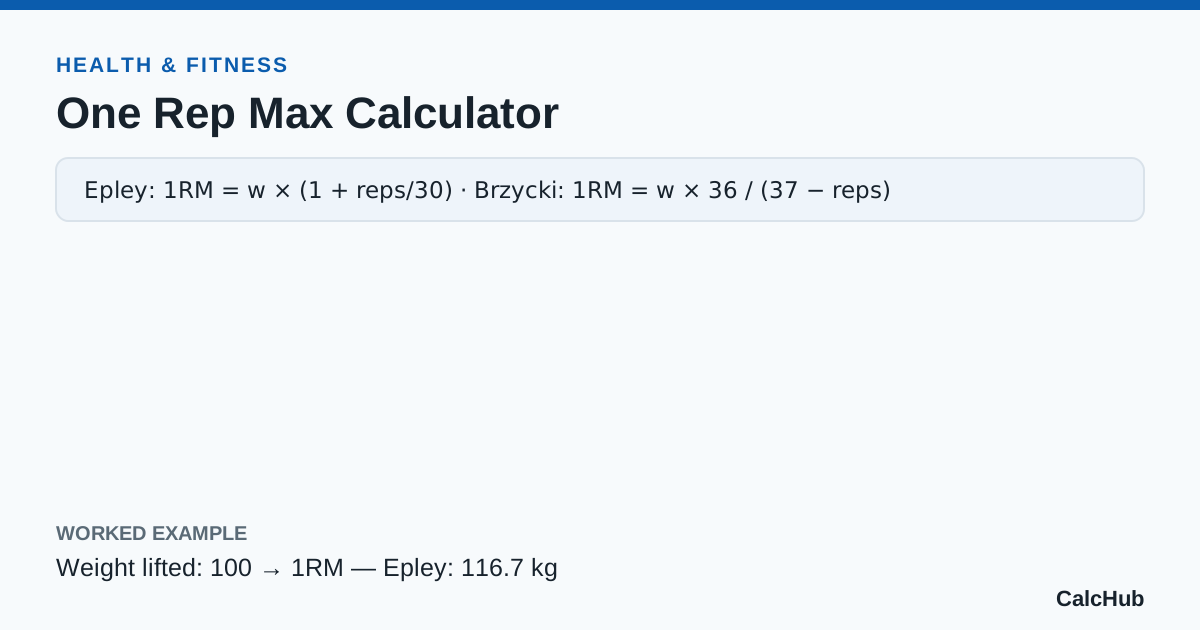
One Rep Max Calculator
Estimate your 1RM from a submaximal set — Epley and Brzycki formulas.