
Cooper Test Calculator
VO2 max from the Cooper 12-minute run test — distance in, aerobic fitness out.
Quick answer
- Every extra 100 metres in 12 minutes is worth about 2.2 VO2 max points — small pacing gains show up clearly.
- Benchmarks for men in their 20s: about 2,400–2,800 m is good and 2,800 m+ is excellent; women's good band is roughly 2,000–2,400 m, with age bands shifting down about 100–200 m per decade.
- Retest under the same conditions (course, weather, time of day) — the test tracks change in your fitness better than it pins down an absolute laboratory value.
- Worked example — Estimated VO2 max: 51.3 ml/kg/min (full example below).
Cooper Test Calculator
| Estimated VO2 max | 51.3 ml/kg/min |
| Average pace held | 4:17 |
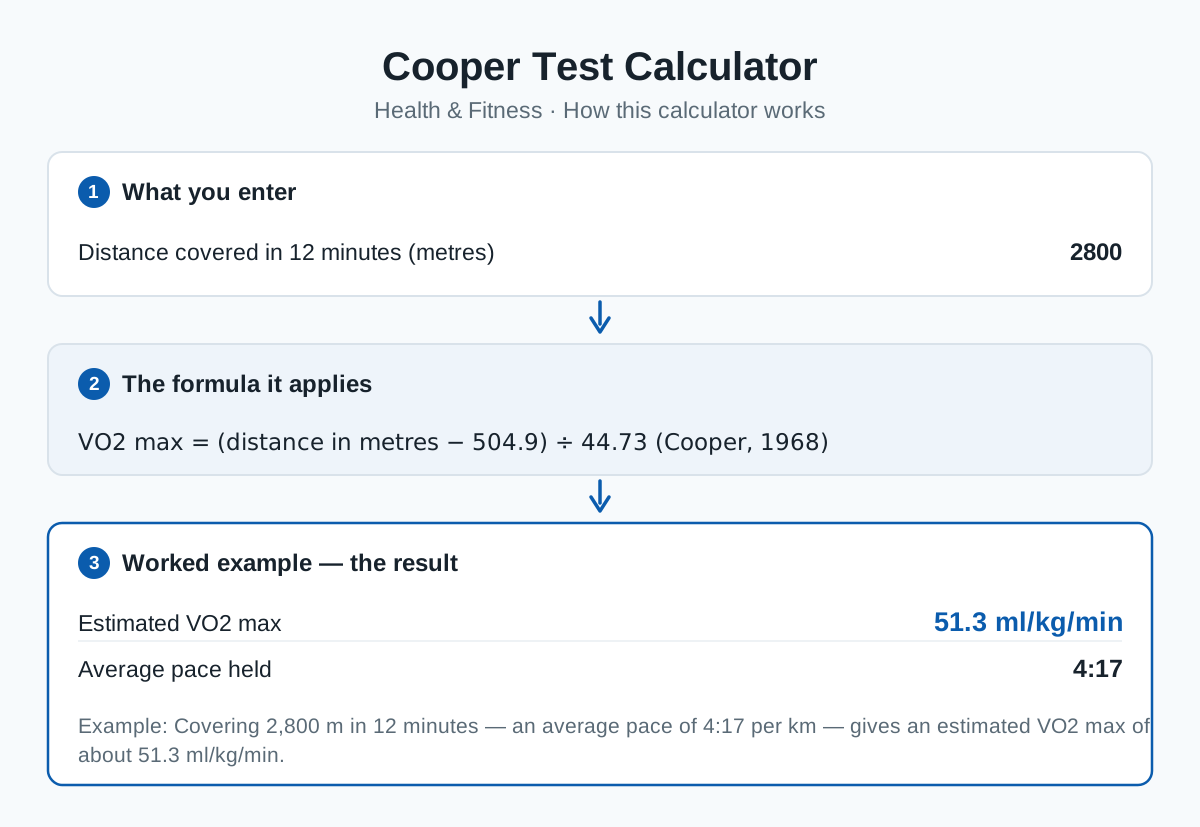
Covering 2,800 m in 12 minutes — an average pace of 4:17 per km — gives an estimated VO2 max of about 51.3 ml/kg/min.
The Cooper test is the classic field test of aerobic fitness: run as far as you can in exactly 12 minutes on a flat, measured course, and convert the distance to a VO2 max estimate. Kenneth Cooper developed it in 1968 for the US Air Force, and it correlated about 0.90 with laboratory-measured VO2 max in his original work.
Pacing decides the result: go out too hard and fade, and the formula reads the lost distance as lost fitness. Settle quickly into the fastest pace you can hold for the full 12 minutes. This is a maximal test — warm up thoroughly, and skip it and see a clinician instead if you have cardiac risk factors or symptoms.
The formula
Worked example
Covering 2,800 m in 12 minutes — an average pace of 4:17 per km — gives an estimated VO2 max of about 51.3 ml/kg/min.

The example is pre-loaded in the result panel — press Calculate with your own numbers to replace it.
Frequently asked questions
How accurate is the Cooper test?
Cooper's original correlation with laboratory VO2 max was about 0.90, and typical field error is around ±10%. Pacing, terrain, wind and motivation are the biggest error sources — a well-paced test on a track is the most trustworthy version.
Can I walk part of the test?
You may — the test measures the distance you cover in 12 minutes however you move — but walking sections lower the distance and therefore the estimate. It is designed as a maximal run for people able to run.
Cooper test or Rockport walk test?
The Cooper test suits runners who can sustain a hard 12-minute effort. The Rockport one-mile walk (our VO2 max calculator) is the better choice for beginners or anyone who should not run maximally.
Category: Health & Fitness calculators
Sources & methodology
VO2 max = (distance in metres − 504.9) ÷ 44.73, Cooper's 1968 regression from the 12-minute run. The pace output is simply 720 seconds divided by the distance in kilometres. Distances under about 505 m fall outside the equation's meaningful range and are rejected.
- Cooper KH — A means of assessing maximal oxygen intake (JAMA, 1968); test protocol and equation
- Cooper test age and sex benchmarks
Content last reviewed by CalcHub Editorial.
Embed this calculator on your site
Free to use with attribution — paste the snippet below and the calculator appears on your page, with a link back to CalcHub.
Related calculators
VO2 Max Calculator
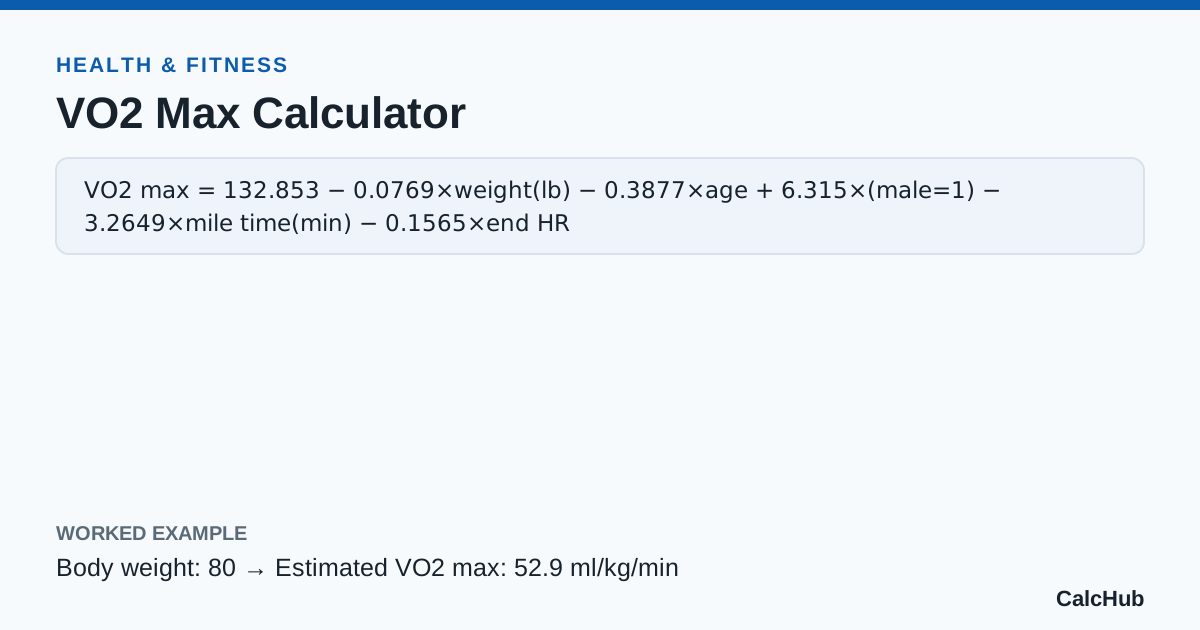
Estimate aerobic fitness with the Rockport one-mile walk test.
Pace Calculator
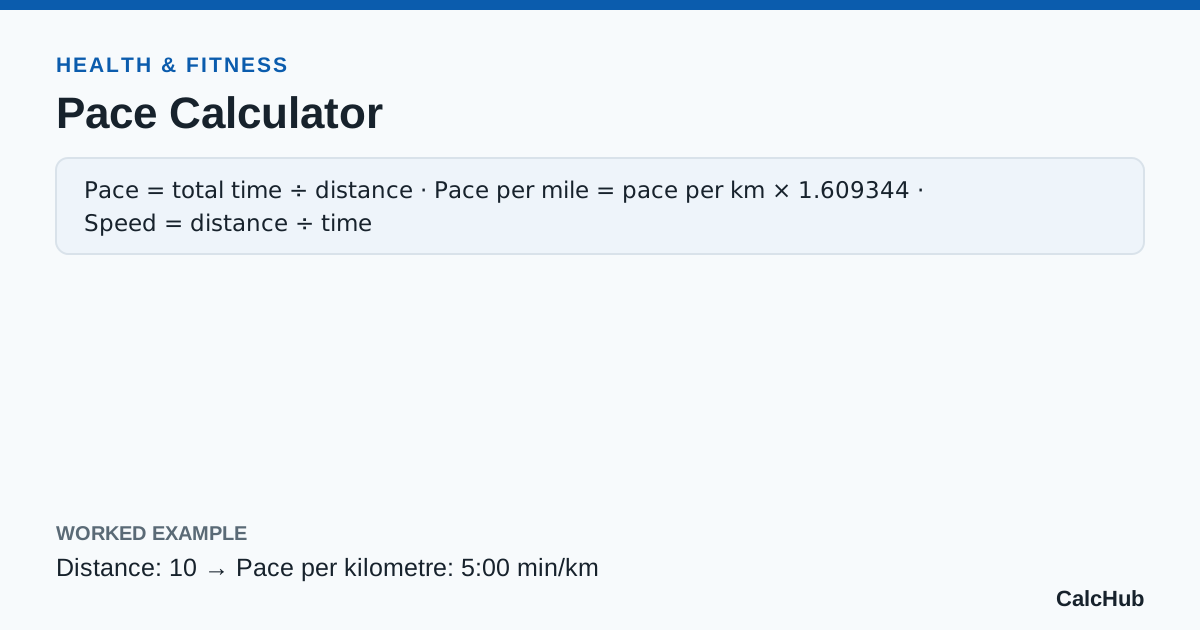
Running pace per kilometre and per mile, plus speed, from distance and time.
Race Time Predictor Calculator
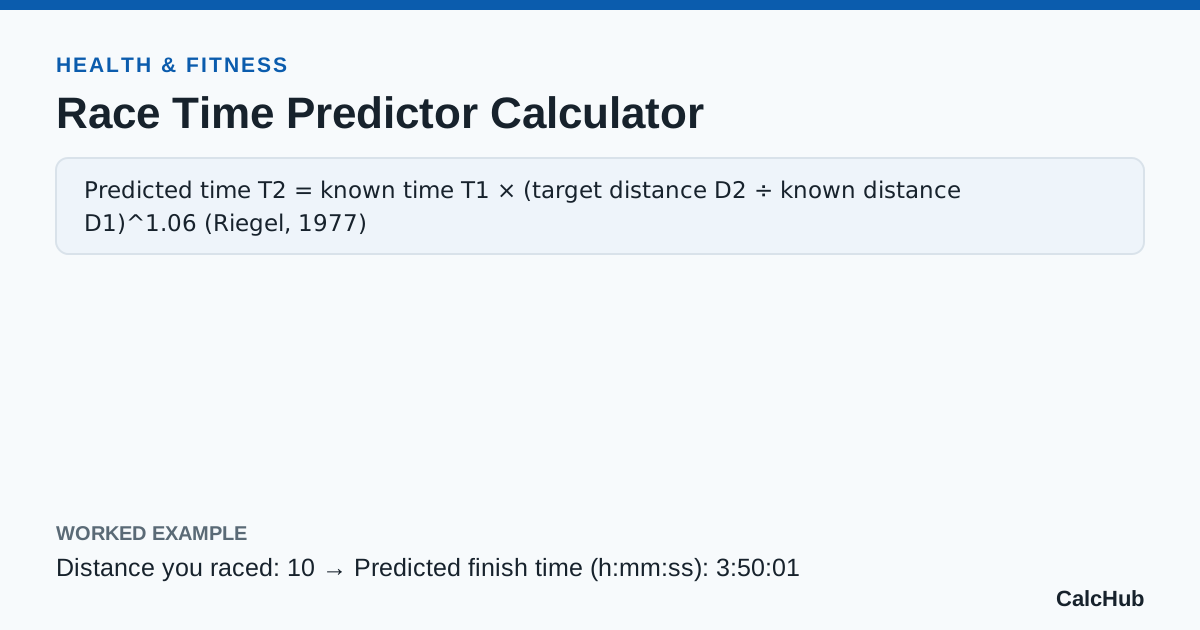
Predict your finish time at any distance from a recent race with the Riegel formula.
Target Heart Rate Calculator
Your target heart rate at any intensity, with the Karvonen heart-rate-reserve method.