
Target Heart Rate Calculator
Your target heart rate at any intensity, with the Karvonen heart-rate-reserve method.
Quick answer
- Karvonen targets use your reserve (max − resting), so they rise as your resting heart rate falls with fitness — the same 70% is a moving, personal target.
- Common training bands of reserve: 50–60% recovery, 60–70% aerobic base, 70–80% tempo, 80–90% threshold, 90–100% maximum effort.
- Estimate HRmax with Tanaka (208 − 0.7 × age), not 220 − age — the old rule overestimates for young adults and underestimates after about age 40.
- Worked example — Estimated maximum heart rate (Tanaka): 187 bpm (full example below).
Target Heart Rate Calculator
| Estimated maximum heart rate (Tanaka) | 187 bpm |
| Heart-rate reserve | 127 bpm |
| Target heart rate | 149 bpm |
At 30 with a resting rate of 60 bpm, Tanaka HRmax is 187 bpm and the reserve is 127 bpm — so 70% intensity means a target of about 149 bpm.
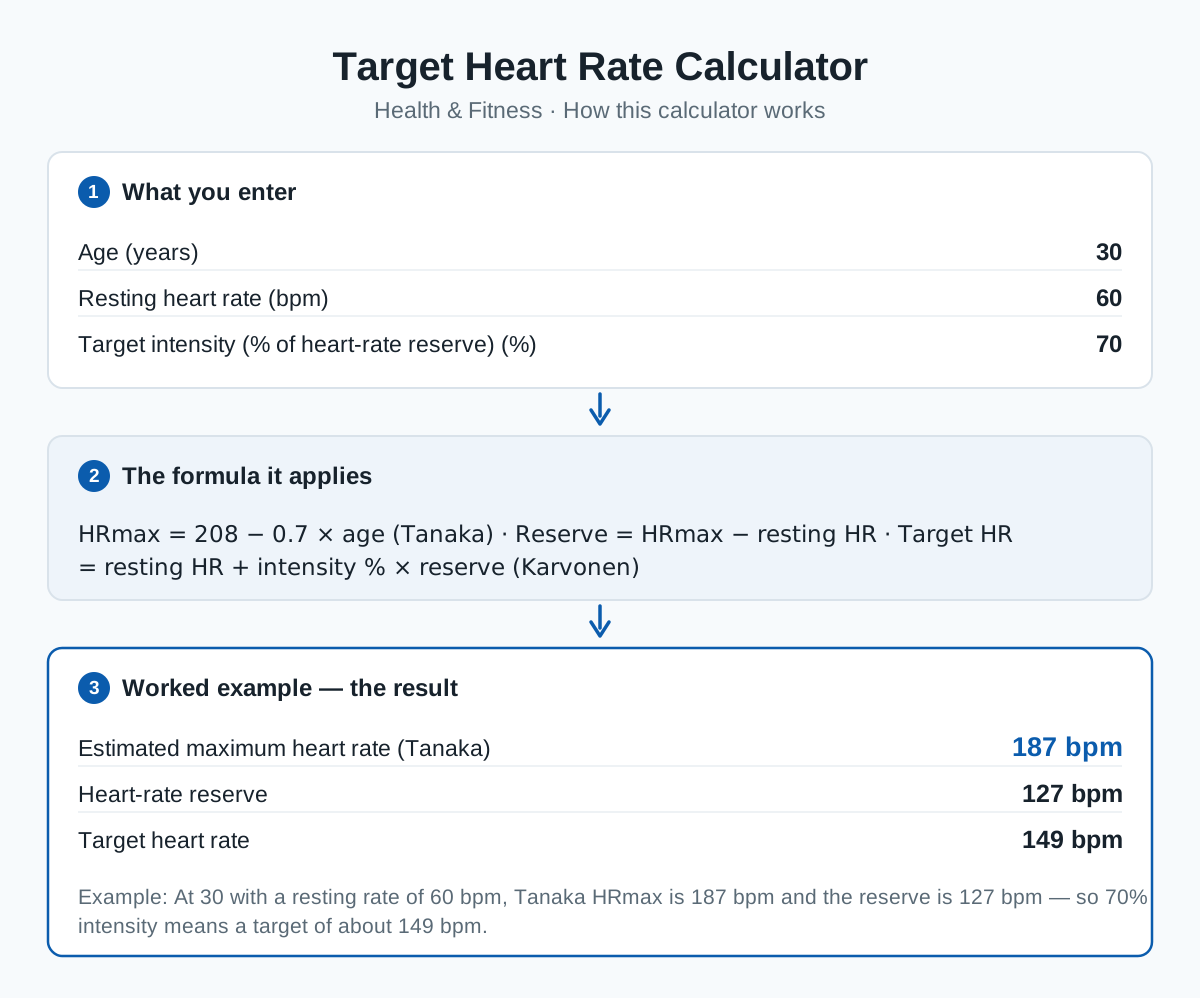
A target heart rate turns 'train at 70%' into an exact number to hold. The Karvonen method personalises that number with your resting heart rate: it works on your heart-rate reserve — the gap between maximum and resting — so a fit athlete with a low resting rate gets appropriately higher targets than a beginner of the same age.
Maximum heart rate is estimated with the Tanaka equation (208 − 0.7 × age), fitted to a meta-analysis of 18,712 subjects and more accurate across adult ages than the older 220 − age rule. Age-predicted maxima still vary by about ±10 bpm between individuals, and heart-rate targets are training guidance, not medical advice — medications such as beta blockers change the picture entirely.
The formula
Worked example
At 30 with a resting rate of 60 bpm, Tanaka HRmax is 187 bpm and the reserve is 127 bpm — so 70% intensity means a target of about 149 bpm.
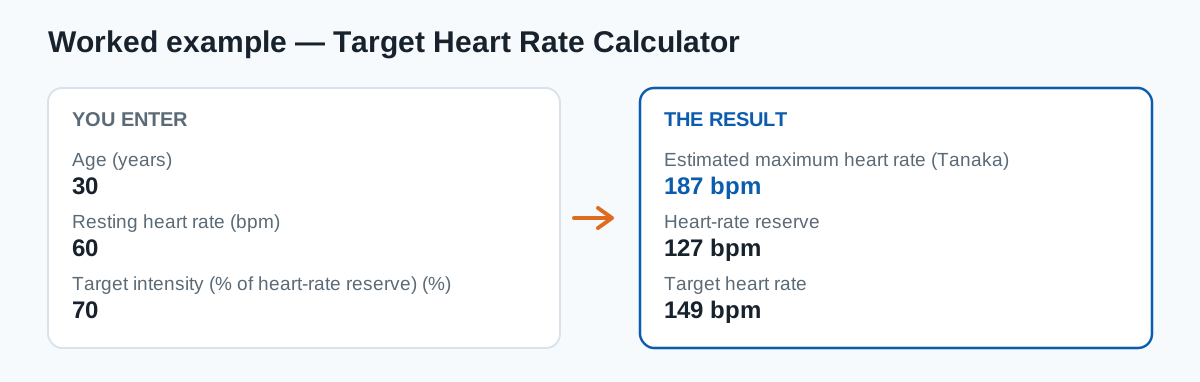
The example is pre-loaded in the result panel — press Calculate with your own numbers to replace it.
Intensity bands (% of heart-rate reserve)
| Band | % HRR | Typical use |
|---|---|---|
| Recovery | 50–60% | Warm-up, cool-down, easy days |
| Aerobic base | 60–70% | Zone 2 endurance work |
| Tempo | 70–80% | Steady, comfortably hard efforts |
| Threshold | 80–90% | Lactate-threshold intervals |
| Maximum | 90–100% | Short VO2 max intervals |
Enter any band's percentage above to get its exact target heart rate for your age and resting rate.
Frequently asked questions
How do I measure resting heart rate properly?
Take your pulse for a full minute lying in bed just after waking, before caffeine or getting up, and average a few mornings. Wrist wearables report a similar overnight figure.
Karvonen vs straight % of HRmax — which is better?
Karvonen is more individual because it accounts for resting rate, which tracks fitness. Two 30-year-olds share the same age-predicted max, but the one with a 48 bpm resting rate has a much bigger reserve and gets higher — more appropriate — targets.
Why does my watch show a different maximum?
Watches often default to 220 − age and refine it from your hardest recorded efforts. A measured field-test maximum beats any equation; if you know yours, compare the Tanaka estimate against it and prefer the measured value for training.
Category: Health & Fitness calculators
Sources & methodology
HRmax = 208 − 0.7 × age (Tanaka et al., 2001). Heart-rate reserve = HRmax − resting HR. Target HR = resting HR + (intensity ÷ 100) × reserve (Karvonen). Percentages here are of reserve, not of HRmax — a 70% reserve target is harder than 70% of HRmax, and the two methods must not be mixed.
- Tanaka H et al. — Age-predicted maximal heart rate revisited (J Am Coll Cardiol, 2001); Karvonen method explained
- Karvonen formula — worked method and examples
Content last reviewed by CalcHub Editorial.
Embed this calculator on your site
Free to use with attribution — paste the snippet below and the calculator appears on your page, with a link back to CalcHub.
Related calculators
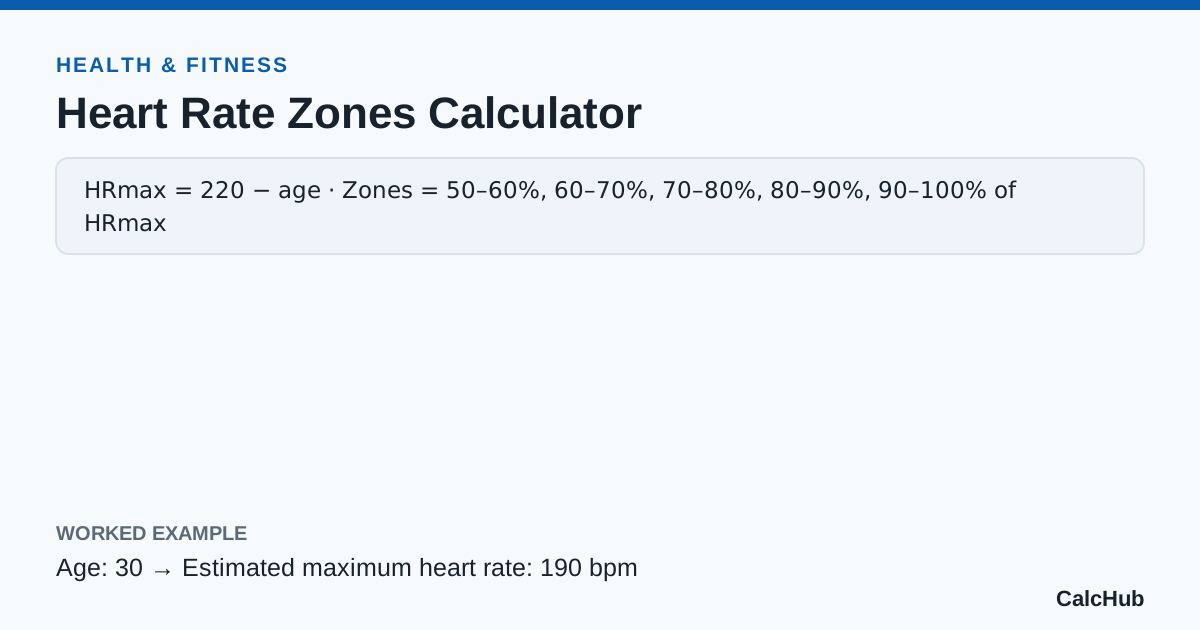
Heart Rate Zones Calculator
Five training zones from your age-predicted maximum heart rate.
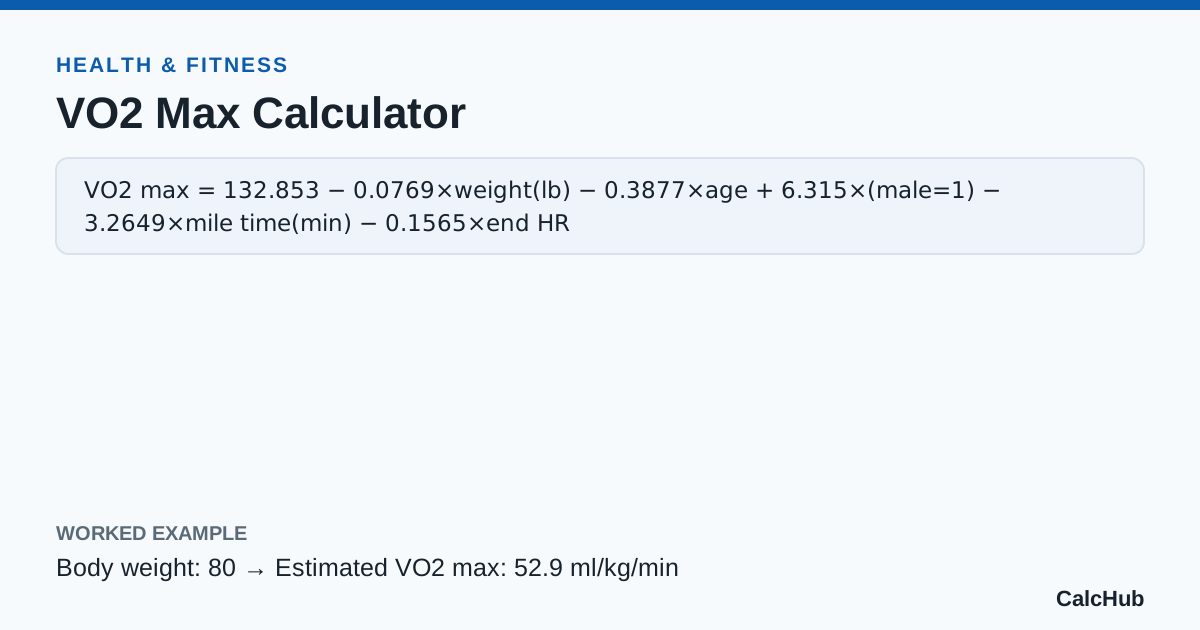
VO2 Max Calculator
Estimate aerobic fitness with the Rockport one-mile walk test.
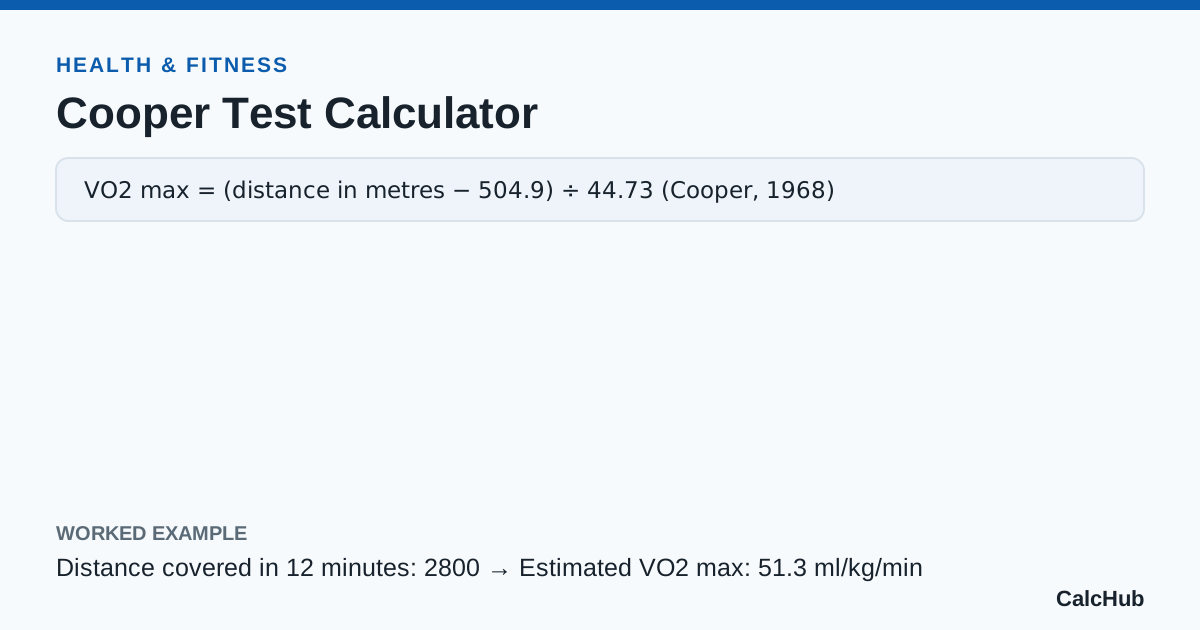
Cooper Test Calculator
VO2 max from the Cooper 12-minute run test — distance in, aerobic fitness out.
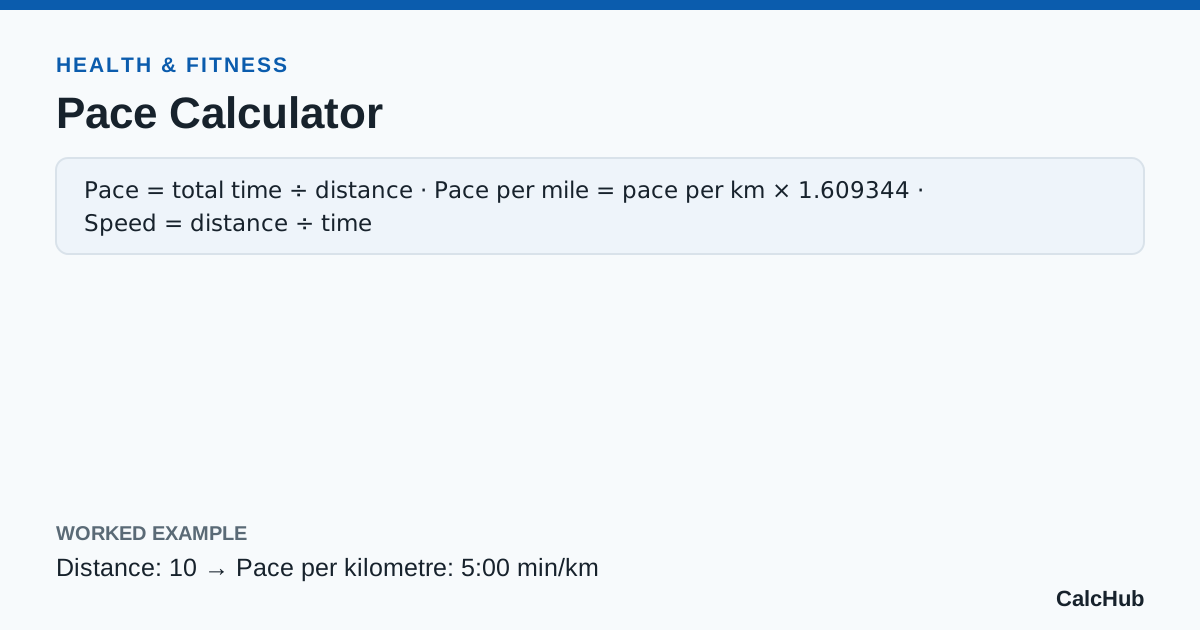
Pace Calculator
Running pace per kilometre and per mile, plus speed, from distance and time.