
Race Time Predictor Calculator
Predict your finish time at any distance from a recent race with the Riegel formula.
Quick answer
- The 1.06 exponent is the whole model: it assumes trained runners slow predictably as distance grows. Recreational runners often fade more (some coaches use 1.07–1.08 for first marathons).
- Use a recent, honestly-paced race as the input — a training run or a blown-up race poisons the prediction.
- Predictions between similar distances are typically within 1–3%; a 5K-to-marathon prediction can miss by 10–20 minutes.
- Worked example — Predicted finish time (h:mm:ss): 3:50:01 (full example below).
Race Time Predictor Calculator
| Predicted finish time (h:mm:ss) | 3:50:01 |
| Predicted pace per km | 5:27 |
| Predicted pace per mile | 8:46 |
A 50:00 10K predicts a marathon of about 3:50:01 — an average of 5:27 per km — assuming marathon-specific training.
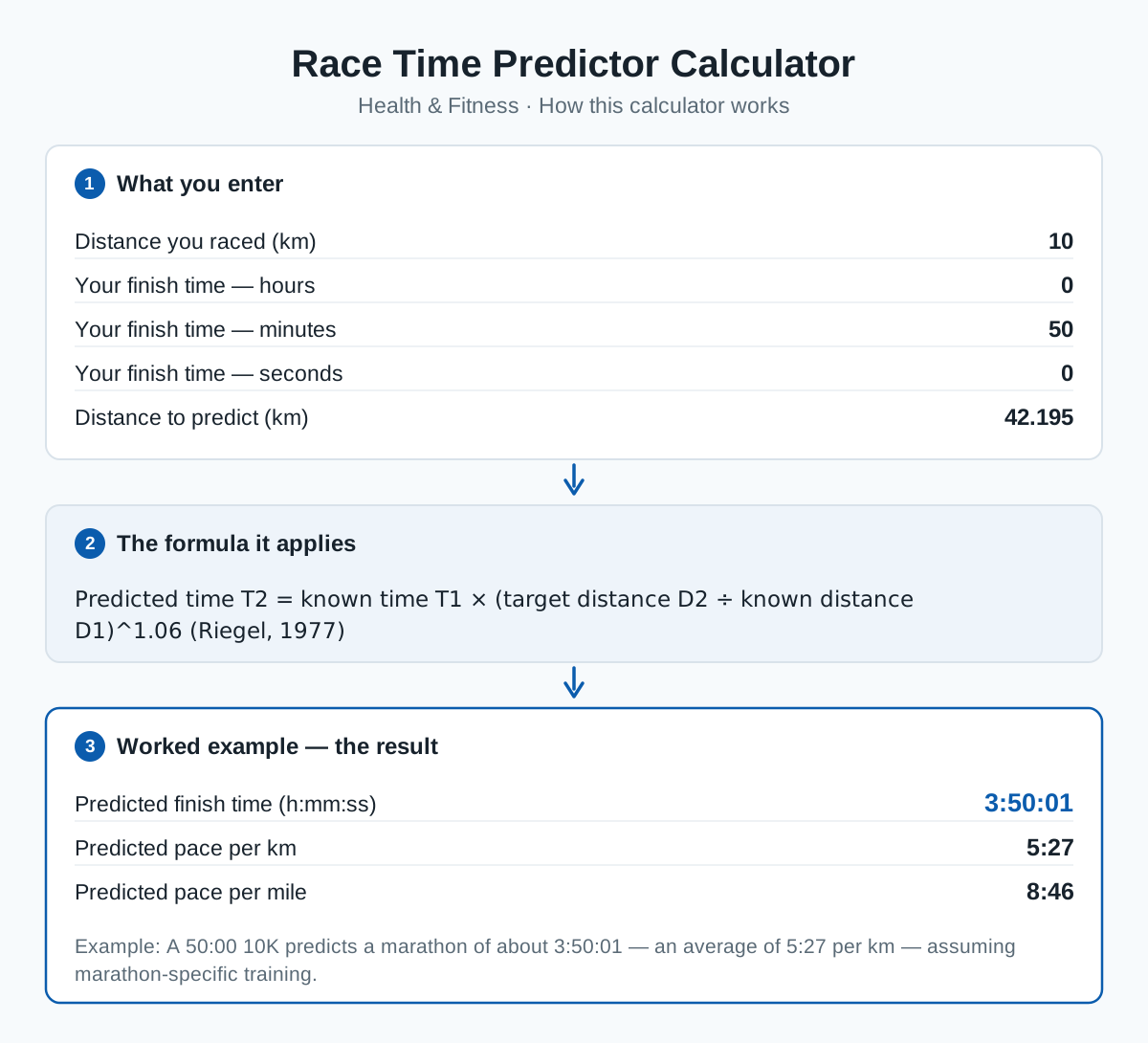
Peter Riegel's 1977 power-law formula predicts race times across distances: T2 = T1 × (D2 ÷ D1)^1.06. The exponent 1.06 captures fatigue — double the distance and the time slightly more than doubles, because nobody holds 5K pace for a marathon.
Predictions are most trustworthy between neighbouring distances (10K from 5K, marathon from half marathon) and assume you have trained for the target distance. A 5K-based marathon prediction describes your fitness ceiling, not a guarantee — course, weather and fuelling all move real results.
The formula
Worked example
A 50:00 10K predicts a marathon of about 3:50:01 — an average of 5:27 per km — assuming marathon-specific training.
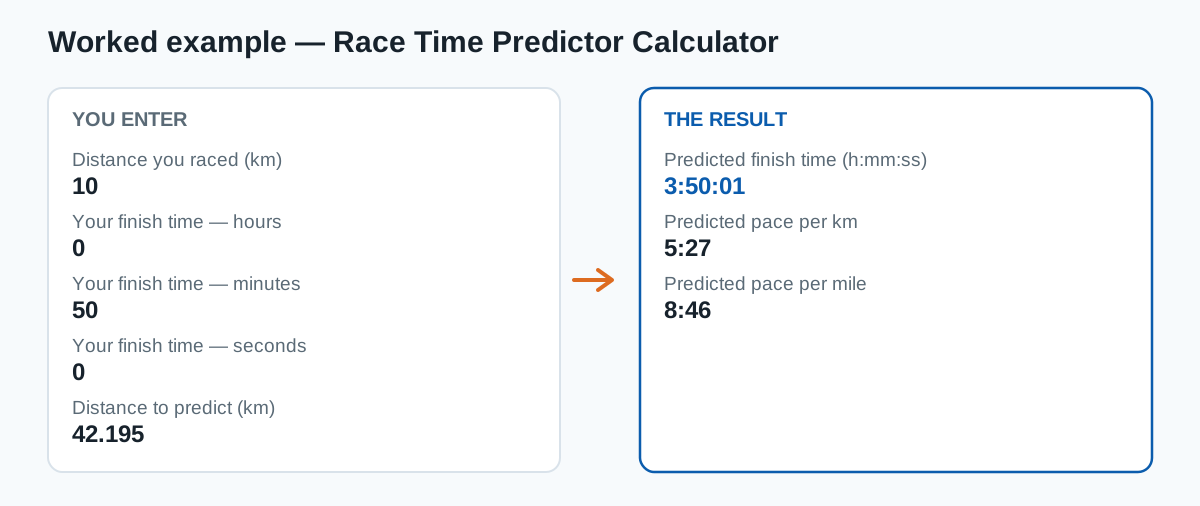
The example is pre-loaded in the result panel — press Calculate with your own numbers to replace it.
Frequently asked questions
How accurate is the Riegel formula?
For trained runners predicting between 1,500 m and the marathon it is typically within 1–3% when the distances are reasonably close. Accuracy falls when extrapolating far (mile to marathon) or when training was specific to only one distance.
Why is the predicted marathon slower than double my half?
Because of the exponent: doubling distance multiplies time by 2^1.06 ≈ 2.085, not 2. That extra ~8.5% is the fatigue cost the formula builds in.
Should beginners use a bigger exponent?
Many coaches use 1.07 or 1.08 for less-trained runners and first-time marathoners, which predicts slower times. This calculator uses Riegel's original 1.06 so results stay comparable with the standard published method.
Category: Health & Fitness calculators
Sources & methodology
T2 = T1 × (D2/D1)^1.06 with times in seconds and distances in the same unit (kilometres here). Pace outputs divide the predicted time by the target distance (×1.609344 for per-mile). No age, sex or course adjustment — Riegel's model is deliberately a one-parameter fit to endurance performance.
- Riegel PS — Athletic records and human endurance (American Scientist, 1981) and the 1977 formula
- Riegel formula compared with VDOT and critical speed methods
Content last reviewed by CalcHub Editorial.
Embed this calculator on your site
Free to use with attribution — paste the snippet below and the calculator appears on your page, with a link back to CalcHub.
Related calculators
Pace Calculator
Running pace per kilometre and per mile, plus speed, from distance and time.
Cooper Test Calculator
VO2 max from the Cooper 12-minute run test — distance in, aerobic fitness out.
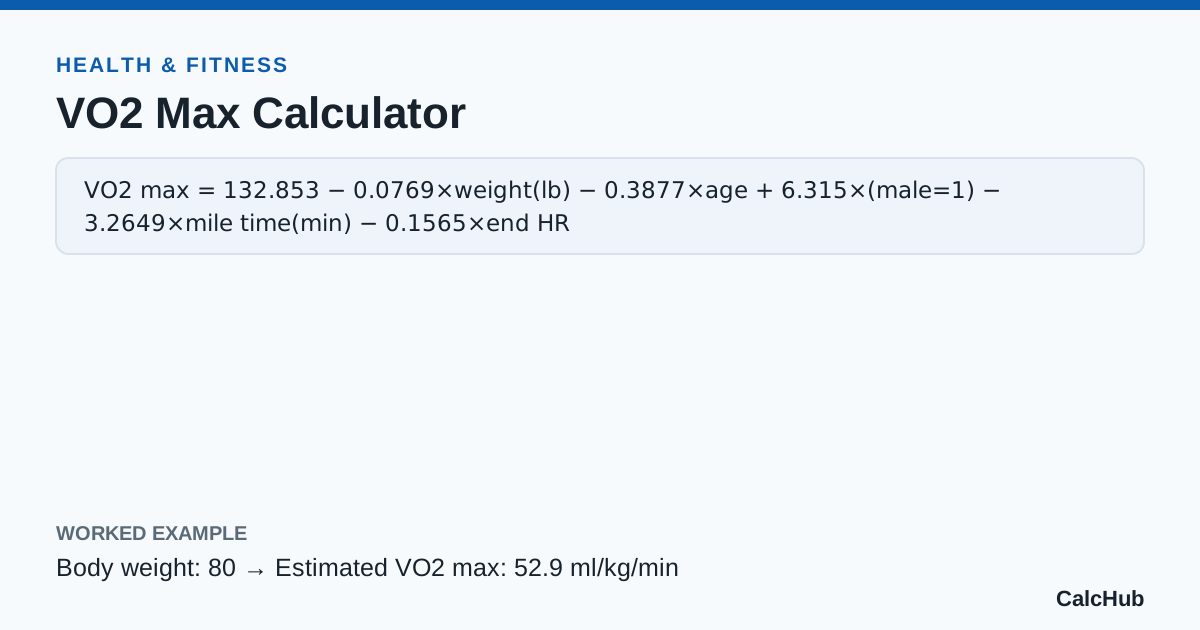
VO2 Max Calculator
Estimate aerobic fitness with the Rockport one-mile walk test.
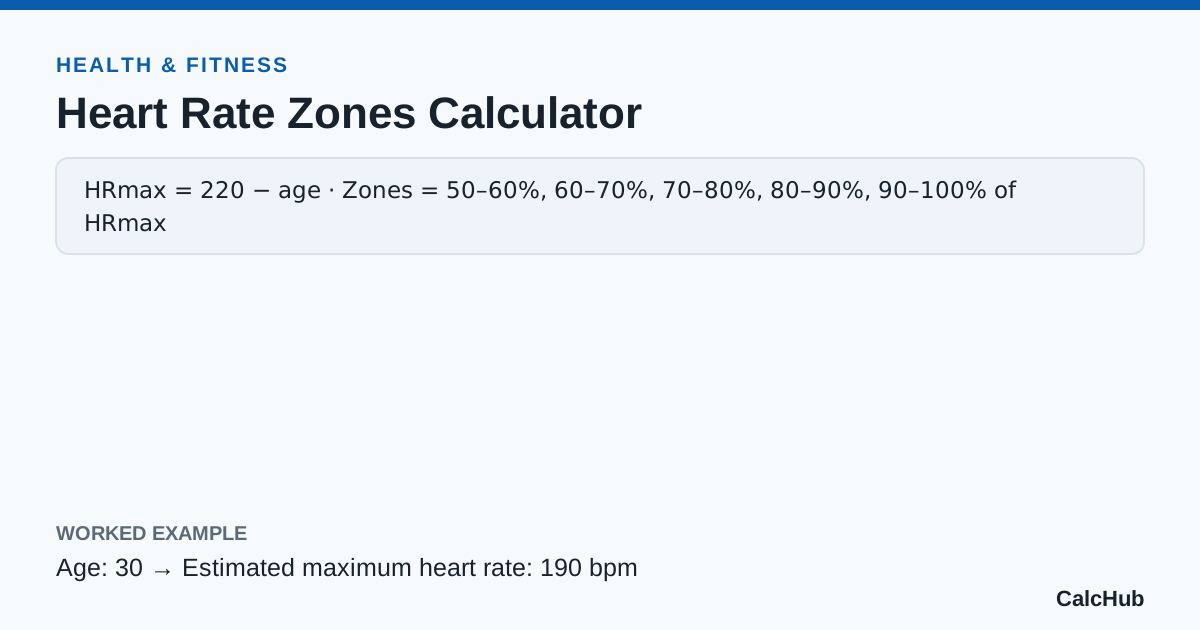
Heart Rate Zones Calculator
Five training zones from your age-predicted maximum heart rate.