
Training Percentage Calculator
Turn any percentage of your one-rep max into the exact weight to load.
Quick answer
- Common working zones: 90–100% strength/peaking, 80–90% heavy strength, 70–80% hypertrophy-strength mix, 60–70% volume and technique work.
- The NSCA chart's anchor points: 95% ≈ 2 reps, 90% ≈ 4, 85% ≈ 6, 80% ≈ 8, 75% ≈ 10, 70% ≈ 12 — memorise these six and you can sanity-check any program.
- Base percentages on a current, honest max — test it, or estimate it from a hard set with our one-rep max calculator rather than using a lifetime best from last year.
- Worked example — Training load: 119.0 kg (full example below).
Training Percentage Calculator
| Training load | 119.0 kg |
| Repetitions possible at this intensity (chart) | 6 reps at about 85% of 1RM (nearest chart value) |
With a 140 kg one-rep max, 85% is 119 kg — a load the standard chart pairs with about 6 repetitions when fresh.
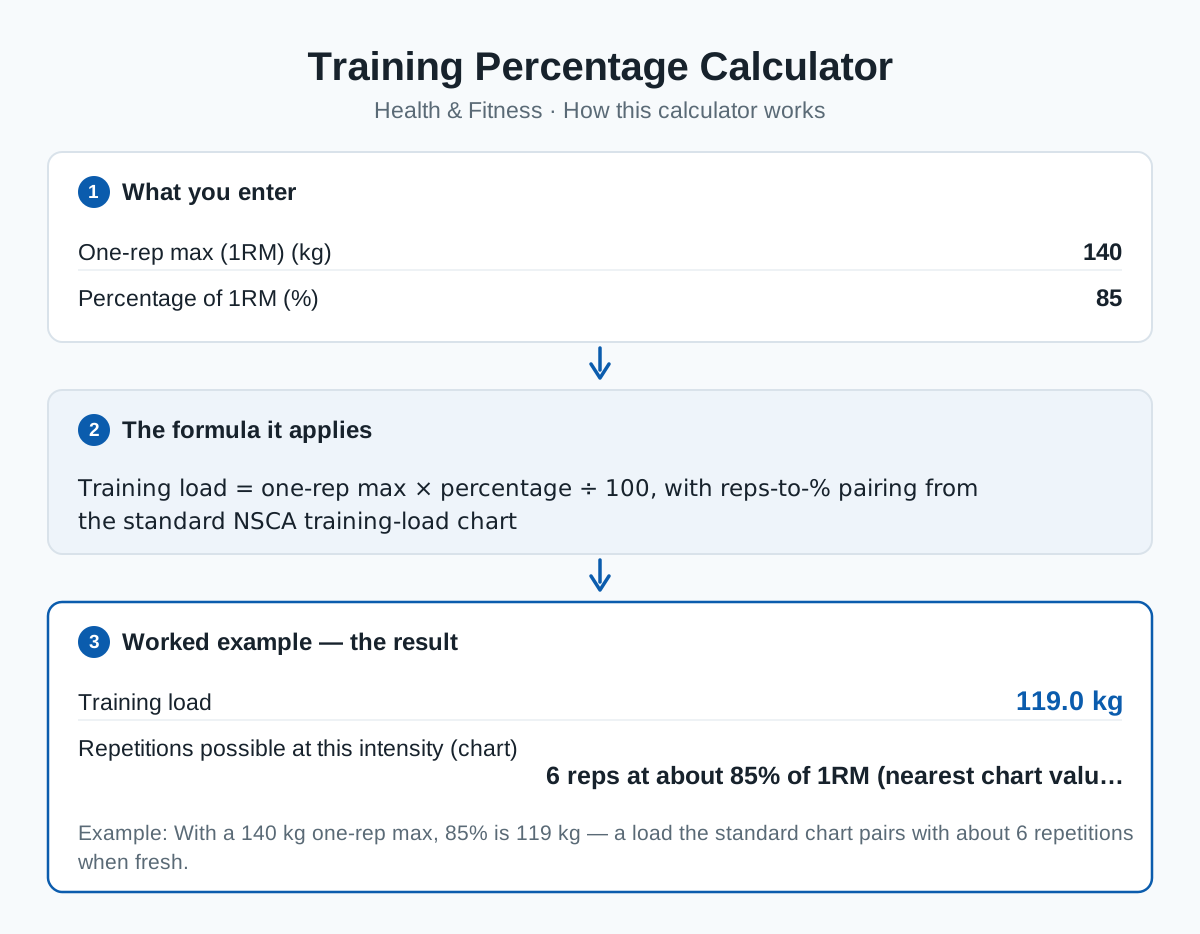
Percentage-based programming runs on your one-rep max: a session written as '5 × 5 at 80%' only means something once 80% of your max is a number on the bar. This calculator does that conversion — enter a 1RM and a percentage and get the training load, plus the repetition range that percentage usually allows from the standard NSCA training-load chart.
The chart pairs percentages with the repetitions typically possible when fresh: 100% for 1, 95% for 2, 90% for 4, 85% for 6, 80% for 8, 75% for 10 and 70% for 12. Individuals vary — leverages, training age and the exercise itself (deadlifts fatigue faster than bench) all shift the true pairing — so treat the load as the prescription and the reps as the expectation, adjusting by feel and bar speed.
The formula
Worked example
With a 140 kg one-rep max, 85% is 119 kg — a load the standard chart pairs with about 6 repetitions when fresh.
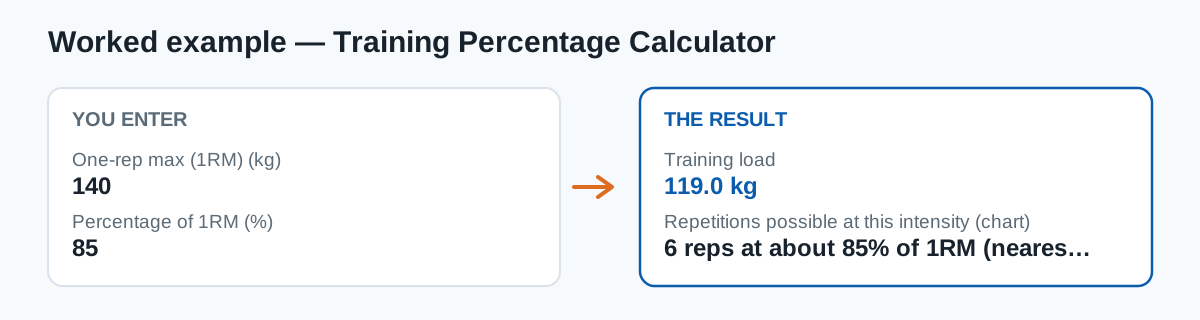
The example is pre-loaded in the result panel — press Calculate with your own numbers to replace it.
Standard training-load chart (% of 1RM vs repetitions)
| % of 1RM | Repetitions |
|---|---|
| 100% | 1 |
| 95% | 2 |
| 93% | 3 |
| 90% | 4 |
| 87% | 5 |
| 85% | 6 |
| 83% | 7 |
| 80% | 8 |
| 77% | 9 |
| 75% | 10 |
| 70% | 12 |
| 65% | 15 |
| 60% | 20 |
The widely reproduced NSCA-style chart. Repetitions at a given percentage vary by lifter and exercise — the chart is a planning guide, not a guarantee.
Frequently asked questions
Should I round the load up or down?
Round to the nearest loadable weight; if in doubt, round down on volume work and up only on planned top sets. A 1–2 kg rounding difference is far smaller than daily readiness variation.
Why can I do more reps than the chart says?
The chart describes an average across lifters and exercises. Trained endurance at submaximal loads, smaller muscle groups and machines all allow extra reps; heavy deadlifts usually allow fewer. If you consistently beat the chart by 3+ reps, your tested max is probably stale.
What percentage should beginners use?
Most beginner linear programs live at 70–85% — heavy enough to drive adaptation, light enough to practise technique for sets of 5. True max testing is unnecessary in the first months; estimate 1RM from a clean set of 3–5.
Category: Health & Fitness calculators
Sources & methodology
Load = 1RM × percent ÷ 100. The repetition estimate reports the nearest entry of the standard training-load chart (100/1, 95/2, 93/3, 90/4, 87/5, 85/6, 83/7, 80/8, 77/9, 75/10, 70/12, 65/15, 60/20). Practical loading rarely matches the maths to the gram — round the computed load to the nearest loadable plate combination (see the barbell plate calculator).
- NSCA-style percentage/repetition chart as reproduced in standard strength-training references
- Baechle & Earle — Essentials of Strength Training and Conditioning (NSCA), load-assignment charts
Content last reviewed by CalcHub Editorial.
Embed this calculator on your site
Free to use with attribution — paste the snippet below and the calculator appears on your page, with a link back to CalcHub.
Related calculators
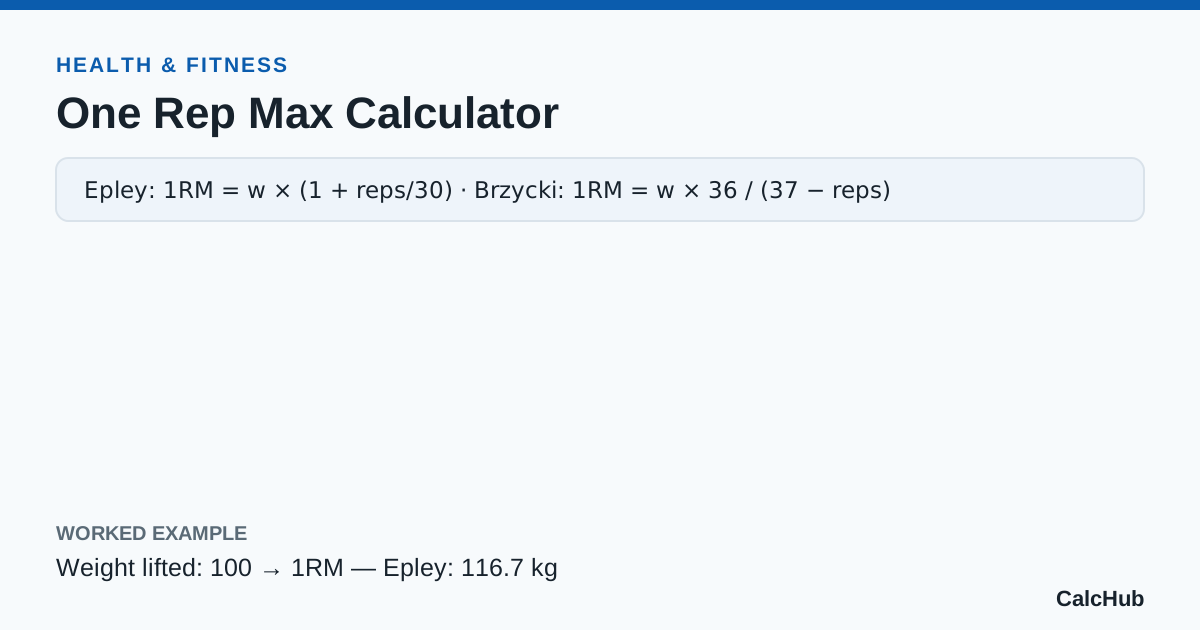
One Rep Max Calculator
Estimate your 1RM from a submaximal set — Epley and Brzycki formulas.
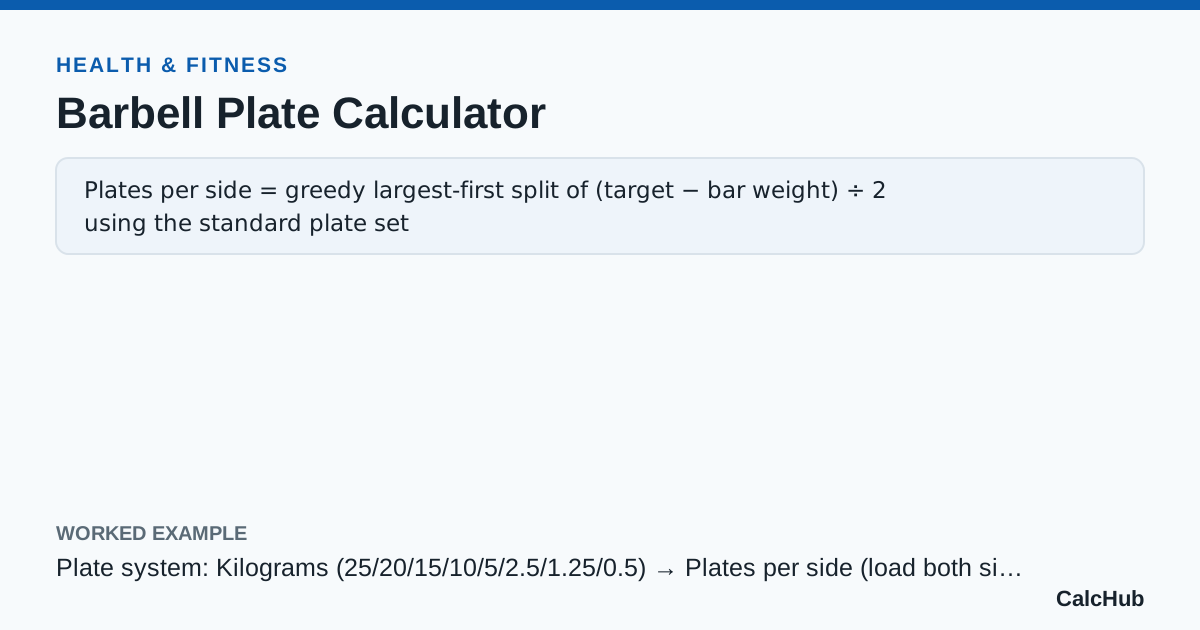
Barbell Plate Calculator
Which plates go on each side of the bar for any target weight — kg or lb.
Powerlifting Total Calculator
Add up squat, bench and deadlift — total, bodyweight multiple and lift split.
Wilks Calculator
The original Wilks score — compare powerlifting totals across bodyweights.