
Barbell Plate Calculator
Which plates go on each side of the bar for any target weight — kg or lb.
Quick answer
- Always load both sides identically and heaviest-plate-first, closest to the bar — it keeps the bar balanced and stable.
- Standard bars: men's Olympic 20 kg (45 lb), women's Olympic 15 kg (35 lb). If your total looks wrong by exactly a bar's worth, the bar weight is the culprit.
- Competition collars count: 2.5 kg per side. Gym spring collars are light enough to ignore — but be consistent in your training log.
- Worked example — Plates per side (load both sides the same): 1 × 25 kg, 1 × 15 kg (full example below).
Barbell Plate Calculator
| Plates per side (load both sides the same) | 1 × 25 kg, 1 × 15 kg |
| Actual loaded weight | 100.00 |
| Shortfall vs target | 0.00 |
For 100 kg on a 20 kg bar, each side takes 40 kg: one 25 and one 15 — loaded exactly, with zero shortfall.
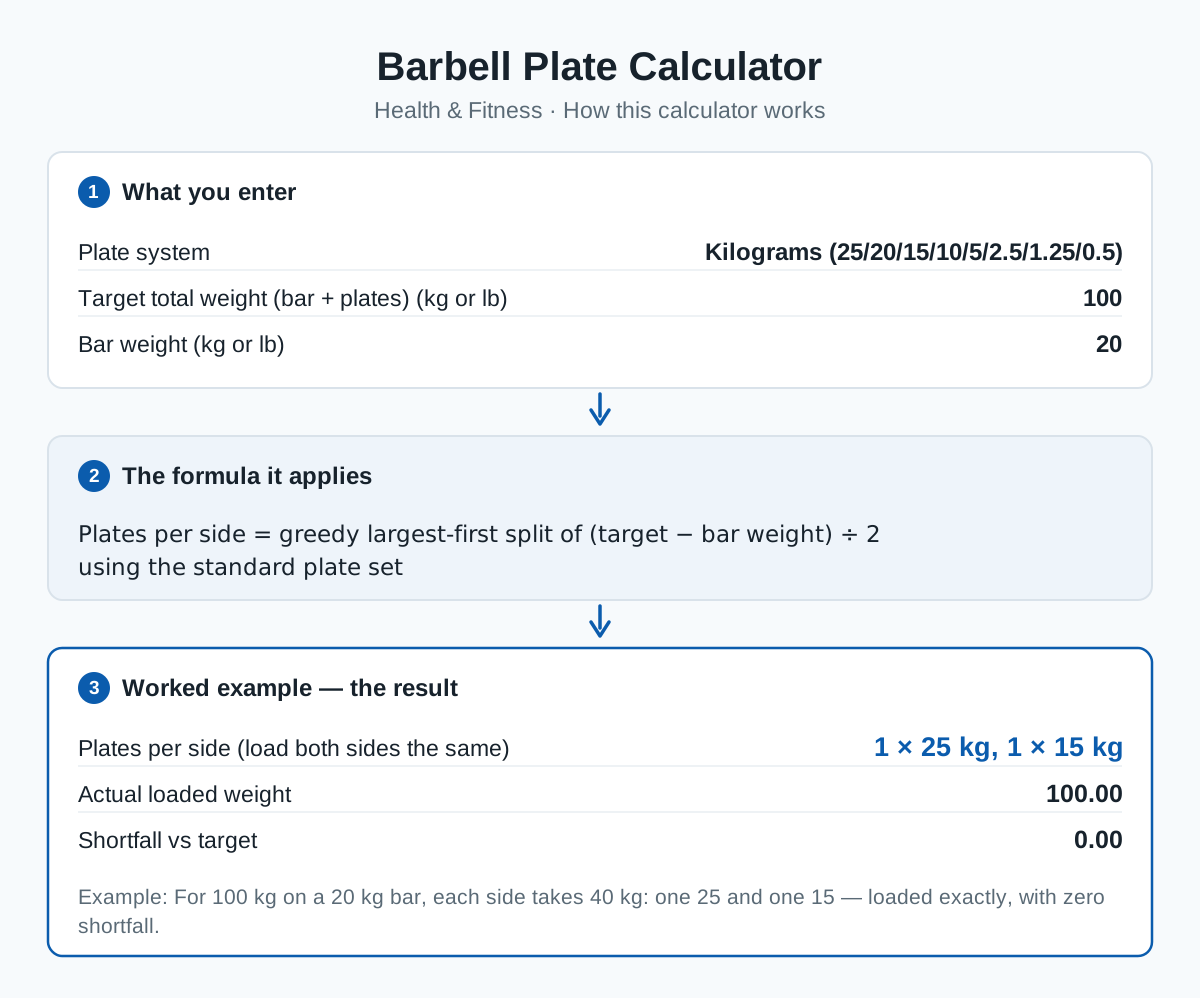
Tell this calculator the weight you want and it loads the bar for you: it subtracts the bar, splits the rest evenly, and fills each side greedily — largest plates first — from the standard plate set. Metric gyms: 25, 20, 15, 10, 5, 2.5, 1.25 and 0.5 kg plates; pound gyms: 45, 35, 25, 10, 5, 2.5 and 1 lb.
If the exact target cannot be built from standard plates, the calculator loads the closest achievable weight below it and reports the shortfall honestly instead of pretending. Collars typically add about 2.5 kg per side in competition (5 kg total) — most gym training ignores them, and so does this calculator unless you include them in the bar weight.
The formula
Worked example
For 100 kg on a 20 kg bar, each side takes 40 kg: one 25 and one 15 — loaded exactly, with zero shortfall.
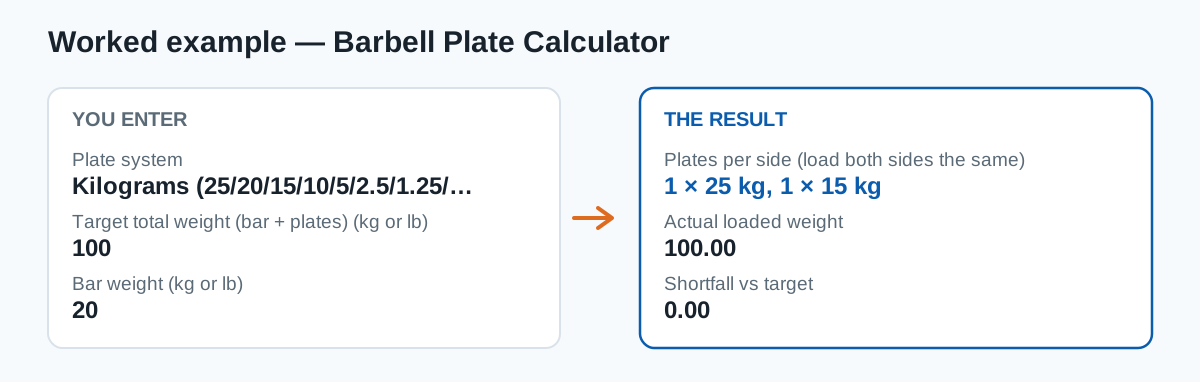
The example is pre-loaded in the result panel — press Calculate with your own numbers to replace it.
Frequently asked questions
Why does my target show a shortfall?
Some totals simply cannot be built from standard plates — for example 101.2 kg on a 20 kg bar. The calculator loads the closest achievable weight under the target and tells you the difference, so you can decide whether to round the target instead.
Do collars count toward the weight?
Competition collars weigh 2.5 kg each (5 kg per bar) and do count in powerlifting and weightlifting totals. Ordinary gym clips weigh a few hundred grams. Add collars to the bar weight field if you want them included.
What if I do not have every plate size?
The calculator assumes the full standard set. If your gym lacks a size — small change plates especially — real-world loading may come out a little under; the shortfall figure shows exactly how far off you are.
Category: Health & Fitness calculators
Sources & methodology
Per-side load = (target − bar) ÷ 2, filled greedily from the largest denomination down — the order lifters actually load, and optimal for standard plate sets. Metric set: 25, 20, 15, 10, 5, 2.5, 1.25, 0.5 kg. Imperial set: 45, 35, 25, 10, 5, 2.5, 1 lb. Any remainder that standard plates cannot make is reported as the shortfall, and the loaded weight is the true total on the bar.
- Standard plate denominations and greedy loading method
- Olympic bar and bumper plate standards (20 kg men's, 15 kg women's bars)
Content last reviewed by CalcHub Editorial.
Embed this calculator on your site
Free to use with attribution — paste the snippet below and the calculator appears on your page, with a link back to CalcHub.
Related calculators
Training Percentage Calculator
Turn any percentage of your one-rep max into the exact weight to load.
One Rep Max Calculator
Estimate your 1RM from a submaximal set — Epley and Brzycki formulas.
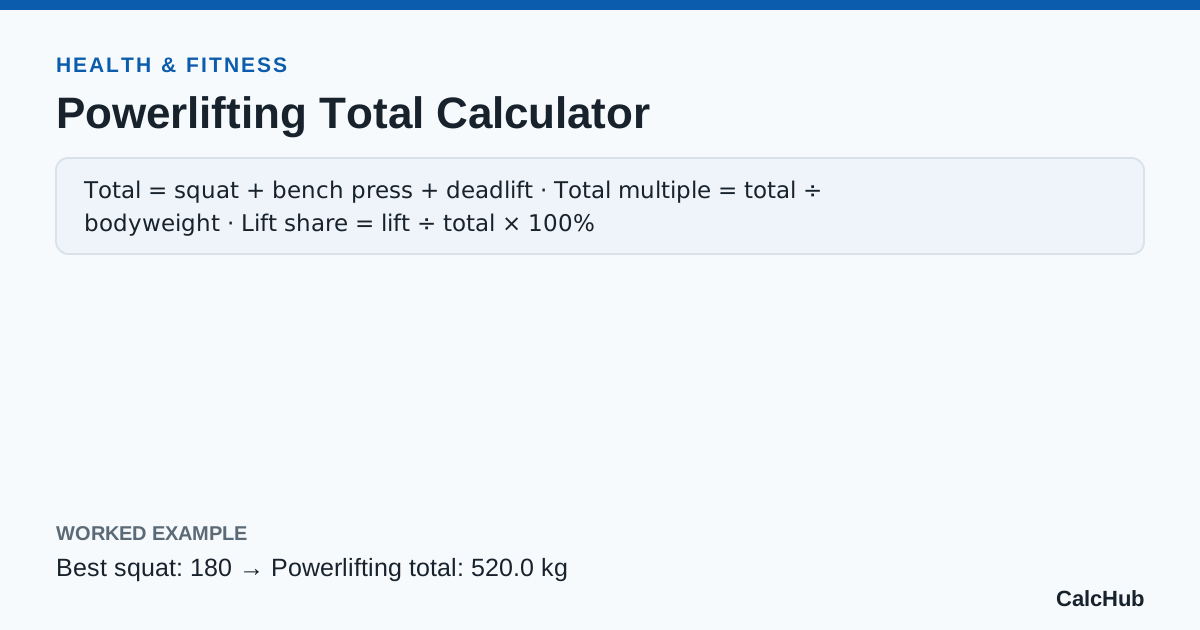
Powerlifting Total Calculator
Add up squat, bench and deadlift — total, bodyweight multiple and lift split.
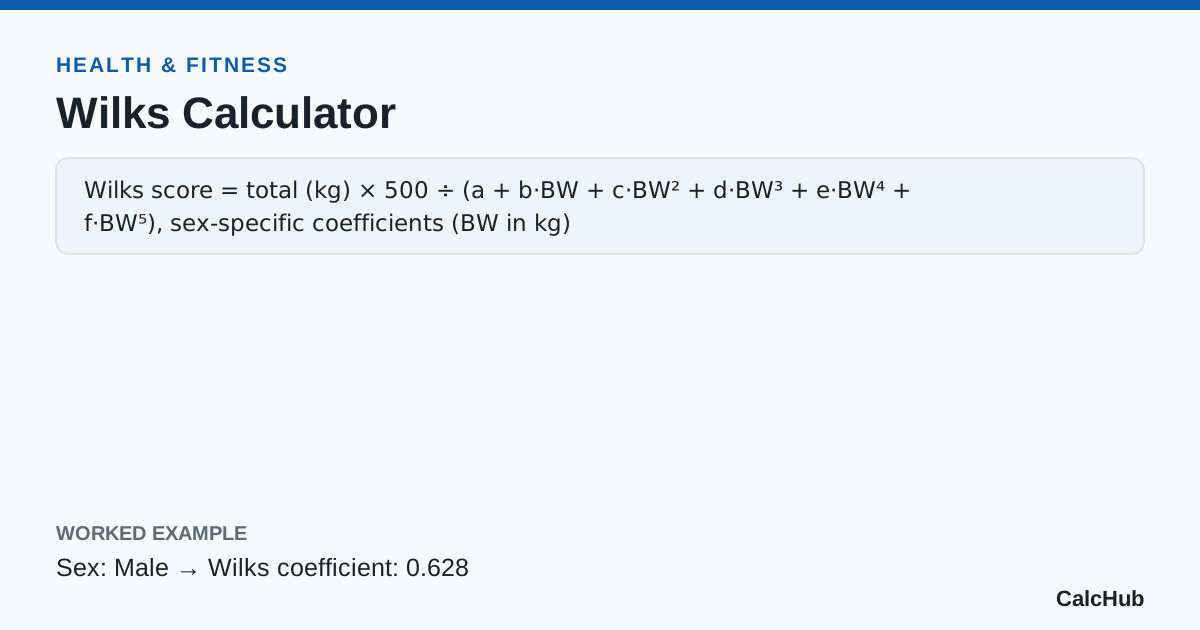
Wilks Calculator
The original Wilks score — compare powerlifting totals across bodyweights.