How Pregnancy Due Dates Are Calculated: Naegele's Rule Explained
The question every new pregnancy starts with
"When is my baby due?" is usually one of the first questions asked after a positive test, and the answer can feel like magic: a clinician hears one date and instantly names another, nine months out. There is no magic in it. Understanding how pregnancy due dates are calculated comes down to one rule applied to one date — count 280 days (40 weeks) from the first day of your last menstrual period (LMP). This guide works that rule through a fully checked example, then explains the adjustments, trimester boundaries, and accuracy limits around it. Everything here is educational; your own dates and any concerns about them belong in a conversation with your clinician.
The direct answer
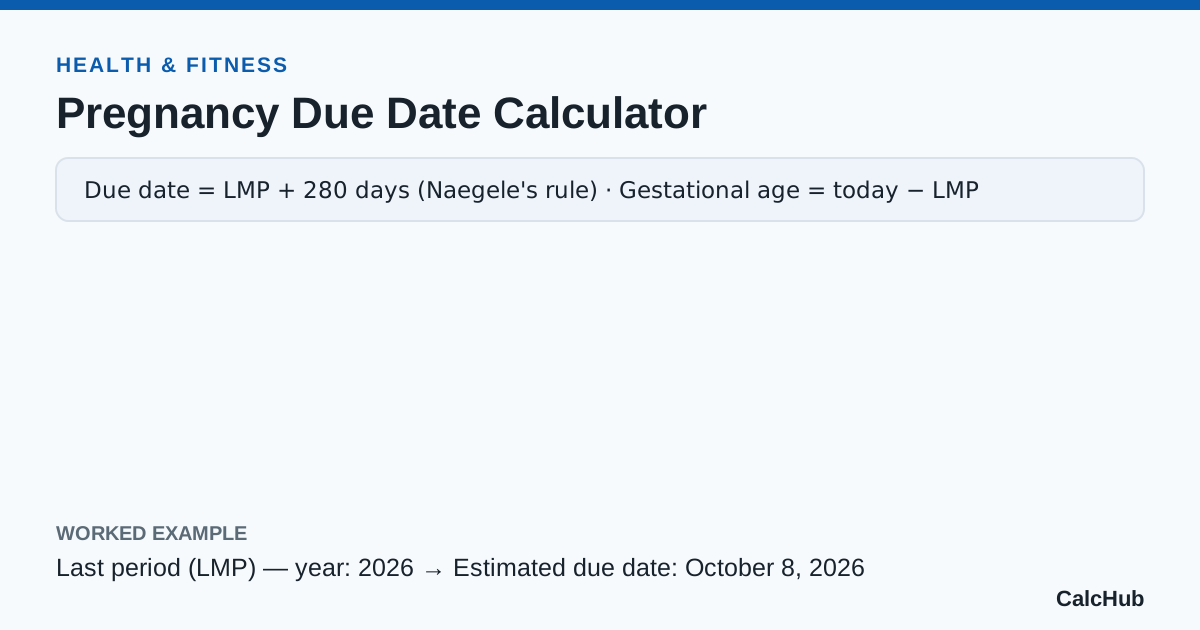
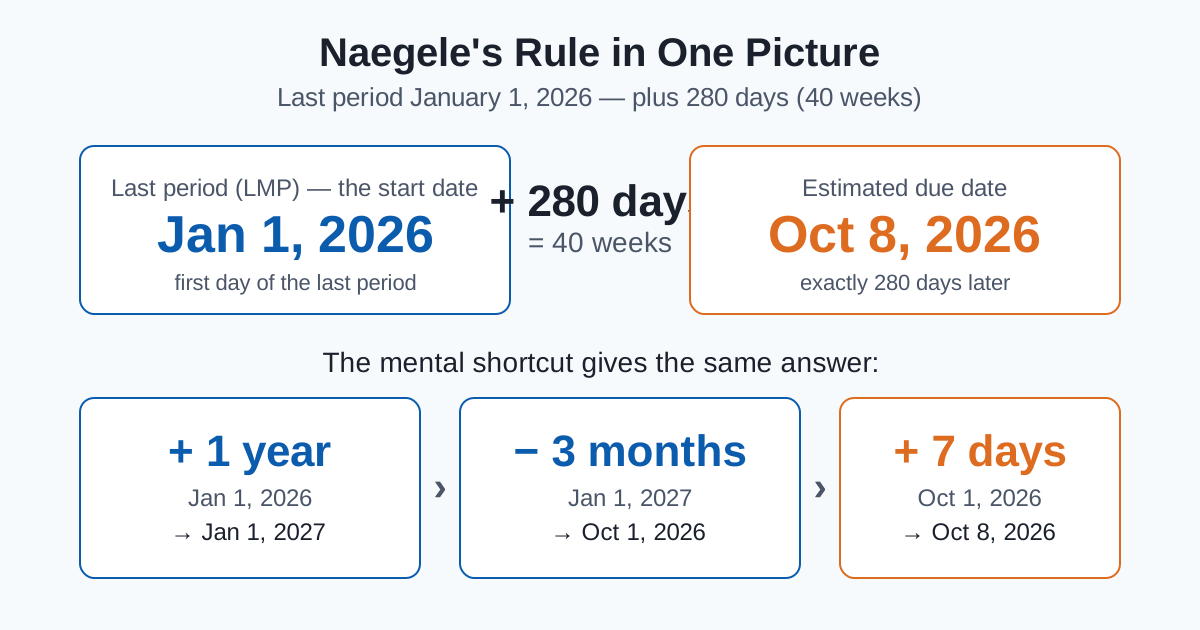
Due date = the first day of your last menstrual period + 280 days (40 weeks). That is Naegele's rule, the standard method in obstetrics since the 19th century.
Applied to a concrete example: with an LMP of January 1, 2026, the estimated due date is October 8, 2026 — exactly 280 days later. Run the same example through our Pregnancy Due Date Calculator and you get the identical result, along with the gestational age and trimester for any check-in date.
One framing note: pregnancy is measured from the last period, not from conception. "12 weeks pregnant" means 12 weeks since the LMP, even though the embryo has been developing for about 10 of them. This two-week offset is the single biggest source of confusion about due dates — see the mistakes section.
Naegele's rule, step by step
The rule has two equivalent forms: the 280-day addition and a mental shortcut that gives the same answer without counting days on a calendar.
Step 1: Identify the LMP — the first day of your last period (not the last day, and not the day you think conception happened). Everything anchors to this one date.
Step 2: Add 280 days — 40 full weeks.
Step 3 (the shortcut): add a year, subtract three months, add seven days. This classic mental version shows why the answer is not a round nine months:
- January 1, 2026 + 1 year → January 1, 2027
- − 3 months → October 1, 2026
- + 7 days → October 8, 2026
The same October 8, 2026. The shortcut is exact because nine calendar months are, on average, three months longer than 280 days — the "+7 days" corrects the drift.
Why 280 and not a round number? The rule assumes a 28-day cycle with ovulation around day 14. Fertilization in that ideal cycle happens roughly 14 days after the LMP, so the 280-day count quietly includes two weeks of "pregnancy" before conception. Conception itself sits about 266 days before the due date. That distinction matters the moment someone counts from the wrong starting line.
Worked example: January 1, 2026 → October 8, 2026
Let us run the full example the way the calculator does it — start date in, every output verified.
Input: LMP = January 1, 2026.
The due date: January 1, 2026 + 280 days = October 8, 2026. The shortcut arithmetic above confirms it independently: +1 year, −3 months, +7 days lands on the same day. Two routes, one answer — that agreement is how you know the rule was applied correctly.
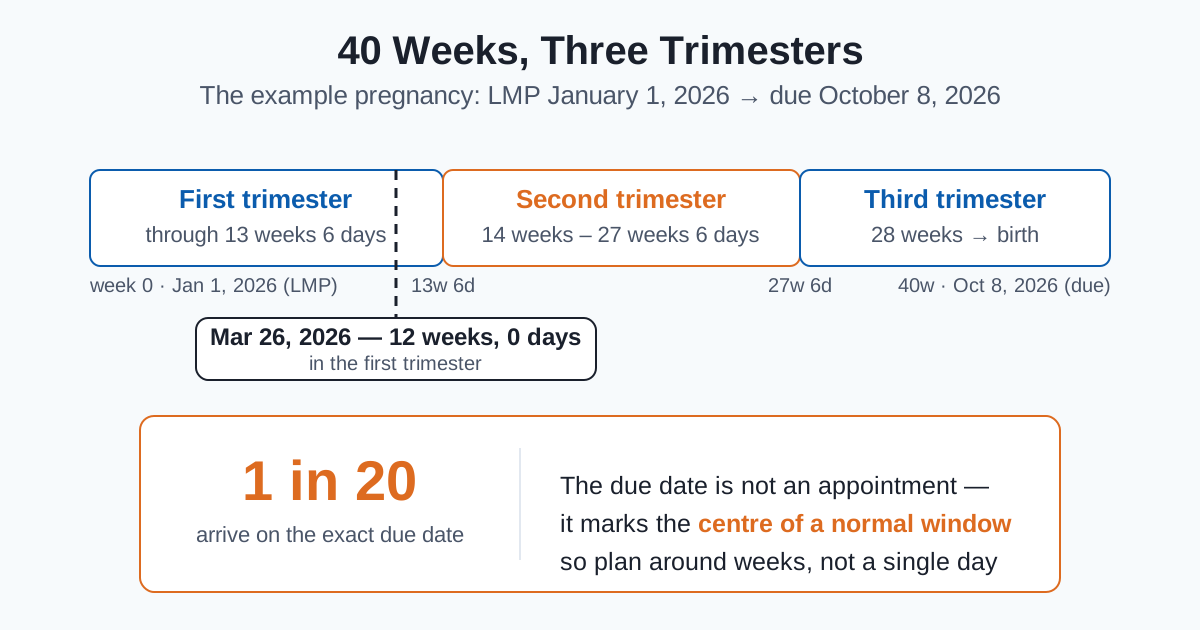
Gestational age on a check-in date: take March 26, 2026. From January 1 to March 26 is 84 days, and 84 ÷ 7 = 12 weeks, 0 days — squarely in the first trimester. This matches the calculator's own example output exactly, which is reassuring: the rule and the tool agree on every figure.
A second example, to show it is not a one-off: LMP of March 10, 2025 + 280 days = December 15, 2025. Same rule, same reliability. If your own dates are in hand, you can reproduce either example — or run your own — in the calculator rather than trusting anyone's mental arithmetic.
The trimester breakdown
The 40 weeks divide into three trimesters. The standard clinical boundaries, which the calculator uses in its own FAQs, are:
| Trimester | Weeks | In the example pregnancy |
|---|---|---|
| First | through 13 weeks 6 days | Jan 1, 2026 → early April 2026 |
| Second | 14 weeks to 27 weeks 6 days | early April 2026 → early July 2026 |
| Third | 28 weeks until birth | early July 2026 → Oct 8, 2026 |
The calculator rounds those boundaries to week 14 and week 28 in its trimester readout — which is why March 26 (12 weeks, 0 days) reports as first trimester. The boundaries are conventions for describing stages, not biological switch points.
As the weeks add up, expected weight gain rises with them. The Pregnancy Weight Gain Calculator maps the typical gain range week by week, so it pairs naturally with a due-date calculation: one tool answers "when," the other helps you track "how it is going" along the way.
What if your cycle is longer (or shorter) than 28 days?
Naegele's rule bakes in a 28-day cycle with ovulation on day 14. If your cycle runs longer, ovulation happens later, and the plain rule lands the due date too early.
The fix is simple: shift the LMP by the difference from 28 days. For a 32-day cycle, use an LMP four days later than the actual first day of bleeding — January 5 instead of January 1 in our example — then count 280 days from there. A 24-day cycle shifts the other way: use an LMP four days earlier. For genuinely irregular cycles, calendar adjustments stop being reliable, and clinicians usually lean on an early ultrasound date instead.
If you track your own cycle rather than assuming 28 days, the Ovulation Calculator estimates when ovulation usually falls in your cycle from your actual cycle length — that is the input that genuinely anchors the date when cycles run long or short.
Why your doctor may change your due date
It is common — and normal — for a clinician to revise an LMP-based due date after the first ultrasound, for two reasons. First, LMP recall is fuzzy: many people are unsure of the exact date, especially with irregular cycles or recent hormonal contraception, and a date nobody is sure of makes a shaky anchor. Second, ultrasound measures the embryo directly: in the first trimester, a crown-rump measurement dates the pregnancy more precisely than any calendar method, because early embryonic growth varies very little between pregnancies. The usual threshold is about a week — when the ultrasound estimate disagrees with the LMP date by more than that, the ultrasound wins.
This is the established clinical standard, not one clinic's preference — ACOG's committee opinion on estimating due dates lays out exactly when ultrasound should take precedence over the LMP date. When your doctor moves the date, it is the ultrasound doing the correcting, not the rule being wrong.
How accurate is the due date, really?
Here is the number to hold onto: only about 1 in 20 babies arrive on the exact due date. The date marks the centre of a normal window, not an appointment — most births fall in the couple of weeks on either side, which is exactly what you would expect from a 280-day estimate built on an assumed cycle and ovulation day. It still does its job: scheduling screenings, tracking growth against the right week, and planning maternity leave. Just plan around a window, not a single day.
Common mistakes
Mistake 1: Counting from conception instead of the LMP. Conception happens roughly 266 days before the due date — about 14 days after the LMP — so starting the 280-day count there lands you two weeks too late. To go from a due date back to an estimated conception date, use the Conception Calculator rather than guessing.
Mistake 2: Forcing the 28-day assumption onto irregular cycles. The rule assumes ovulation on day 14. With irregular or very long cycles the LMP alone can be off by weeks — precisely when an early ultrasound date is the better anchor.
Mistake 3: Treating the date as a deadline. The 1-in-20 statistic is the antidote. A due date that "passes" is not a failed calculation — it is the normal spread of a window centred on that date. Discuss timing concerns with your clinician rather than re-running the arithmetic hoping for a different answer.
Mistake 4: Mixing up gestational age and fetal age. "12 weeks pregnant" (gestational, from LMP) and "12 weeks of fetal development" (from conception) differ by about two weeks. Medical contexts always mean gestational age — when two sources seem to disagree by a fortnight, this is almost always why.
Frequently asked questions
Why 280 days and not 266?
Because the count starts at the last period — an observable, datable event — rather than at conception, which is never directly observed. The extra ~14 days are the follicular phase, the half-cycle between the period and ovulation; the 266-day and 280-day figures describe the same pregnancy from different starting lines.
What if my cycles are longer than 28 days?
Adjust the LMP by the difference before applying the rule: for a 32-day cycle, use an LMP four days later than the actual first day of bleeding. For cycles that are irregular rather than just long, ask your clinician about dating by early ultrasound, which does not depend on cycle assumptions at all.
Why did my doctor change my due date?
Because a first-trimester ultrasound measured the pregnancy directly and disagreed with the LMP-based date by more than about a week. Early ultrasound dating is more precise than calendar dating, so the revision is an upgrade in accuracy, not a warning sign.
How are trimesters divided?
First trimester through 13 weeks 6 days, second from 14 weeks to 27 weeks 6 days, third from 28 weeks until birth. Calculators often display these rounded to week 14 and week 28.
How accurate is the due date?
It is an estimate with a known spread: only about 1 in 20 babies arrive on the exact date. Think of it as the centre of a normal window of a few weeks, useful for scheduling care and tracking milestones, rather than a fixed appointment.
Conclusion: one date, two ways to check it
The whole calculation is one line — last period plus 280 days — with a mental shortcut (+1 year, −3 months, +7 days) for verifying it without a calendar. Both routes agree: January 1, 2026 gives October 8, 2026, and March 26 sits at 12 weeks, 0 days in the first trimester. Cycle length and ultrasound findings refine the estimate; the 1-in-20 reality keeps expectations honest.
Your next step: enter your own last period date into the Pregnancy Due Date Calculator to get your estimated due date, gestational age, and trimester in one pass — then bring the result to your clinician to confirm against your cycle history and any early ultrasound.