Calorie Deficit Explained: How Many Calories You Need to Lose Weight
"How many calories should I eat to lose weight?"
It is the single most searched question in weight loss, and the answer has not changed in decades: eat less than your body burns. The hard part is turning that sentence into a number you can actually use — a daily calorie target that is honest about how your body burns energy, how fast you can reasonably lose, and where the safety line sits.
That is what this guide builds from scratch: the two steps to your own number, one fully worked example with the calculator's own maths, the safety floors you must not cross, and the mistakes that stall almost everyone. Every figure below was computed with the same formula code our calorie calculator uses, so the example matches what you would get by typing those details in yourself.
A note on tone: this is general educational information about how the numbers work, not medical advice. If you have a medical condition, are pregnant, or are a teenager, talk to a clinician before setting a deficit.
The direct answer
A calorie deficit means eating fewer calories than your maintenance level — the number of calories your body needs each day just to stay the same weight. Create a deficit of 275–550 kcal per day below maintenance, and you lose weight at roughly 0.25–0.5 kg per week.
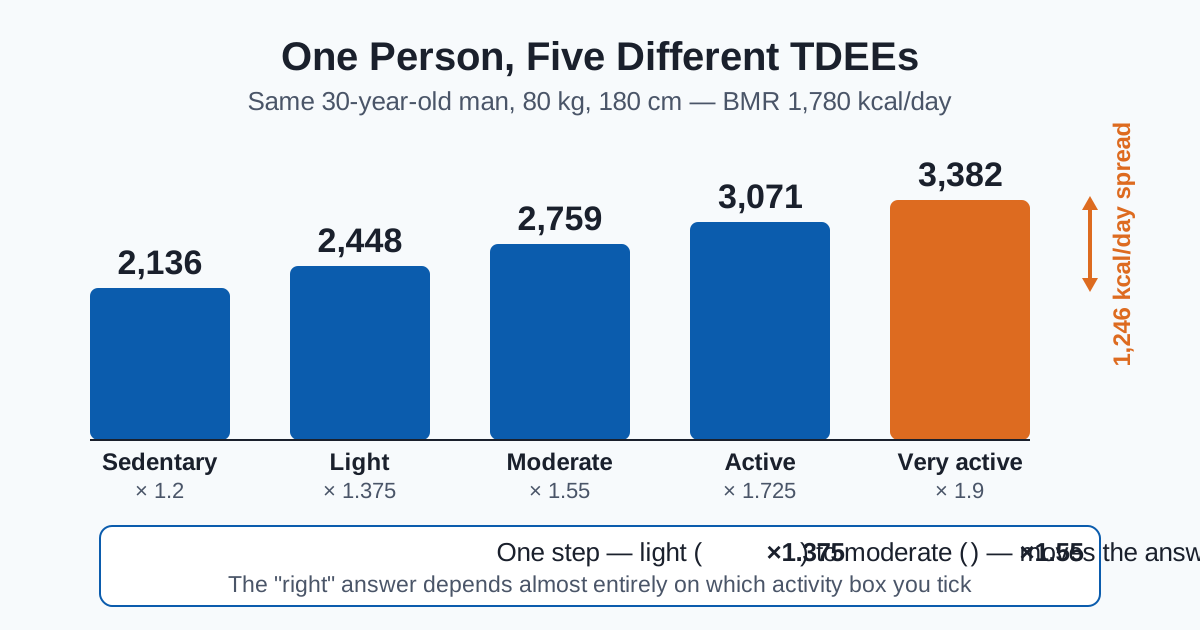
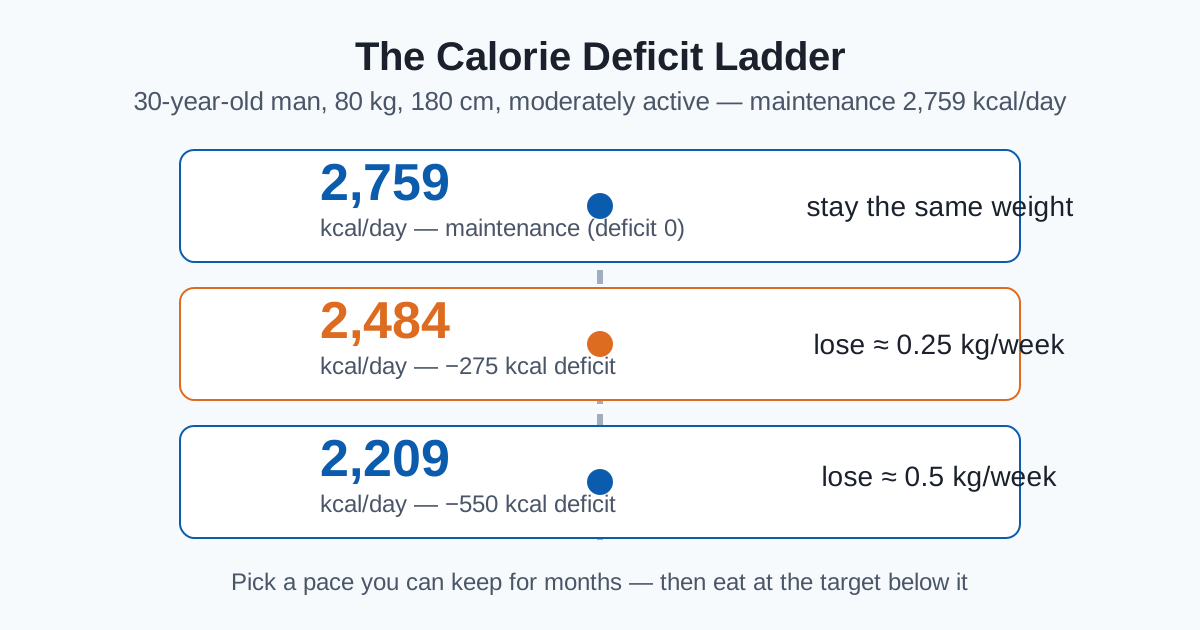
Here is the idea on one person, a 30-year-old man at 80 kg and 180 cm tall, who is moderately active. Our calorie calculator estimates his maintenance at 2,759 kcal/day. From that one number, his whole plan falls out:
- Maintain weight: eat about 2,759 kcal/day
- Lose ~0.25 kg/week: eat about 2,484 kcal/day (a 275 kcal deficit)
- Lose ~0.5 kg/week: eat about 2,209 kcal/day (a 550 kcal deficit)
That is the entire mechanism. The rest of this guide is how each number is earned — so you can check it and adapt it.
How the numbers are built: the two-part method
Every calorie target on this site is built from two parts: maintenance, then the deficit you subtract from it.
Part 1: finding maintenance
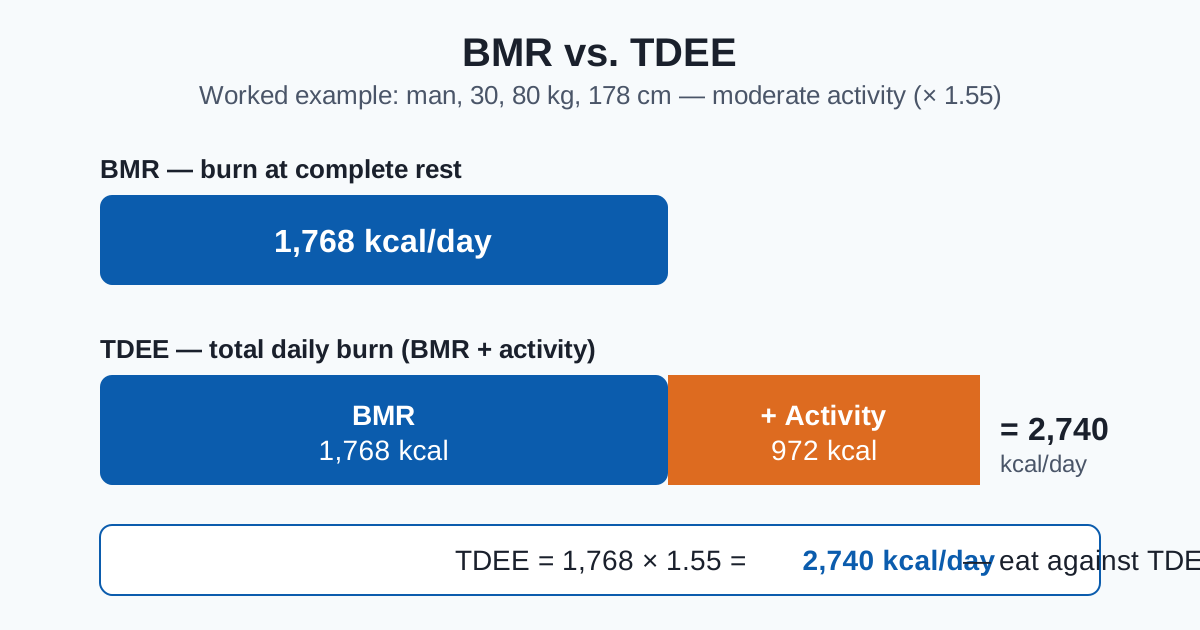
Maintenance (your total daily energy expenditure, or TDEE) is estimated in two sub-steps. First, your resting energy expenditure — what you burn at rest — is estimated from weight, height, age, and sex using the Mifflin-St Jeor equation, derived in the Mifflin-St Jeor study on PubMed from 498 measured subjects.
For the worked example: 10 × 80 + 6.25 × 180 − 5 × 30 + 5 = 1,780 kcal/day at rest.
Second, that resting figure is multiplied by an activity factor. "Moderately active" uses ×1.55, and 1,780 × 1.55 = 2,759 kcal/day — the maintenance figure from the direct answer, computed the same way the calculator computes it.
Part 2: the 7,700 kcal rule that turns a deficit into a weekly rate
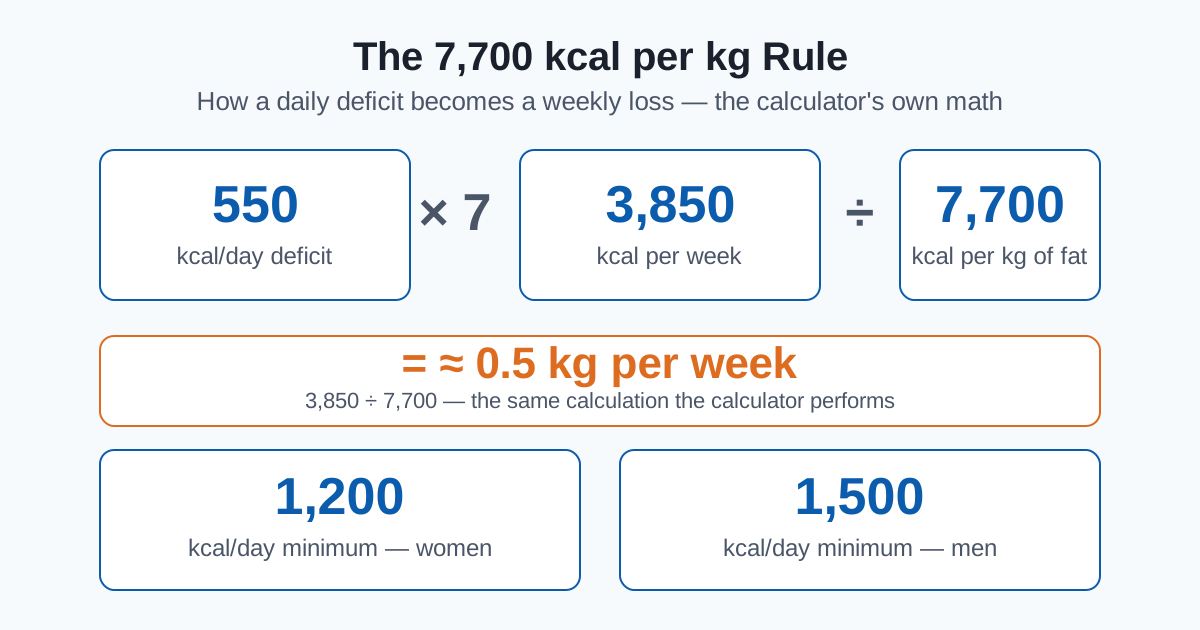
The calculator converts a daily deficit into an expected weekly loss using the long-established energy rule: 1 kg of body fat stores about 7,700 kcal. So the math for the standard deficit is:
550 kcal/day × 7 days = 3,850 kcal/week, and 3,850 ÷ 7,700 ≈ 0.5 kg/week.
It is an approximation, not a law: water retention, glycogen, digestion, and metabolic adaptation all blur the number from week to week. But it is the right order of magnitude, and it is what makes the ladder below work.
The worked example, step by step
Same person throughout: 30-year-old man, 80 kg, 180 cm, moderately active (×1.55). All three numbers come straight from the calculator's output for those inputs.
Step 1: get your maintenance
Run your details through a calorie or TDEE calculator — the TDEE calculator shows the same resting-plus-activity breakdown. For our example person, the result is 2,759 kcal/day. Without it, any target is guesswork.
Step 2: choose your weekly rate — and read off your target
| Goal | Daily deficit | Target |
|---|---|---|
| Maintain weight | 0 | 2,759 kcal/day |
| Lose ~0.25 kg/week | −275 kcal | 2,484 kcal/day |
| Lose ~0.5 kg/week | −550 kcal | 2,209 kcal/day |
This is the deficit ladder: pick the pace you can live with for months, then eat at the target below it. Most people land best on the moderate rung (0.25 kg a week) because it leaves room to eat normally, train, and stay consistent.
Step 3: split the target into macros
A calorie number tells you how much to eat; it says nothing about what to eat. The people who keep weight off tend to be the ones who protect protein and keep carbs and fat balanced — which is exactly what the macro calculator does with your new target, while the protein calculator gives you a per-day gram target from your body weight.
Why calculators give different numbers
If you have typed your stats into three calculators and got three answers, you are not doing anything wrong. The disagreements come from known sources: different resting-energy equations (Mifflin-St Jeor, Harris-Benedict, Katch-McArdle), different definitions of "moderately active", and rounding in the activity multipliers.
None of that makes calculators useless — it makes them starting estimates. To understand which part is yours to adjust, read our BMR vs TDEE explainer, and see how accurate are TDEE calculators for calibrating the estimate against your own scale data. The NIH's Body Weight Planner is also a useful independent comparison for any number this guide gives you.
The safety floors: the part that is not optional
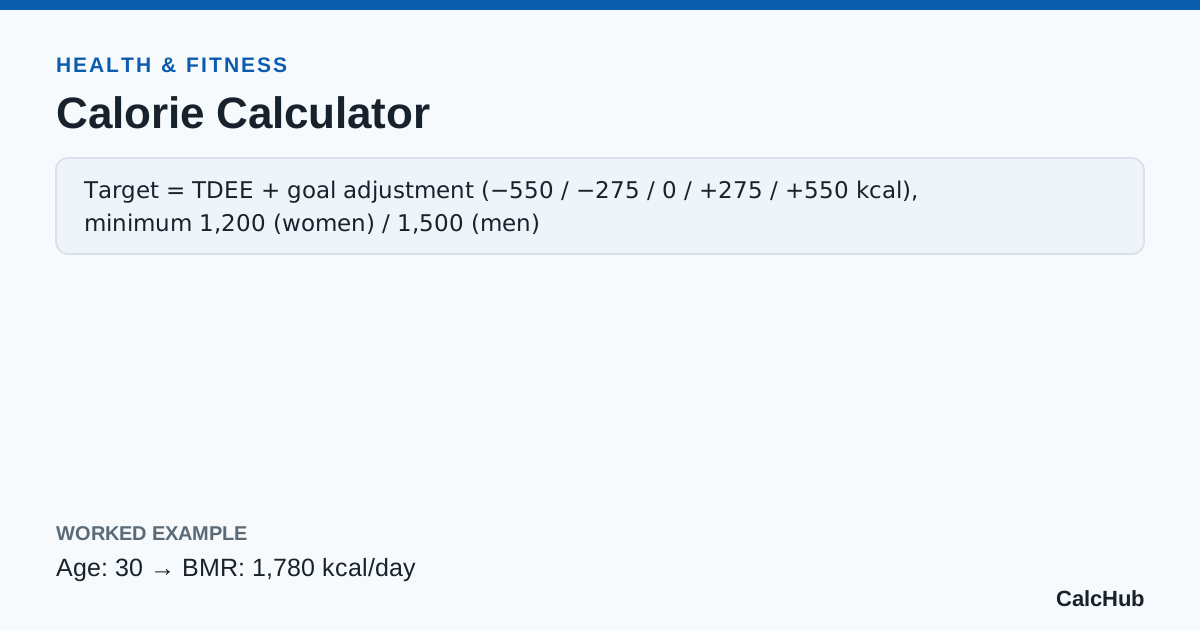
Every target this calculator produces is checked against hard minimums: 1,200 kcal/day for women and 1,500 kcal/day for men. The tool never sets a target below those lines, and neither should you.
The reason is unglamorous. Below those intakes, it becomes difficult to cover protein, essential fats, vitamins, and minerals, and the deficit stops being a plan and becomes a gamble — muscle loss, hormonal disruption, gallstones, and fatigue that ends the diet in a fortnight are all well-documented at crash-diet intakes. Targets below the floors are only safe under medical supervision. That is a safety boundary, not a challenge to test.
How to actually use your target
- Track intake honestly for 2–3 weeks. You do not need to weigh food forever, but you need a calibration period where logged intake and your scale agree. Estimate rather than measure and the deficit quietly disappears.
- Weigh under the same conditions (morning, after the bathroom) and watch the weekly average, not daily numbers. Daily swings of a kilo or more are water and food mass, not fat.
- Adjust from evidence. If the two-week average trend is flat while in deficit, the starting estimate was high for you — drop the target by 200 kcal and repeat. If you are losing faster than about 1% of body weight per week, eat a little more; speed is not the prize, sustainability is.
- Do not keep moving the goalposts weekly. Metabolic adaptation is slow; changing the target every three days just adds noise to the one signal you have.
Common mistakes
Mistake 1: setting the deficit too aggressive. Eating at a 1,000+ kcal deficit feels virtuous for a week and then collides with hunger, training quality, and sleep. Most rebounds start here. The ladder has a 0.25 kg rung for a reason.
Mistake 2: eating back "burned" exercise calories. Fitness trackers estimate exercise burn, and most people add those calories to dinner. The activity multiplier in your maintenance estimate already includes typical exercise — the calculator's own FAQ says exactly this — so adding tracker calories back on top double-counts the workout.
Mistake 3: ignoring the safety floors. A 550 kcal deficit sounds moderate until you realise the starting maintenance of a small, sedentary woman can be low enough that 550 below it lands under 1,200. Always check the absolute number, not just the size of the cut.
Mistake 4: changing nothing about the food. A deficit works on paper regardless of food quality, but 2,200 kcal of mostly sugar loses muscle and regains fast. Keep protein adequate, keep meals regular, and the same calorie target produces a much better body at the end.
Frequently asked questions
What deficit should I choose?
For most people, 275–550 kcal/day below maintenance — roughly 0.25–0.5 kg a week. New to tracking, training hard, or eating close to a normal diet already? Start at the smaller end (our example: 2,484 kcal/day). Have done this before and have plenty to lose? The larger end (2,209) is reasonable — but never below the 1,200/1,500 floors.
Why is 500 kcal a day the standard recommendation?
Because the arithmetic is clean: about 500 kcal/day × 7 days ≈ 3,500 kcal, roughly half a kilo of body fat on the 7,700 kcal-per-kg rule — and a cut most people can sustain for months. The calculator's exact figure for our example person is a 550 kcal deficit for the 0.5 kg/week rung.
How fast will I lose weight on a deficit?
About 0.25–0.5 kg per week at the deficits in the ladder. Week one is often faster — dropping carbs empties glycogen stores, and each gram of glycogen carries water with it, so 1–2 kg in week one is mostly water. Judge the plan on weeks two through four.
Why does the scale stall in week 1–2?
Water and glycogen mask fat loss on short timescales. A 550 kcal daily deficit burns roughly 0.07 kg of fat a day — invisible against daily water swings of a kilogram or more. Weigh daily, average weekly, and compare week averages across at least two weeks before concluding anything.
Is 1,200 kcal a day safe?
For most women it is the absolute floor, not a target — and for men the floor is 1,500. Either way, it is inadequate for athletes, teenagers, pregnant or breastfeeding women, and anyone with a medical condition. When in doubt, eat more and lose slower.
Should I recalculate my target as I lose weight?
Yes, roughly every 5–10 kg lost or every couple of months. A lighter body burns fewer calories at rest, so the same 2,209 target that produced a 550 kcal deficit at 80 kg becomes a smaller deficit at 72 kg. Re-running the calculator keeps the deficit real instead of letting the plan quietly stall.
Conclusion: find your number, then protect it
Your next step: enter your own age, weight, height, and activity level into the calorie calculator to get your maintenance, your deficit ladder, and your safety floors in one place — then start tracking against the target that fits your pace.
Related articles: /blog/bmr-vs-tdee, /blog/how-accurate-are-tdee-calculators