How Accurate Are TDEE Calculators? The Two Choices That Decide the Answer
Five calculators, five answers — and why that is expected
Type the same details into five different TDEE calculators and you can get five different answers, sometimes hundreds of calories apart. It is natural to distrust all of them at that point — if they cannot agree, how can any of them be accurate?
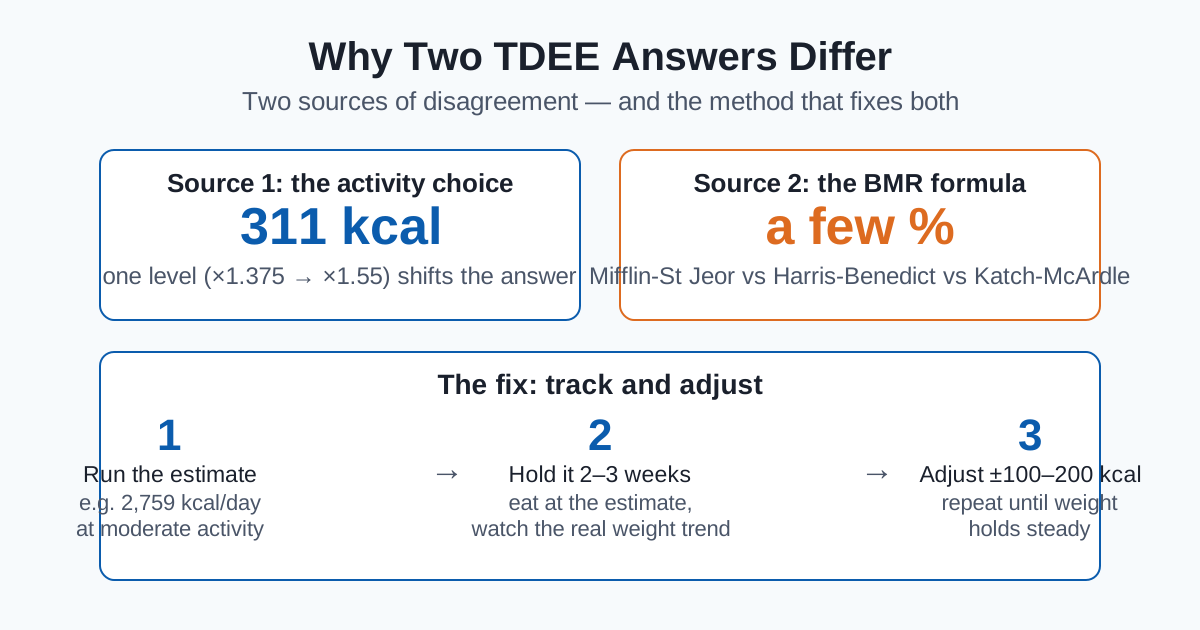
They can disagree without any of them being broken. A TDEE calculator's number is not measured from your body; it is estimated from two choices you make: the activity level you pick, and (behind the scenes) the BMR formula the tool uses. Change either choice and the answer moves. This guide shows exactly how much each choice moves the number, with one person's figures worked through every option — computed with the same formula code our TDEE calculator runs, so the example matches what you would see if you typed those details in yourself.
Related articles: /blog/bmr-vs-tdee, /blog/calorie-deficit-explained
The direct answer
TDEE calculators are accurate to roughly ±10% — if, and only if, the activity level is picked honestly. The calculator is not the weak link; the two choices that decide the number are:
- The activity multiplier you select. One person can get answers 1,246 kcal/day apart simply by choosing "sedentary" versus "very active". Picking one level too high is the single biggest source of error.
- The BMR formula the tool uses. Mifflin-St Jeor, Harris-Benedict, and Katch-McArdle differ by a few percent for the same person, which is why two tools can disagree even when the activity box is identical.
Treat the result as a well-calibrated starting estimate, not a measured value. The right way to use it is the track-and-adjust method below: run the number for two to three weeks, watch what your weight actually does, and correct in 100–200 kcal steps.
The formula: TDEE = BMR × activity
Every TDEE calculator does the same two-step computation:
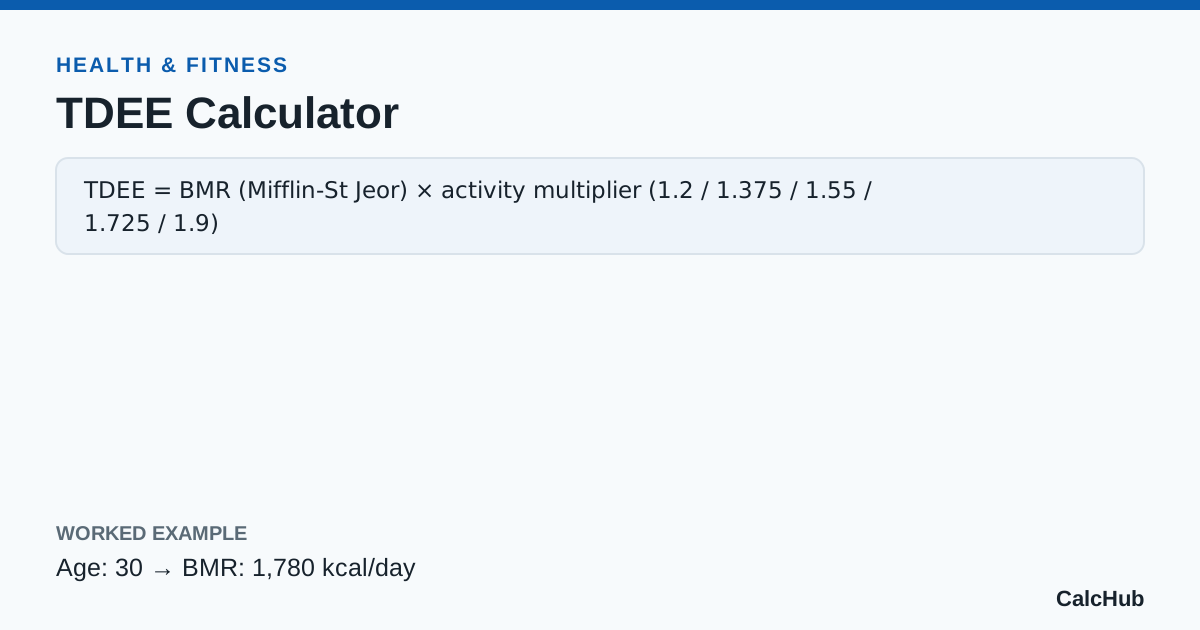
TDEE = BMR × activity multiplier
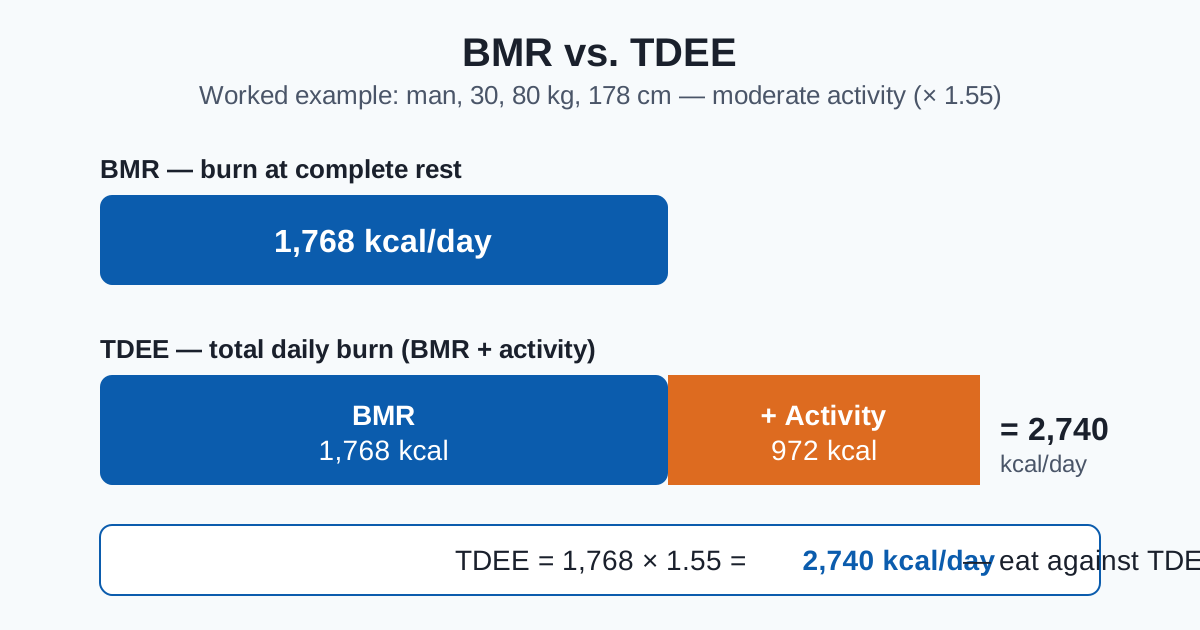
Step 1 estimates your basal metabolic rate — what your body burns at complete rest. Our tools use the Mifflin-St Jeor equation, published in 1990 and derived from measurements on 498 healthy subjects — see the original Mifflin-St Jeor study on PubMed. For men: BMR = 10 × weight(kg) + 6.25 × height(cm) − 5 × age + 5. You can see your own resting figure in the BMR Calculator.
Step 2 multiplies that by an activity factor meant to describe the whole day, not just workouts:
| Level | Multiplier | Rough meaning |
|---|---|---|
| Sedentary | × 1.2 | Desk job, little exercise |
| Light | × 1.375 | Light exercise 1–3 days/week |
| Moderate | × 1.55 | Moderate exercise 3–5 days/week |
| Active | × 1.725 | Hard exercise 6–7 days/week |
| Very active | × 1.9 | Very hard exercise + physical job |
If you want the full background on how BMR and TDEE relate, /blog/bmr-vs-tdee works through it with a different example.
Worked example: one person, five answers
Take a 30-year-old man, 80 kg, 180 cm tall. Step 1:
10 × 80 + 6.25 × 180 − 5 × 30 + 5 = 800 + 1,125 − 150 + 5 = 1,780 kcal/day BMR
Step 2, at each activity level:
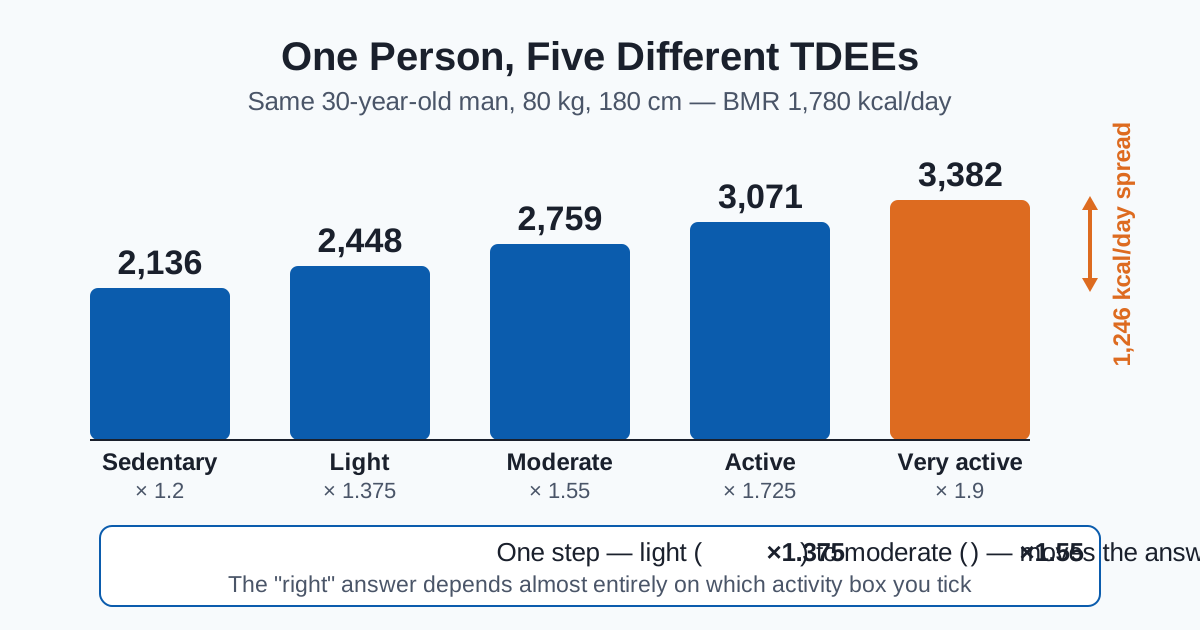
| Activity level | Multiplier | TDEE |
|---|---|---|
| Sedentary | × 1.2 | 2,136 |
| Light | × 1.375 | 2,447.5 (≈ 2,448) |
| Moderate | × 1.55 | 2,759 |
| Active | × 1.725 | 3,070.5 (≈ 3,071) |
| Very active | × 1.9 | 3,382 |
Read that column of answers as the proof of the whole article: the same person, with the same body, gets answers 1,246 kcal/day apart (3,382 − 2,136) depending on which activity box is ticked. Even moving a single level — light (×1.375) to moderate (×1.55) — shifts the answer by 311 kcal/day (2,759 − 2,448), roughly the calories in a full meal. When five calculators give five answers, this is almost always what happened: different people picked different activity levels, or the tools defaulted to different ones.
The two reasons different calculators disagree
Reason 1: the activity choice dwarfs everything else. The worked example shows the multiplier is the dominant input. It is also the most honestly answered input: the multiplier is meant to estimate the entire day — work, commute, chores, fidgeting — and most people answer it as if it only asked about gym sessions. A desk worker who runs three times a week is usually "light", not "moderate". Answering one level too high is the single biggest source of error in any TDEE estimate.
Reason 2: the BMR formula differs between tools. Not every calculator uses the same resting-rate equation. The Mifflin-St Jeor equation our site uses was derived from 498 healthy subjects and is the most widely validated for general use; the Harris-Benedict equations (1919, revised since) and the Katch-McArdle equation (which uses lean body mass) can land a few percent above or below for the same person. A few percent of a 1,780 kcal BMR is a few dozen calories — noticeable, but small next to the hundreds that a wrong activity level moves the needle.
Note what is not a reason for disagreement: rounding, or metric versus imperial units. Those change the answer by ones, not hundreds.
How to use the number anyway: track and adjust
Because the estimate is a starting point, the correct workflow is a short experiment, not a single calculation:
- Run the estimate. Take the TDEE for the activity level that honestly describes your whole week. For our example man at moderate activity, that is 2,759 kcal/day.
- Hold it for two to three weeks. Eat at the estimate and record your weight under consistent conditions (same time of day, similar routine).
- Adjust in 100–200 kcal steps. If weight holds steady, the estimate was right for maintenance. If it climbs, trim 100–200 kcal and repeat. If it falls and you wanted maintenance, add 100–200 kcal.
After one or two of these cycles, the number you are eating at is your TDEE — calibrated to your body, your job, and your actual routine. If you want an independent cross-check while doing this, the NIH's Body Weight Planner is the National Institute of Diabetes and Digestive and Kidney Diseases' own tool for building a personalised estimate. Once your maintenance number is settled, the Calorie Calculator applies a deficit or surplus to it for weight change, and the Macro Calculator splits the calories into protein, carbs, and fat targets.
One safety boundary from the calculator's own guidance: never target below roughly 1,200 kcal/day (women) or 1,500 kcal/day (men) without medical supervision — very low intakes need professional oversight.
Common mistakes
Mistake 1: Answering the activity question with workouts only. The multiplier covers the full 24 hours. A warehouse worker who never exercises can legitimately outscore a desk worker with a gym membership, because the desk worker sits for nine hours of the day.
Mistake 2: Choosing "very active" for a desk job. "Very active" means very hard daily exercise plus a physical job. It is the least honestly applicable level and the most commonly ticked one. When in doubt, pick the lower of the two levels you are torn between.
Mistake 3: Treating the number as measured. A TDEE calculator never measured anything from your body — it estimated from population equations. ±10% around the estimate is normal; a number like 2,759 means "somewhere in the 2,500s", not "exactly 2,759".
Mistake 4: Adding exercise calories on top. The activity multiplier already includes typical exercise at that level. Logging a workout separately and eating those calories back is double-counting.
Mistake 5: Changing the target after three days. Weight swings with water, glycogen, and meals — three days of data is noise. Two to three weeks is the minimum before an adjustment means anything.
Frequently asked questions
Why do different TDEE calculators disagree with each other?
For two reasons: different activity levels selected (or defaulted), and different BMR formulas underneath. The activity choice alone can swing one person's answer by 1,246 kcal/day; the formula choice adds a few percent on top. Two tools that both say "moderate" should agree within a small margin.
Which activity level should I choose?
The one that describes your whole week, averaged. Count your job, commute, chores, and workouts together. Most office workers fall at sedentary or light even with regular gym visits, because the seated hours dominate. A level you can defend for an average week is more useful than a level that describes your best week.
How accurate is the Mifflin-St Jeor formula?
It is the best-validated of the common equations for general use — derived from 498 measured subjects and checked against indirect calorimetry. Expect individual estimates to land within about ±10% of measured values; body composition differences (more or less muscle than average) are the main reason someone falls outside that band.
Should I eat back exercise calories?
No — not when you are using a TDEE estimate. The activity multiplier already accounts for exercise typical of that level, so adding logged workout calories on top double-counts them. If your routine genuinely exceeds what your chosen level describes, the fix is to move up one activity level, not to bolt exercise calories onto the result.
What if my weight doesn't do what the estimate predicts after three weeks?
Then the estimate was wrong for you, and three weeks of your own data is worth more than any calculator's. Adjust the intake by 100–200 kcal in the direction the scale demands and repeat. After one or two such corrections, the number is calibrated to your body.
Is TDEE the same as maintenance calories?
Practically, yes. TDEE is the estimate of everything you burn in a day; eating at TDEE should hold your weight steady, which is the definition of maintenance calories. From there, a fat-loss target is TDEE minus a deficit — /blog/calorie-deficit-explained builds that number step by step.
Conclusion: honest activity, then calibrate
TDEE calculators are accurate to about ±10% when the activity level is chosen honestly — and the same person can get answers 1,246 kcal/day apart by choosing it dishonestly, which is why five calculators give five answers. The number that matters is not the one the tool prints; it is the one your weight trend confirms after two to three weeks of the track-and-adjust method, corrected in 100–200 kcal steps.
Your next step: run your own details through the TDEE calculator, pick the activity level that describes your whole week — not just your workouts — and start the three-week check. That is how a ±10% estimate becomes your personal number.