BMR vs. TDEE: What's the Difference (and Which Number Should You Use?)
Two numbers, one common mix-up
If you have ever tried to work out how many calories you should eat, you have probably run into two numbers that sound almost identical: BMR and TDEE. They are often shown side by side by calculators, sometimes only a few hundred calories apart and sometimes more than a thousand apart, with little explanation of which one you are actually supposed to use.
Picking the wrong one matters. Eat to the lower number when you should be using the higher one, and you will likely feel constantly hungry and tired. Eat to the higher number when you meant to lose weight, and progress can stall for reasons that are hard to spot. This guide explains what each number means, how both are calculated, and which one to use in practice.
This article is educational only and is not personal medical advice. If you have a medical condition, are pregnant, or have a history of disordered eating, talk to a qualified health professional before changing how you eat.
The direct answer
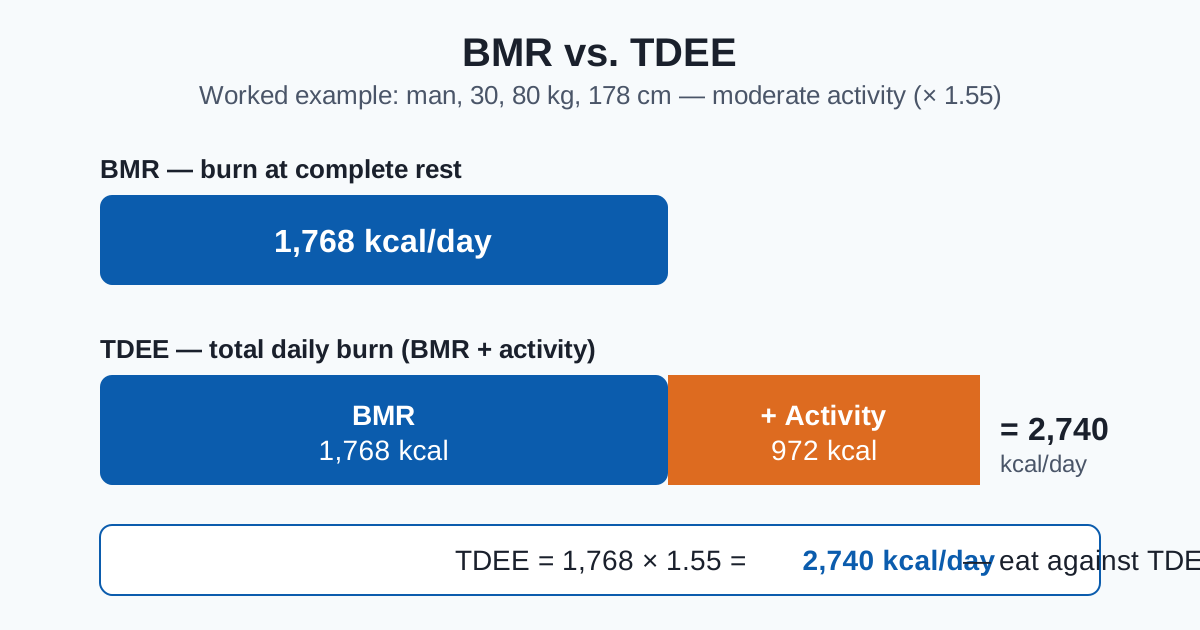
BMR (basal metabolic rate) is the energy your body uses at complete rest, just to keep basic functions running — breathing, circulation, temperature regulation, and cell repair. It does not include walking, working, exercising, or even digesting food.
TDEE (total daily energy expenditure) is your BMR plus everything else you do in a day. It is an estimate of your total daily calorie burn, including activity.
The practical rule is simple:
- You eat against TDEE, not BMR. TDEE is the number that represents your real day.
- BMR is the starting point for the calculation, and a useful reference for understanding how much of your burn happens before you move at all.
Eating below your BMR for a long period is not the intended use of either number. If your goal involves a calorie target below or near your BMR, that is a sign to slow down and get professional guidance rather than pushing ahead on your own.
Step by step: how the two numbers connect
You do not calculate TDEE from scratch. You calculate it in two stages:
- Calculate BMR from your weight, height, age, and sex using an equation.
- Multiply BMR by an activity multiplier that reflects how active your typical day and week are.
- Use the resulting TDEE as your estimated maintenance level — the intake at which your weight would be expected to stay roughly stable, on average.
- Adjust from real results over the following weeks (more on this below, because it is the step most people skip).
You can run both stages in seconds with the TDEE calculator, or calculate the first stage on its own with the BMR calculator. The sections below show the work behind those tools, in line with how CalcHub calculators show their work.
The formulas
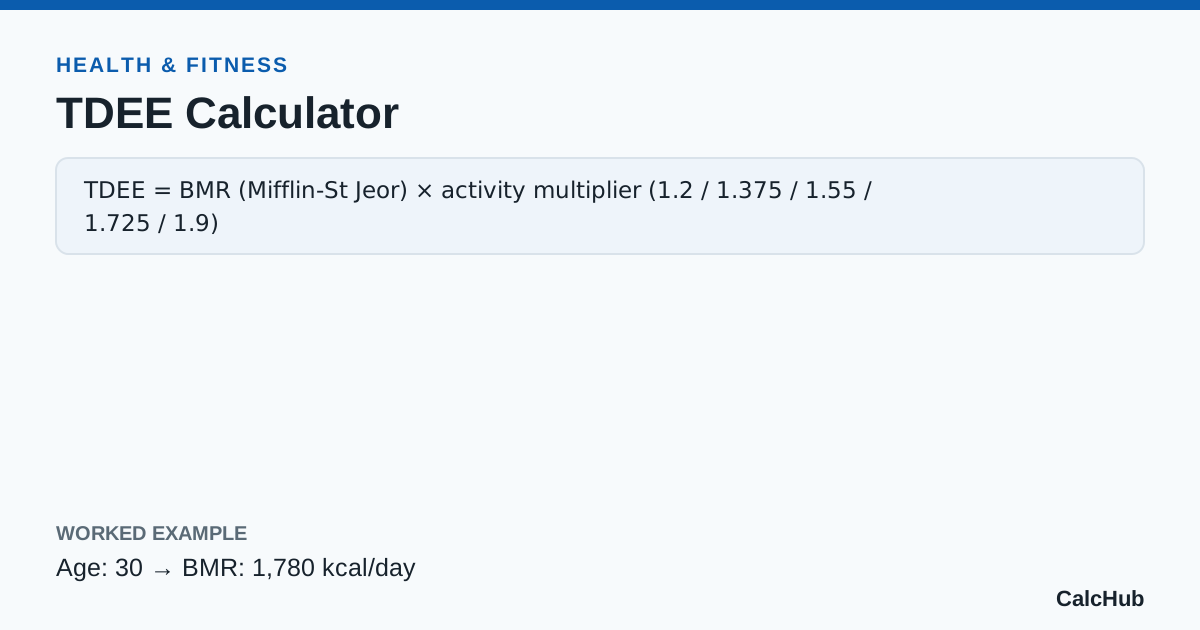
Both of the calculators linked above use the Mifflin-St Jeor equation, a widely used formula for estimating BMR.
For men:
BMR = 10 × weight (kg) + 6.25 × height (cm) − 5 × age (years) + 5
For women:
BMR = 10 × weight (kg) + 6.25 × height (cm) − 5 × age (years) − 161
The only difference between the two versions is the final constant: +5 for men and −161 for women.
Once you have BMR, TDEE is:
TDEE = BMR × activity multiplier
| Activity level | Multiplier | What it generally describes |
|---|---|---|
| Sedentary | 1.2 | Desk-based day, little or no exercise |
| Light | 1.375 | Light exercise or an active job a few days a week |
| Moderate | 1.55 | Moderate exercise most days |
| Active | 1.725 | Hard exercise or a physically demanding job most days |
| Very active | 1.9 | Very hard daily exercise, a physical job plus training, or both |
These multipliers are conventions, not measurements of your individual day. Treat the descriptions as rough guides for choosing the closest match, not as exact definitions.
Worked examples
Example 1: BMR for a man
A man, age 30, weighing 80 kg, 178 cm tall:
BMR = 10 × 80 + 6.25 × 178 − 5 × 30 + 5 BMR = 800 + 1,112.5 − 150 + 5 BMR = 1,767.5, or about 1,768 kcal/day
That is his estimated burn at complete rest, before any activity is counted.
Example 2: BMR for a woman
A woman, age 30, weighing 65 kg, 165 cm tall:
BMR = 10 × 65 + 6.25 × 165 − 5 × 30 − 161 BMR = 650 + 1,031.25 − 150 − 161 BMR = 1,370.25, or about 1,370 kcal/day
Example 3: From BMR to TDEE
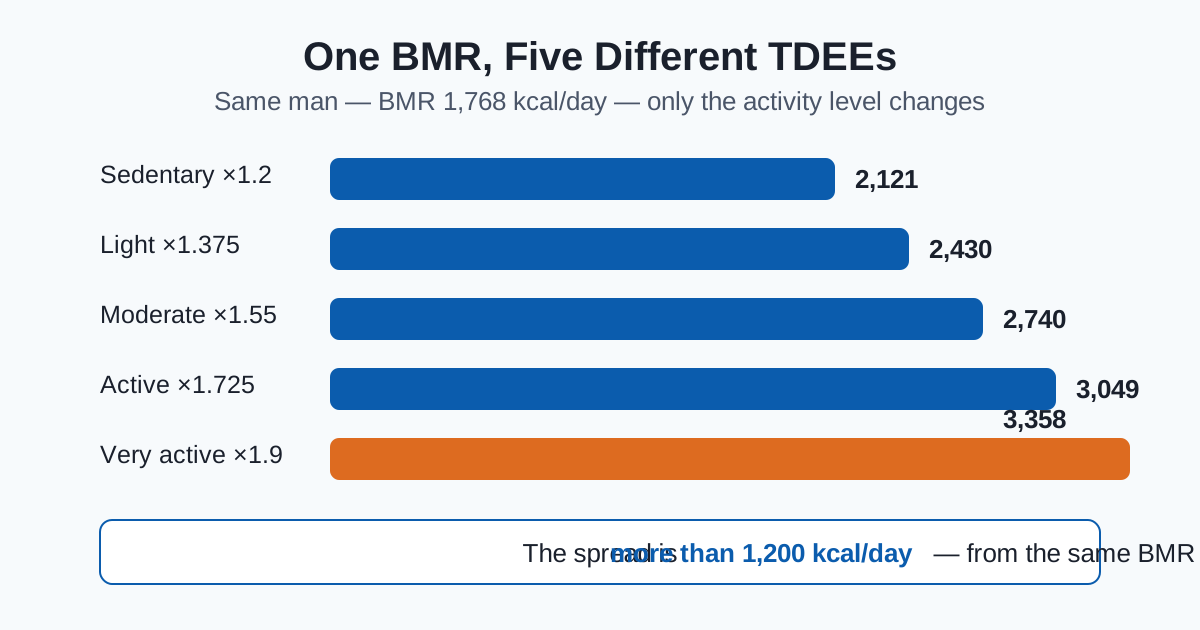
Using the man's BMR of about 1,768 kcal/day from Example 1, here is what each activity level gives:
| Activity level | Calculation | TDEE (kcal/day) |
|---|---|---|
| Sedentary (× 1.2) | 1,768 × 1.2 | 2,121 |
| Light (× 1.375) | 1,768 × 1.375 | 2,430 |
| Moderate (× 1.55) | 1,768 × 1.55 | 2,740 |
| Active (× 1.725) | 1,768 × 1.725 | 3,049 |
| Very active (× 1.9) | 1,768 × 1.9 | 3,358 |
Notice the spread. The same person, with the same BMR, has an estimated TDEE anywhere from about 2,121 to 3,358 kcal/day depending on activity. That gap of more than 1,200 kcal/day is exactly why confusing BMR with TDEE leads to such misleading calorie targets.
Once you have a TDEE estimate, the calorie calculator can help you explore what different goals would mean relative to that maintenance level. For background on how deficits work, see calorie deficit explained.
Which number should you use?
For everyday eating decisions, use TDEE. It is the only one of the two that reflects a real day that includes moving, working, and living. If your weight is stable at your current intake, your true maintenance is likely somewhere near your estimated TDEE.
Use BMR as context. It helps you understand the floor of your energy needs and why TDEE changes so much with activity. It is also the input every TDEE estimate is built on, so an error in BMR carries through to TDEE.
A sensible way to use both:
- Calculate your BMR.
- Calculate your TDEE with the activity level that best matches your typical week — not your most active day.
- Treat that TDEE as a starting estimate for maintenance.
- Track your actual weight trend for 2–3 weeks at a consistent intake, then adjust the number up or down based on what really happened.
Common mistakes and limitations
Mistake 1: Eating to your BMR by accident. Some calculators display BMR prominently, and it is easy to mistake it for a daily eating target. For most people it will be far below what an active day requires.
Mistake 2: Picking an activity level based on your best week. One hard training week does not make you "very active" if the other three weeks of the month are sedentary. Choose the level that matches your average week.
Mistake 3: Treating the result as exact. The Mifflin-St Jeor equation estimates a population average. Two people with the same weight, height, age, and sex can have genuinely different energy needs because of differences the formula cannot see, including body composition and day-to-day activity that does not fit neatly into one multiplier. This is not a flaw in your arithmetic — it is a limit of any formula-based estimate.
Limitation: one-shot numbers deserve scepticism. It is reasonable to distrust any calculator that presents a single figure as if it were measured from your body. It was not measured; it was estimated. For a deeper look at this, read how accurate are TDEE calculators.
The honest method is the validation step: use the estimate as a starting point, hold your intake reasonably steady, watch the weight trend over 2–3 weeks rather than day to day, and adjust your working TDEE based on that trend. Your own data, collected consistently, is more useful than any refinement to the formula. The same estimate-test-adjust approach is built into the NIH's Body Weight Planner, developed by NIDDK researchers to model how calorie needs change over time.
Limitation: life changes the inputs. Weight change, a new job, an injury, or a change in training all change your real TDEE. Recalculate when your circumstances change materially, rather than relying on a number from months ago.
Frequently asked questions
Should I eat my BMR or my TDEE?
For normal daily eating, use TDEE as your reference point, because it includes your activity. BMR covers rest only. Eating at exactly your BMR while living a normal active day means eating well below your total burn, which is not what either number is designed for.
Can TDEE be lower than BMR?
No. TDEE is BMR multiplied by a factor of 1.2 or more, so TDEE is always higher than BMR in this method. If a tool shows you a "daily calories" figure below your BMR, you are probably looking at a goal-adjusted target rather than TDEE itself — check the label carefully.
How accurate is the Mifflin-St Jeor equation?
It is an estimate of an average, not a measurement of you personally. It is a reasonable starting point for many adults, but individual results vary. That is why the recommended approach is to start with the estimate and then correct it using 2–3 weeks of your own weight trend at a consistent intake.
Which activity multiplier should I choose if I am between levels?
Choose the lower one if you are unsure, then let your 2–3 week weight trend tell you whether to adjust. It is easier to correct a slightly conservative starting point with real data than to guess high and wonder why nothing is changing.
Do I need to recalculate BMR and TDEE as my weight changes?
Yes, periodically. Because weight is an input to the BMR formula, a meaningful change in weight changes both numbers. Recalculating after a substantial change — and re-validating against your recent weight trend — keeps your working numbers grounded.
Is it safe to eat below my BMR to lose weight faster?
Eating below BMR long-term is not the intended use of these numbers, and faster is not automatically better. This article cannot advise you on a personal target. If you are considering a low intake, or if eating changes are affecting your health or wellbeing, speak to a qualified health professional first.
Conclusion: use TDEE, respect BMR, then verify
BMR is what your body burns at complete rest. TDEE is that figure scaled for the life you actually live, and TDEE is the number to eat against. Neither figure is exact — both are estimates built to give you a sensible starting point.
Your next step: run your numbers in the TDEE calculator, note the activity level you chose, and then do the part that makes the number trustworthy — compare it with your real weight trend over the next 2–3 weeks and adjust. That loop of estimate, test, and adjust is worth more than any single calculation. For the weight measure that sits behind many of these numbers, our guide BMI explained covers what BMI can and cannot tell you.