How Much Do I Need to Retire? The 25x Rule, the 4% Rule, and a Worked Example
The question that keeps people up at night
"How much do I need to retire?" is one of the most searched finance questions in the world, and for good reason: the number feels unknowable. Your income, spending, age, and the decades of market returns between now and your last day at work all seem to pull in different directions. Most people either guess wildly or avoid the question entirely.
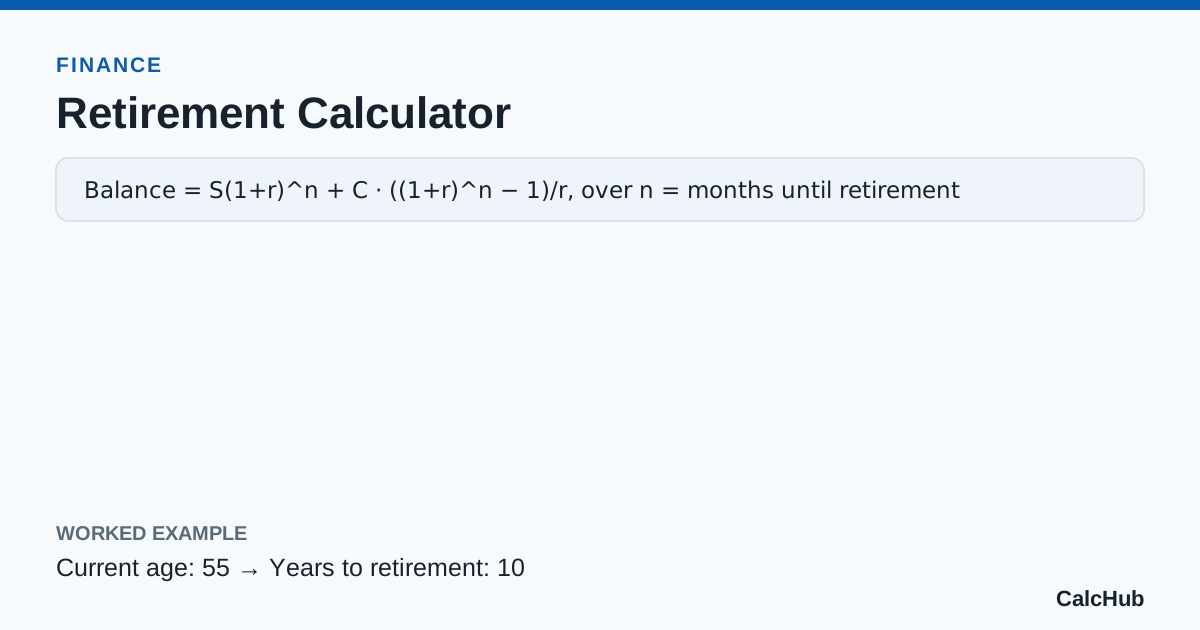
The good news is that you don't need a perfect answer to start planning. Retirement planners use a simple rule of thumb — the 25x rule — that turns your yearly spending into a concrete savings target in one line of arithmetic. This guide gives you that answer first, then shows exactly how the numbers work with a fully worked example: what $500 a month becomes when you start at 25 versus 45, computed with the site's own retirement formula. You can plug in your own numbers in the retirement calculator and see your own version of this example.
The direct answer: the 25x rule
The standard rule of thumb is this: aim to save 25 times your annual spending in retirement.
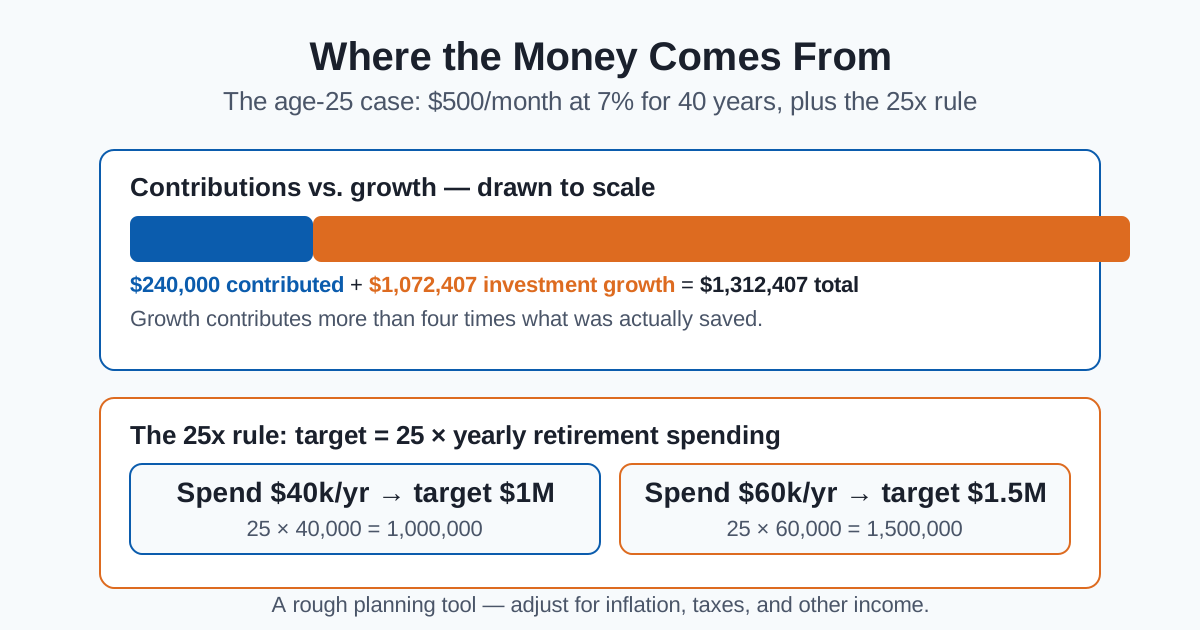
- Plan to spend $40,000 a year in retirement → target 25 × $40,000 = $1,000,000.
- Plan to spend $60,000 a year in retirement → target 25 × $60,000 = $1,500,000.
That's the whole rule. Estimate what you'd spend in a year of retirement — housing, food, transport, healthcare, a little fun — multiply by 25, and you have a target to start working toward. It's a rough planning tool, not a forecast, but you can refine it with your real figures in the retirement calculator.
Why 25? The 4% rule behind it
The 25x rule comes from the well-known 4% rule: the idea that you can withdraw about 4% of your savings each year in retirement, adjusted for inflation, and expect the portfolio to last roughly 30 years. The math is a simple inversion — 1 ÷ 0.04 = 25 — so needing 4% withdrawals each year means needing 25 years' worth of spending saved up.
A $1,000,000 portfolio at a 4% withdrawal rate produces $40,000 a year. A $1,500,000 portfolio produces $60,000 a year. The 4% figure itself comes from retirement research studying how portfolios behaved across decades of market history, including bad periods. It is a guideline, not a guarantee — market returns, inflation, and how long you live all move the real safe withdrawal rate around. Treat the 25x target as your compass, not your contract.
The worked example: $500 a month from age 25 vs 45
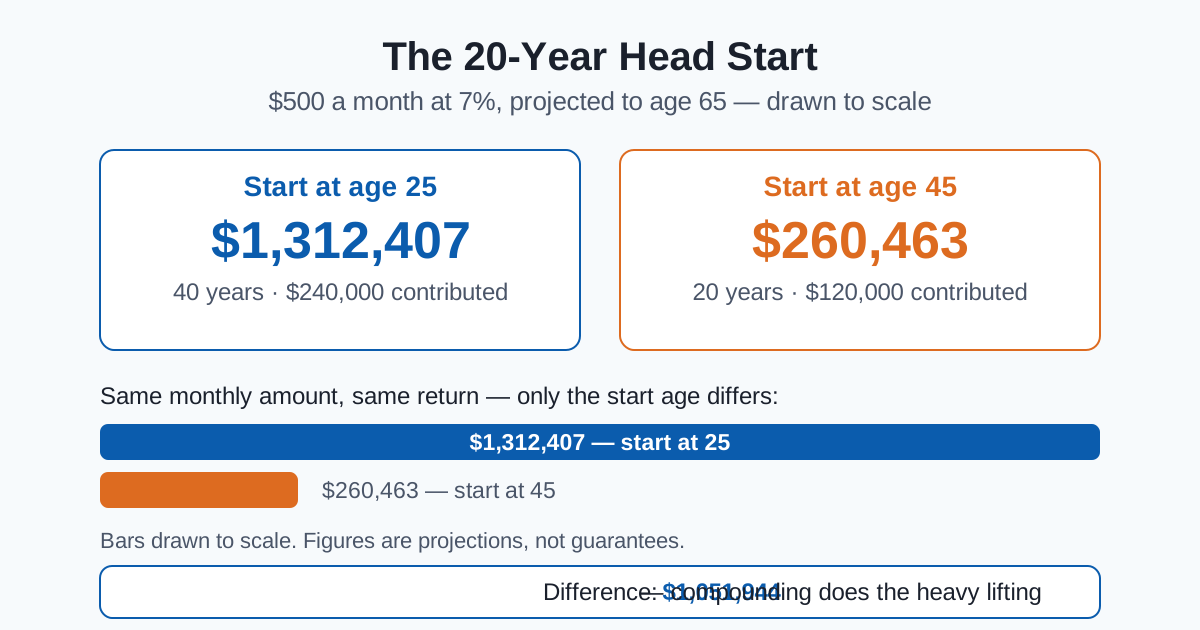
Here's where the abstract becomes concrete. Take two savers. Both put away $500 a month and earn an average 7% annual return. The only difference: one starts at age 25, the other at age 45. Both retire at 65.
| Start at 25 | Start at 45 | |
|---|---|---|
| Years of saving | 40 | 20 |
| Total contributed | $240,000 | $120,000 |
| Projected at 65 (7%) | $1,312,407 | $260,463 |
| Of which is growth | $1,072,407 | $140,463 |
The early starter projects over five times the savings — $1,312,407 versus $260,463 — from contributions that are only double. The 20-year head start turns $120,000 of extra contributions into over $1,000,000 of extra projected savings. That difference is almost entirely compounding: growth earning growth, year after year.
To see compounding in its purest form: $10,000 growing at 10% for 10 years, with no further contributions, becomes $27,070 — $17,070 of pure growth on a single deposit, per the retirement calculator. Now imagine that effect running for 40 years with fresh money added every month.
In the age-25 example, investment growth contributes more than four times the amount actually saved — and the 25x rule turns a yearly spending figure into a concrete savings target.
A few honest caveats before you run with these figures. Projections from the calculator come out in nominal dollars — they are not inflation-adjusted, so mentally subtract 2–3% of inflation a year when judging what the number really buys. The projection is an estimate, not a guarantee, and past performance doesn't guarantee future results. The 7% figure used here is a planning assumption, not a promise.
What the numbers teach: starting early beats saving more later
The uncomfortable lesson of the table above is that time is the most powerful input in retirement saving — more powerful than how much you contribute each month. The 45-year-old could double the contribution to $1,000 a month and still land around $521,000 — less than half of what the 25-year-old reaches at $500 a month.
That's because every dollar invested early gets more years of compounding. A dollar saved at 25 has 40 years to multiply; a dollar saved at 45 has only 20. This is why retirement growth is compound interest, and it's worth understanding that mechanism properly — our guide on how compound interest works walks through exactly how growth-on-growth accelerates over long periods. The compound interest calculator lets you isolate the compounding effect itself, stripping away the monthly contributions so you can watch a single sum grow.
Adjusting the three inputs to your own situation
The example used one contribution, one return, and one retirement age. Your numbers will differ, and three inputs control almost everything:
1. Your contribution. The input you control completely. Raise the monthly amount and the projection scales roughly in proportion — doubling $500 to $1,000 a month at the same 7% roughly doubles the result. For irregular saving — a lump sum plus yearly top-ups, or contributions stepped up over time — the savings calculator handles those shapes.
2. Your assumed return. Return matters enormously over decades, but it's the input you control least. A portfolio tilted toward stocks has historically returned more than a conservative one, with far more volatility along the way. The ROI calculator is the right tool for sanity-checking a return assumption against an actual past investment — if you're assuming 9% going forward, check what your money has really been doing.
3. Your retirement age. Retiring later is brutally effective: each extra year means another year of contributions and another year of compounding on the whole balance. Someone who works from 65 to 67 doesn't just add two years of deposits — they add two years of growth on a balance that's already large. Run the calculator at 62, 65, and 67 to see the spread.
Once you've picked your inputs, work backwards from the 25x target. If your spending target is $50,000 a year, you need roughly $1,250,000 — enter your figures and see whether the projection clears it, then adjust the contribution or timeline until it does.
Common mistakes and limitations
Mistake 1: Ignoring inflation. This is the most common error in retirement planning. A projection of $1,312,407 in nominal dollars 40 years from now buys far less than $1,312,407 buys today. At 2–3% annual inflation, prices roughly double every 24–36 years. Always think of your target in terms of what it will buy, not the raw number.
Mistake 2: Assuming the return is guaranteed. A 7% assumption is a long-run planning average, not a promise written into your account. Real markets deliver returns in a jagged line — strong years, flat years, and painful drawdowns. Run your numbers at 5% and 9% too, so you know the range of outcomes you're planning around.
Mistake 3: Forgetting Social Security and taxes. Your savings don't have to cover all your spending alone — Social Security is a separate income source that reduces what your portfolio must produce. Use Social Security's retirement estimator to see your likely benefit at different claiming ages, and subtract it from your spending target before applying the 25x rule. On the tax side, withdrawals from traditional retirement accounts are generally taxed as income — learn the rules of tax-advantaged accounts from the IRS's retirement plans resource so the tax bite doesn't surprise you.
Mistake 4: Treating the 25x target as finished. The rule assumes about a 30-year retirement and a standard spending pattern. Retire at 55, expect a longer life, or plan for major healthcare costs, and you may need a larger cushion. Revisit the target whenever your life changes — a new job, a new city, a new health reality.
Frequently asked questions
What is the 25x rule?
Save 25 times your expected annual spending in retirement. If you'll spend $40,000 a year, your target is $1,000,000. It's the standard planning shortcut, derived from the 4% withdrawal rule (1 ÷ 0.04 = 25).
What return should I assume for retirement planning?
Many planners use 6–8% nominal for a stock-heavy portfolio over long horizons, then note that inflation eats 2–3% of it. The honest answer: pick a conservative assumption you can live with, and check the result at a lower return too, so one bad decade doesn't wreck the plan.
Does this account for inflation?
The calculator's projections are in nominal dollars — not inflation-adjusted. Mentally subtract 2–3% of annual inflation, or equivalently, reduce your assumed return by the inflation rate to get a "real" projection.
What if I'm starting at 45 — is it too late?
No — but the math asks more of you. At $500 a month and 7%, starting at 45 projects about $260,463 at 65. To close the gap: contribute more each month, consider working a few years longer (compounding on a large balance is powerful), and estimate your Social Security benefit, which covers part of the target.
How does the 4% rule relate to the 25x rule?
They're two faces of the same idea. The 4% rule says you can withdraw about 4% of savings yearly in retirement; the 25x rule says to save 25 times your yearly spending. Since 1 ÷ 0.04 = 25, one implies the other.
Should I count Social Security in my target?
Yes — subtract your estimated Social Security benefit from your yearly spending before multiplying by 25. If you spend $50,000 a year but expect $20,000 from Social Security, your portfolio only needs to produce $30,000 — a 25x target of $750,000, not $1,250,000.
Conclusion: get your number, then get to work
The question "how much do I need to retire" has a real answer: 25 times your yearly spending, adjusted for inflation, taxes, and the Social Security income you can count on. And the example proves the uncomfortable part: when you start matters more than how much you start with. Twenty extra years of compounding turned identical monthly habits into a million-dollar difference.
Your next step: open the retirement calculator, enter your current age, monthly contribution, and expected return, and compare your projection against your 25x target. If it falls short, you now know the three levers — save more, earn a bit more, or retire a bit later — and exactly how much each one moves the number.