How Loan Payments Are Calculated: The Amortization Formula Explained
Why the same payment is not split the same way
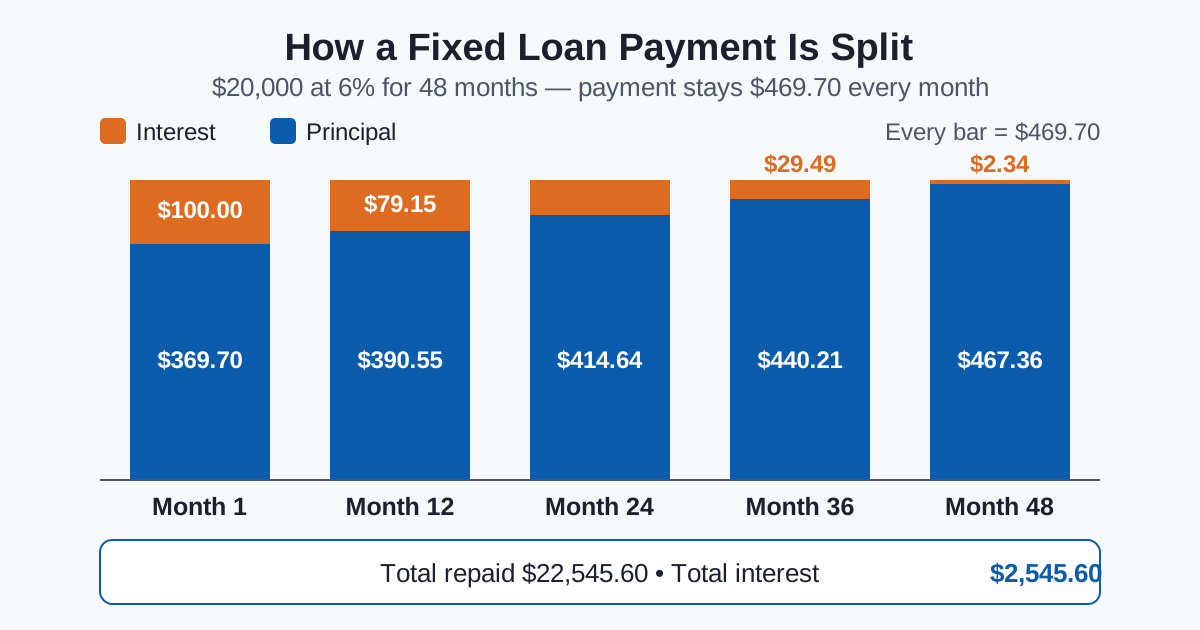
Take out a loan and the monthly payment usually stays the same from the first month to the last. That fixed payment can hide what is really happening underneath: in the early months, most of the payment covers interest and only a smaller part reduces what you owe. By the final months, the balance is much smaller, so almost all of the same payment goes towards principal.
Understanding that split explains a lot of otherwise confusing experiences — why a balance seems to fall slowly at first, why extra payments early on can help more than people expect, and why two loans with similar monthly payments can cost very different amounts overall. This guide shows the formula behind the payment, works through a complete example by hand, and flags the mistakes that make loans hard to compare.
This article is educational only and is not financial advice. Loan terms, fees, and conditions vary by lender and by product, so always check your own agreement and consider independent professional advice for decisions about your finances.
The direct answer
For a standard fixed-rate loan repaid in equal monthly instalments, the monthly payment is set so that:
- each month, interest is charged on the balance still owed,
- the rest of the payment reduces that balance, and
- the balance reaches exactly zero with the final payment.
One formula captures all three conditions at once:
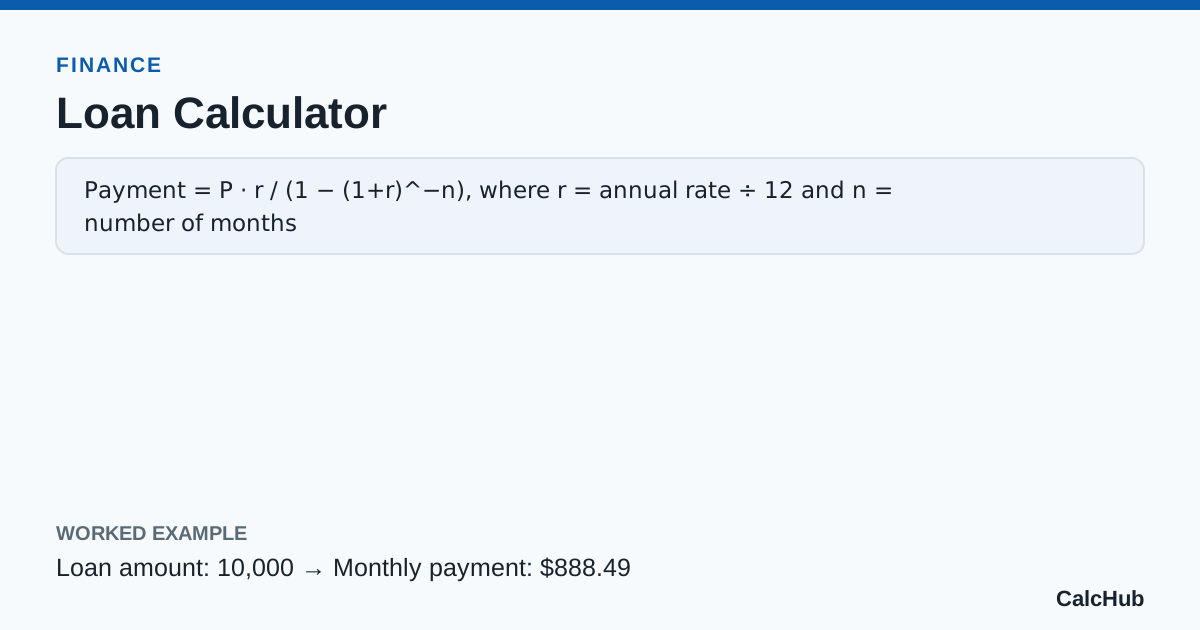
M = P × r(1 + r)^n ÷ ((1 + r)^n − 1)
Where:
- M = monthly payment
- P = amount borrowed (principal)
- r = monthly interest rate = annual rate ÷ 12
- n = total number of monthly payments
If you would rather not do the exponent by hand, the loan calculator runs the same formula and shows the payment, total repaid, and total interest. For a home loan specifically, the mortgage calculator applies the same maths over a mortgage term. The worked example below shows exactly what those tools are doing.
Step by step: from loan details to monthly payment
- Start with the amount borrowed (P). This is the principal — the sum you receive and must repay, before interest.
- Convert the annual rate to a monthly rate (r). Divide the annual rate, written as a decimal, by 12. For a 6% annual rate, that is 0.06 ÷ 12 = 0.005 per month.
- Count the payments (n). Multiply the term in years by 12. A 4-year loan has 48 monthly payments.
- Apply the formula to get the fixed monthly payment (M).
- Check the totals. Multiply M by n to get the total repaid. Subtract P to get the total interest over the life of the loan. These two totals are the fairest way to compare the true cost of loans.
Worked example: $20,000 at 6% for 48 months
Suppose you borrow $20,000 at 6% APR for 48 months (4 years).
- P = $20,000
- r = 0.06 ÷ 12 = 0.005
- n = 48
Putting those values into the formula gives:
M = $469.70 per month
From that single payment, the full cost of the loan follows:
| Item | Amount |
|---|---|
| Amount borrowed (P) | $20,000.00 |
| Monthly payment (M) | $469.70 |
| Number of payments (n) | 48 |
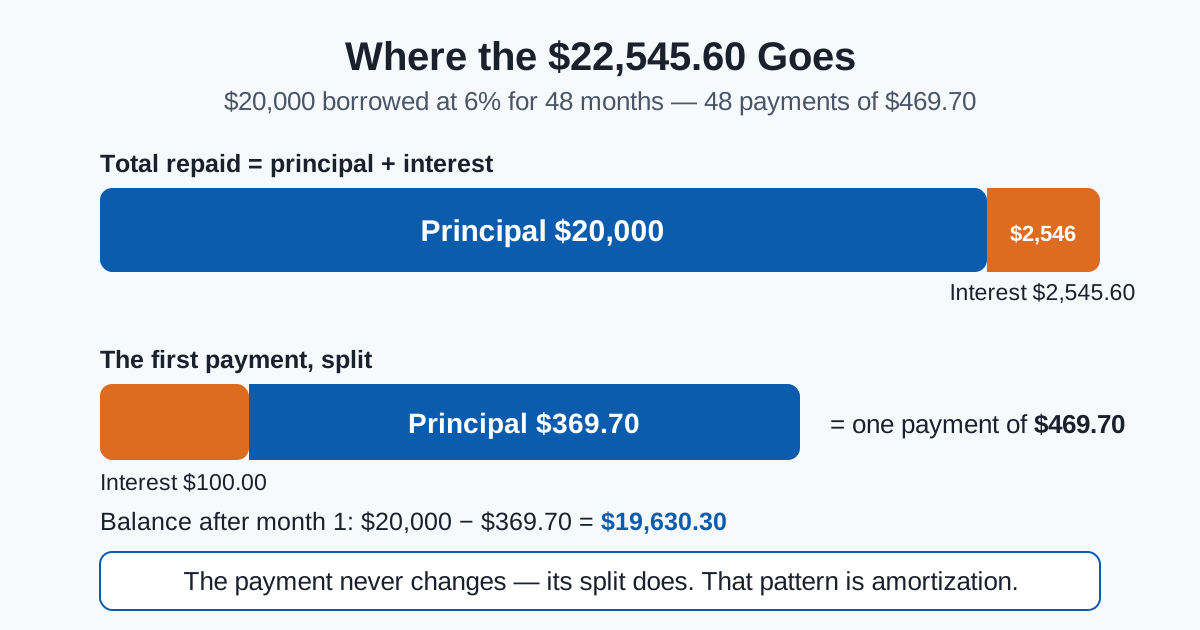
| Total repaid (M × n) | $22,545.60 |
| Total interest (total repaid − P) | $2,545.60 |
So this loan costs $2,545.60 in interest over its life, on top of repaying the $20,000 borrowed. There is no guaranteed saving or outcome attached to any loan strategy — these figures simply describe this example loan on its stated terms, assuming every payment is made on time and the rate stays fixed.
How the first payment is split
Interest for a month is always calculated on the balance at the start of that month:
- Month 1 interest = $20,000 × 0.005 = $100.00
- Month 1 principal = $469.70 − $100.00 = $369.70
- Balance after month 1 = $20,000 − $369.70 = $19,630.30
That is why early payments are interest-heavy: the balance is at its highest, so the interest charge is at its highest too. As the balance falls month by month, the interest part of each fixed payment shrinks and the principal part grows by the same amount. The payment does not change — its internal split does. This pattern is called amortization, and the schedule of splits across all 48 payments is the amortization schedule.
A useful sanity check: the 0% case
The formula has a helpful edge case. At 0% interest, there is nothing to calculate beyond simple division:
Payment = P ÷ n
For $20,000 over 48 months at 0%, that would be $20,000 ÷ 48, with no interest at all. If a calculator or lender quote for a supposedly interest-free deal does not reduce to something close to that logic (before any fees), it is worth asking what else has been added. Fees are one common reason a quote differs — see the section on mistakes below, and APR vs. interest rate for how APR captures more than the note rate alone.
What happens if you pay extra?
Adding a regular extra amount to the monthly payment reduces the balance faster, which reduces the interest charged in every following month. Using the same example loan:
- Standard payment: $469.70/month for 48 months, total interest $2,545.60
- With an extra $50/month: $519.70/month
On these figures, paying $519.70 per month clears this loan in about 43 months instead of 48 and saves roughly $280 of interest. Treat both of those results as approximate — the exact outcome depends on how your lender applies extra payments, when they are credited, and whether your loan has any conditions on overpayment, so confirm the details with your lender before relying on them.
The general principle behind the example applies to mortgages as well, over much longer terms. For a fuller walkthrough on the mortgage side, see extra mortgage payments: how much you save.
Common mistakes and limitations
Mistake 1: Assuming each payment is half interest, half principal. It is not, except possibly at one point partway through. Early payments are weighted towards interest because the balance is largest; late payments are weighted towards principal. In the worked example, the first payment is $100.00 interest and $369.70 principal — nowhere near half and half.
Mistake 2: Comparing loans by monthly payment alone. A lower monthly payment often just means a longer term, which usually means more total interest. Compare total interest and total repaid as well. In the example above, those totals ($22,545.60 repaid; $2,545.60 interest) tell you far more than "$469.70 a month" on its own.
Mistake 3: Treating the interest rate and APR as the same thing. The rate used in the payment formula is the note rate on the loan. APR is broader and can include fees and other costs, so two loans with the same note rate can have different APRs and different true costs. Our explainer on APR vs. interest rate covers the distinction in detail, and the CFPB's explanation of the difference between a loan interest rate and the APR makes the same distinction in its consumer guidance.
Mistake 4: Forgetting fees and changing terms. The formula assumes a fixed rate, fixed payment, and no additional fees, late charges, or rate changes. Real loans may include origination or other fees, and variable-rate loans can change payment behaviour over time. The formula explains the core mechanism; your loan agreement defines your actual obligations.
Limitation: rounding and lender practice. Lenders round payments to cents and may handle the final payment slightly differently to clear the exact balance. Small cent-level differences between a hand calculation and a lender statement are normal.
Frequently asked questions
Why is so much of my first payment interest?
Because interest is charged on the outstanding balance, and the balance is never higher than at the start. On a $20,000 loan at a monthly rate of 0.005, the first month's interest alone is $100.00. As you repay principal, the balance — and therefore each month's interest charge — falls, so more of the fixed payment can go to principal.
If I double my monthly payment, do I halve the loan term?
Not exactly — you will usually clear the loan in less than half the time. That is because a larger payment reduces the balance faster, which also cuts the interest charged in later months. The worked example shows the effect at a smaller scale: an extra $50 a month shortens a 48-month loan to about 43 months. Use the loan calculator to model your own figures rather than assuming a simple proportion.
Does the formula work for mortgages too?
Yes. A standard fixed-rate mortgage uses the same amortization formula, just with a larger principal and a much larger n. The mortgage calculator is built for that case. Keep in mind that a real mortgage payment collected by a lender may also include amounts for taxes or insurance, which are not part of this formula. The CFPB's guide to the Loan Estimate shows where the payment, rate, and closing costs appear on the standard disclosure a lender must give you.
What is the difference between the interest rate and APR?
The interest (note) rate is the rate applied to your balance in the payment formula. APR expresses the broader cost of borrowing and can include fees, which is why APR is often higher than the note rate. Comparing APRs can be more informative than comparing note rates alone — see APR vs. interest rate, or run two offers side by side in the APR calculator.
How is the payment calculated if the interest rate is 0%?
Simply divide the amount borrowed by the number of payments: P ÷ n. With no interest to cover, every dollar of every payment goes directly to principal, and the total repaid equals the amount borrowed, before any fees.
Conclusion: one formula, three numbers to check
Every fixed-rate loan payment comes from the same idea: charge interest on what is still owed, put the rest of a fixed payment towards the balance, and size that payment so the balance ends at zero on the final month. The formula M = P × r(1 + r)^n ÷ ((1 + r)^n − 1) turns that idea into a number.
Your next step: enter your own amount, rate, and term into the loan calculator and look past the monthly payment to the other two numbers — total repaid and total interest. Those totals, checked against your lender's terms including fees and APR, are what let you compare loans honestly.