Salary to Hourly: How to Convert Your Pay (and Find Your Real Hourly Rate)
The problem: two jobs, two different ways of stating pay
One job offer says $60,000 a year. Another says $30 an hour. A third pays by the paycheck, and the number on the check does not obviously match either of the other two.
They are all describing the same thing — pay for your time — just in different units. Until you convert them to the same unit, you cannot compare them fairly, work out what an hour of your work is actually worth, or check whether a paycheck looks right.
This guide shows the standard conversion, the reverse conversion, and the adjustment that gives you your real hourly rate once paid time off and unpaid extra hours are taken into account. All figures below are gross pay, before tax.
The direct answer
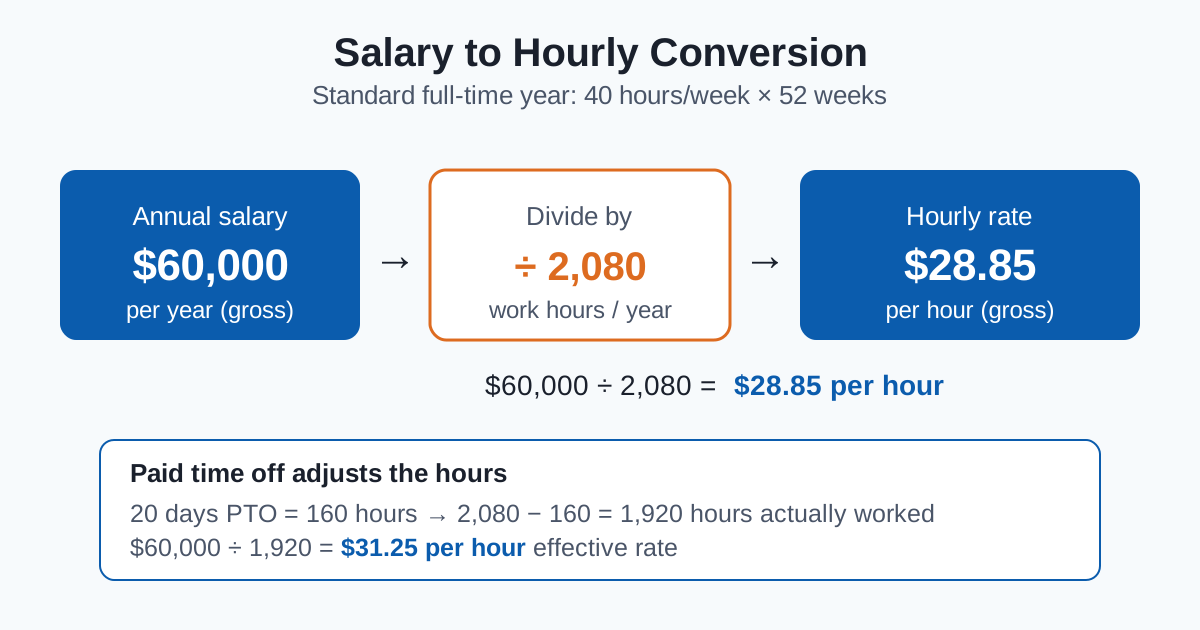
For a standard full-time schedule, there are 2,080 work hours in a year:
40 hours per week × 52 weeks = 2,080 hours
To convert an annual salary to an hourly rate, divide the salary by 2,080.
Hourly rate = annual salary ÷ 2,080
So a $60,000 salary works out to:
$60,000 ÷ 2,080 = $28.85 per hour
If you want to run your own number, the salary to hourly calculator does this division for you and shows the working.
Step by step: converting a salary to an hourly rate
- Start with the gross annual salary. Use the full yearly figure before tax and before any deductions.
- Confirm the schedule. The 2,080-hour figure assumes 40 hours a week for 52 weeks. If your hours vary week to week, the work hours calculator can total them for you first. That is the standard baseline employers and payroll systems use for full-time roles.
- Divide the salary by 2,080. The result is your hourly rate.
- Round sensibly. Hourly rates are usually quoted to the nearest cent, so $28.846 becomes $28.85.
That is the whole standard conversion. Everything else in this article is either running it backwards, or adjusting the hours to reflect how you actually work.
The formula and worked examples
Formula: Hourly rate = annual salary ÷ 2,080
Worked example 1 — $50,000 a year
$50,000 ÷ 2,080 = $24.04 per hour
Worked example 2 — $75,000 a year
$75,000 ÷ 2,080 = $36.06 per hour
Worked example 3 — $100,000 a year
$100,000 ÷ 2,080 = $48.08 per hour
Running it backwards: hourly to salary
The reverse conversion uses multiplication instead of division:
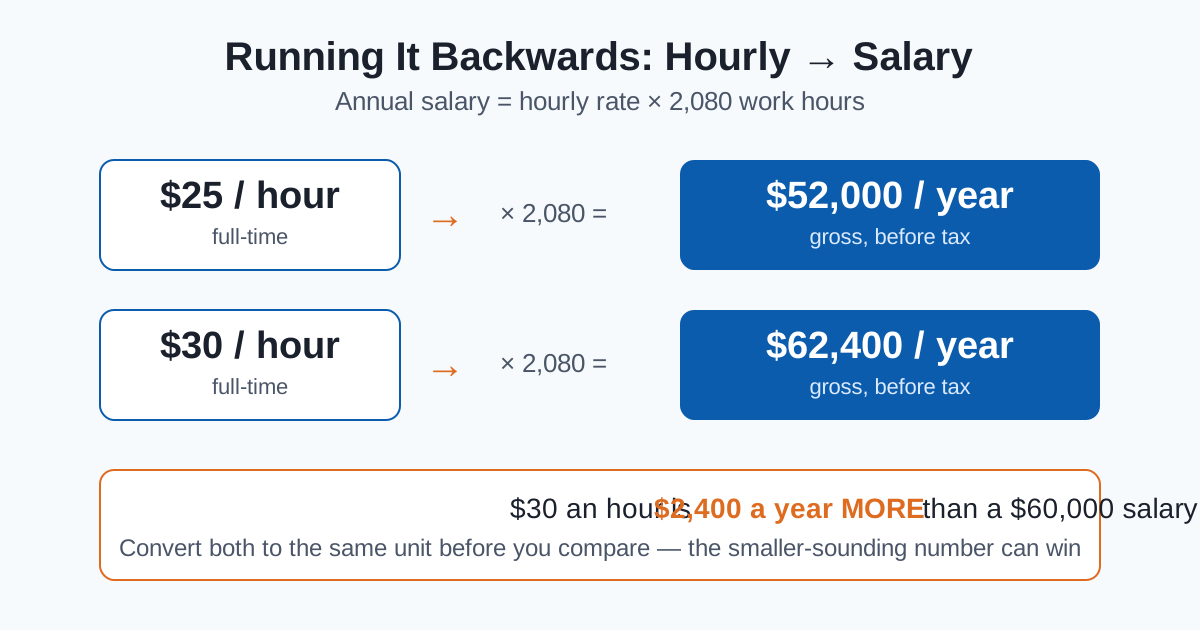
Annual salary = hourly rate × 2,080
For example, $25 an hour full-time is:
$25 × 2,080 = $52,000 a year
A common comparison question
Is $30 an hour more than $60,000 a year? Yes.
$30 × 2,080 = $62,400 a year
That is $2,400 a year more than a $60,000 salary, even though $60,000 sounds like the bigger number when the two figures are placed side by side. Converting both to the same unit is what makes the difference visible.
Salary to hourly conversion table
| Annual salary | Hourly rate |
|---|---|
| $35,000 | $16.83 |
| $40,000 | $19.23 |
| $50,000 | $24.04 |
| $60,000 | $28.85 |
| $75,000 | $36.06 |
| $100,000 | $48.08 |
| $120,000 | $57.69 |
All rates in this table use the standard 2,080-hour year and are gross, before tax.
Your real hourly rate: adjusting for the hours you actually work
The standard conversion assumes you work all 2,080 hours. In practice, two things change the picture: paid time off reduces the hours you are actually at work, and unpaid extra hours increase them. Dividing by the hours you actually work gives your effective, or real, hourly rate.
Paid time off raises the effective rate. Take a $60,000 salary with 20 days of paid time off and holidays. Those 20 days are 160 hours, so the hours actually worked are:
2,080 − 160 = 1,920 hours
$60,000 ÷ 1,920 = $31.25 per hour
The pay is the same, but it is spread over fewer working hours, so each worked hour is worth more.
Unpaid extra hours lower the effective rate. Now take the same $60,000 salary in a job where you regularly work 50 hours a week. Over a year that is:
50 × 52 = 2,600 hours
$60,000 ÷ 2,600 = $23.08 per hour
Same salary, notably lower real rate. This is why the effective rate matters when you compare a salaried role against an hourly one: the headline salary alone does not tell you what an hour of your time is earning.
Paycheck math: biweekly is not semimonthly
If you are paid a salary, the amount per paycheck depends on how many pay periods there are in the year, and two common schedules are easy to confuse.
Using a $60,000 salary:
- Biweekly means every two weeks, which gives 26 paychecks a year: $60,000 ÷ 26 = $2,307.69 per paycheck
- Semimonthly means twice a month, which gives 24 paychecks a year: $60,000 ÷ 24 = $2,500 per paycheck
The annual pay is identical. The semimonthly check is larger simply because the same salary is split into fewer checks. If a paycheck looks smaller than you expected, check the pay schedule before assuming the salary is wrong.
Common mistakes
- Using 2,000 hours instead of 2,080. Dividing by 2,000 is a rough shortcut, and because the divisor is smaller, it overstates the hourly rate. For an exact standard conversion, use 2,080.
- Forgetting that unpaid overtime dilutes the real rate. A salary divided by 2,080 describes a 40-hour week. If you consistently work more hours without extra pay, your effective rate is lower than the standard figure, as the 50-hour example above shows.
- Comparing gross to net. The conversions here are all gross, before tax. Comparing a gross salary against an hourly figure that has already had tax taken out mixes two different things and makes one option look better or worse than it really is. The IRS explains what employees need to know about income tax withholding if you want to work out the net side as well.
- Treating biweekly and semimonthly as the same schedule. They produce different paycheck amounts — $2,307.69 versus $2,500 on a $60,000 salary — from the exact same annual pay.
Frequently asked questions
How many work hours are in a year?
For a standard full-time schedule, 2,080: 40 hours a week multiplied by 52 weeks. That is the baseline used for salary-to-hourly conversions.
How do I convert a salary to an hourly rate?
Divide the gross annual salary by 2,080. For example, $60,000 ÷ 2,080 = $28.85 per hour. The salary to hourly calculator does the same calculation with the working shown.
Is $30 an hour more than $60,000 a year?
Yes. At 2,080 hours, $30 an hour equals $62,400 a year, which is more than $60,000.
What is $25 an hour as an annual salary?
Full-time at 40 hours a week, $25 × 2,080 = $52,000 a year, before tax.
Why is my biweekly paycheck less than I expected?
Because a biweekly schedule splits your salary into 26 checks rather than 24. On $60,000 that is $2,307.69 biweekly versus $2,500 semimonthly. The yearly total is the same either way.
Does paid time off change my hourly rate?
It does not change the standard rate, but it raises your effective rate. On a $60,000 salary with 20 days (160 hours) of paid time off, you actually work 1,920 hours, which works out to $31.25 for each hour worked.
Conclusion
The standard conversion is one division: salary ÷ 2,080. That gives you a rate you can compare directly against hourly offers, and running it in reverse — hourly rate × 2,080 — puts hourly pay into annual terms. For a fuller picture, adjust the hours for paid time off and any regular unpaid extra time to find your effective rate.
Your next step: enter your own salary into the salary to hourly calculator to see your rate with the working shown. And if you are untangling a price that includes sales tax rather than pay, our guide on reverse sales tax walks through that calculation step by step. For the tax side of a paycheck itself, the income tax calculator estimates the deductions from the same gross pay.