Extra Mortgage Payments: How Much $100 a Month Really Saves
The question almost every borrower asks
"Is it worth paying $100 extra a month on my mortgage?" It sounds too small to matter — a hundred dollars against a loan of hundreds of thousands. But extra payments do not chip away at the loan evenly; they strike at exactly the part that costs you the most. This guide answers how much extra mortgage payments actually save, with one fully worked example computed with our own mortgage formula, a base-versus-extra comparison table, and the checks you need to run before you start paying extra. If you want the general mechanics of how any loan payment is built from interest and principal, how loan payments are calculated is the companion explainer — this article is the extra-payment application of it.
The direct answer
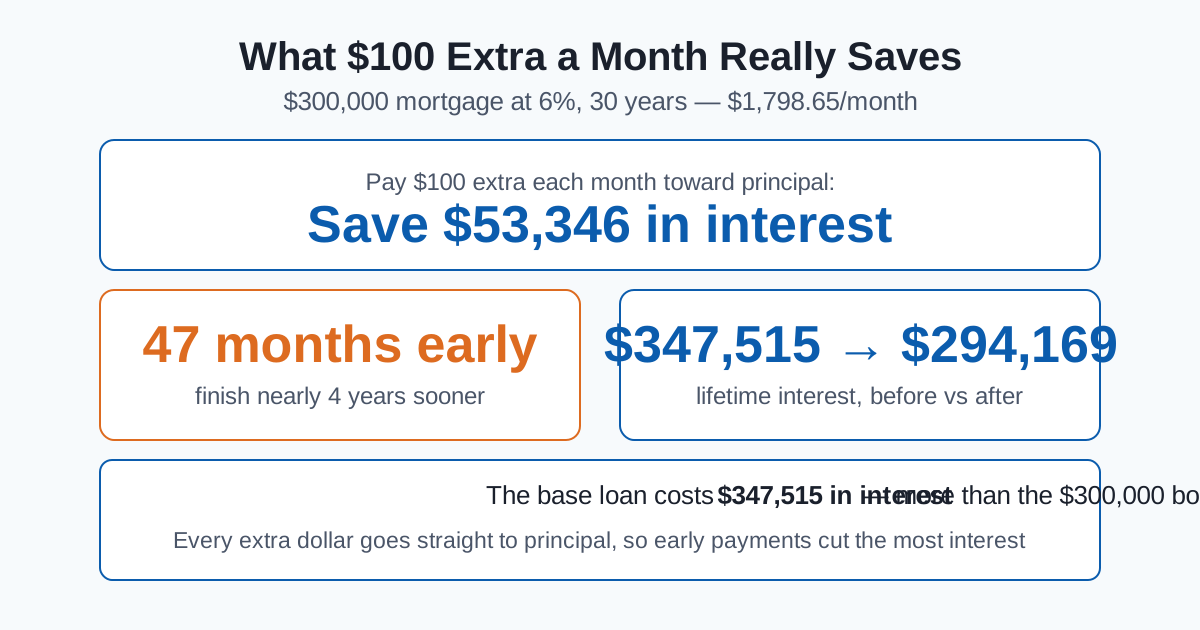
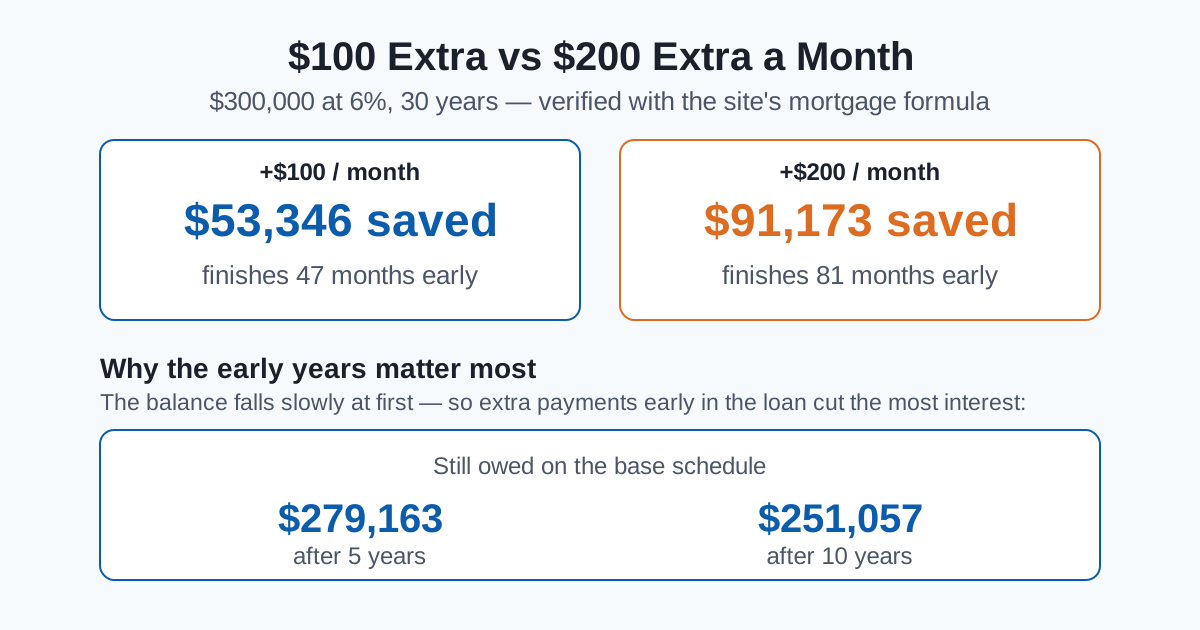
On a $300,000 mortgage at 6% for 30 years, paying $100 extra each month saves $53,346 in interest and finishes the loan 47 months early — nearly four years sooner.
Doubling the extra to $200 a month saves $91,173 in interest and shortens the loan by 81 months — almost seven years. Use the mortgage calculator to model these figures against your own loan amount and rate; every number below comes from the site's own mortgage formula code.
Why extra payments work: amortization in brief
Your monthly mortgage payment is computed by the standard amortization formula — the same one behind our Loan Calculator for general-purpose loans:
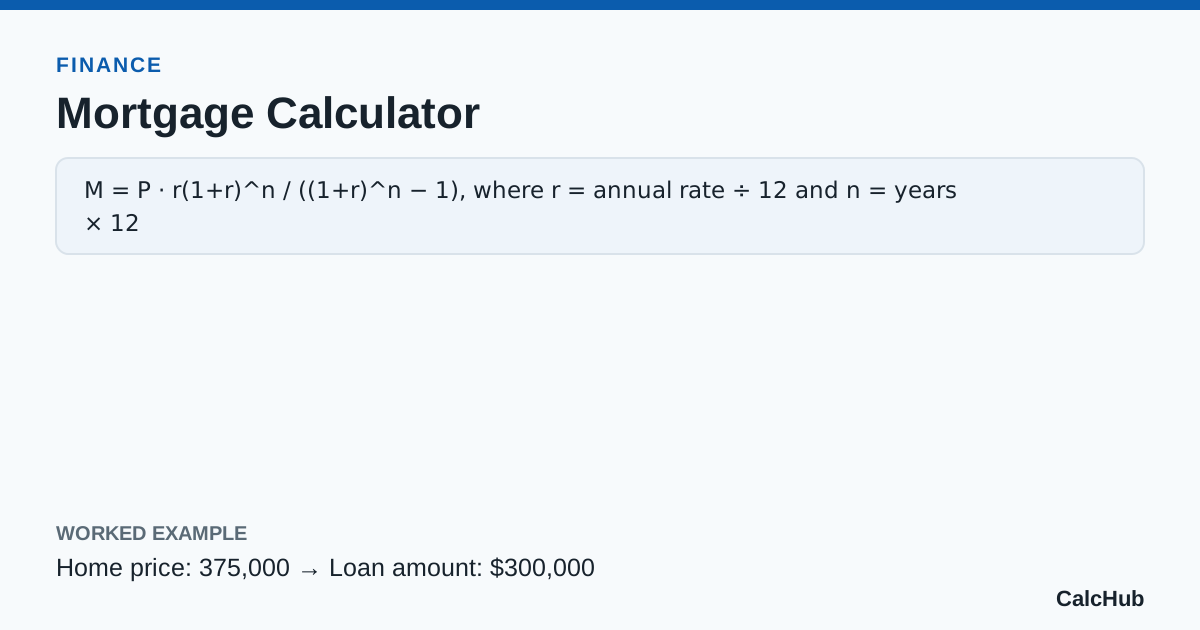
M = P · r(1+r)^n / ((1+r)^n − 1), where P is the loan amount, r is the monthly rate (6%/12 = 0.005), and n is the number of payments (360 for 30 years).
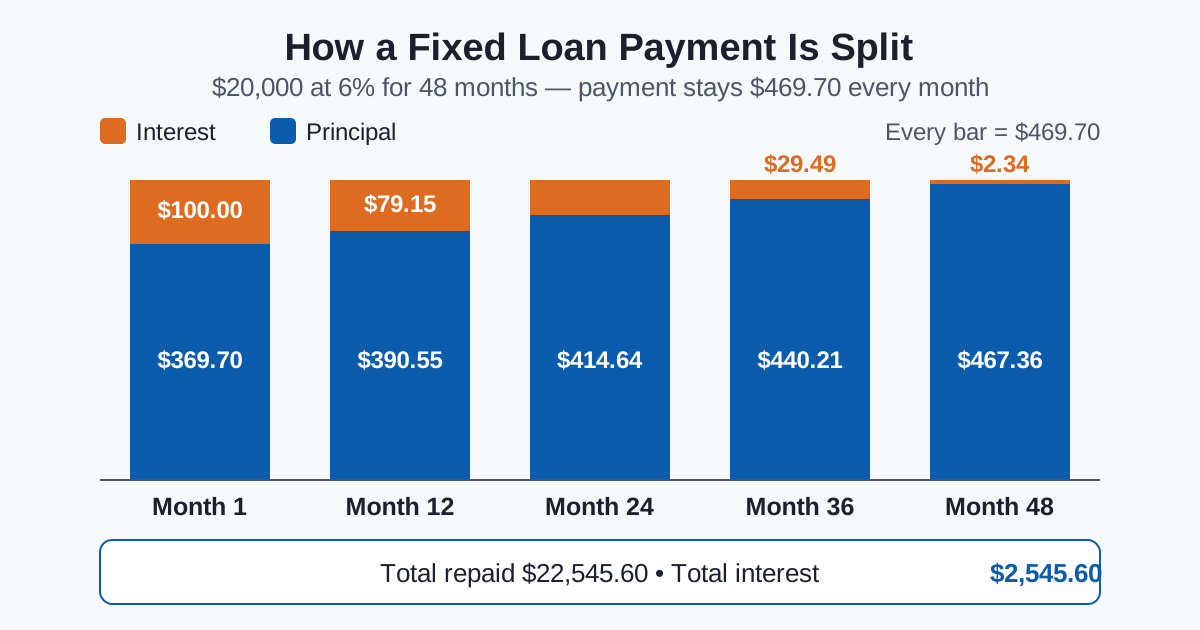
The payment stays constant, but its split does not. Early in the loan the balance is large, so the interest portion of each payment is large and the principal portion is small — your first payment is mostly interest. As the balance falls, the interest portion shrinks and more of each payment attacks principal. That is exactly why extra payments are so powerful: every extra dollar goes straight to principal, which shrinks the balance the interest is charged on for every remaining month. The full mechanics are covered in how loan payments are calculated.
Worked example: $300,000 at 6% for 30 years
The base loan: $1,798.65 a month for principal and interest, for 360 months. Over the full life of the loan you would pay $347,515 in interest — more interest than the $300,000 you borrowed.
| Scenario | Monthly payment | Total interest | Interest saved | Loan shortened by |
|---|---|---|---|---|
| Base (no extra) | $1,798.65 | $347,515 | — | — |
| +$100/month | $1,898.65 | $294,169 | $53,346 | 47 months |
| +$200/month | $1,998.65 | $256,342 | $91,173 | 81 months |
Notice the asymmetry: doubling the extra payment saves far more than double the interest relative to its cost, because the savings compound — each month's extra payment reduces the interest charged on every month after it. That is also why starting early matters so much: the balance falls painfully slowly at first, so the most expensive months are the earliest ones.
The slow start: why early extra payments cut the most interest
On the base schedule above, the balance barely moves in the early years:
- After 5 years: $279,163 still owed — only about $20,800 of principal repaid.
- After 10 years: $251,057 still owed — under $50,000 of the $300,000 repaid.
Nearly a third of the way through the loan, over 83% of the balance remains. Every payment in those years is mostly interest. That is precisely why an extra $100 in month 12 is worth far more than the same $100 in month 300: the early extra dollar erases interest that would otherwise have been charged, month after month, for decades. If you are deciding between paying extra and saving for other goals, the debt-to-income calculator can help you see how your housing payment already sits against your income.
What to check before you pay extra
Extra payments only save interest if they are applied correctly and your loan allows them. Run these checks first:
- Confirm extra amounts go to principal. Some servicers apply overpayments to future payments (advancing your due date) rather than reducing the balance. Call your servicer and ask for payments explicitly applied to principal; some require the extra amount sent as a separate payment or flagged in a specific way.
- Check for a prepayment penalty. Whether you can be charged a fee for paying early depends on your loan type and terms, so read your loan documents first — the CFPB's guidance on prepayment penalties explains which loans allow them and what to look for.
- Clear higher-rate debt first. Extra mortgage payments earn you, in effect, your mortgage rate — 6% in the example. Credit card debt at 20%+ costs you far more; pay that down first.
- Keep an emergency fund. Once a dollar goes into the house, it is not available for a broken furnace or a job loss. Most guidance suggests a cash cushion of several months of expenses before locking money into the mortgage.
- Know your true rate. If you are comparing extra payments against refinancing, compare the all-in cost using the APR calculator so fees and points are part of the picture. The Consumer Financial Protection Bureau is the authoritative source for general mortgage guidance and borrower rights.
Common mistakes
Mistake 1: Assuming extra payments automatically reduce principal. The most common and most expensive error. If your servicer applies the overage to future due dates instead of the balance, your loan term does not shorten and you save nothing. Get the principal-application rule in writing from your servicer before the first extra payment.
Mistake 2: Ignoring the penalty clause. A small number of loans carry prepayment penalties, especially some adjustable-rate and non-qualified mortgages. A penalty can wipe out months of extra-payment savings, so check the documents — and the CFPB guidance linked above — before you start.
Mistake 3: Rounding the payment the "wrong" way up. Rounding $1,798.65 up to $1,900 rather than down to $1,800 is a real saving — but rounding down the required amount below $1,798.65 creates a shortfall, which can mean fees or worse. Only round up from the full required payment.
Mistake 4: Treating the extra payment as flexible. Skipping the extra payment now and then costs more than it seems, because the early-month compounding effect is lost. If you might need the money, consider keeping it in savings and making one lump principal payment per year instead — the result is nearly identical and your cash stays liquid.
Frequently asked questions
How much does $100 extra a month really save? On a $300,000 mortgage at 6% over 30 years: $53,346 in interest and 47 months off the term. Your own saving scales with your loan amount, rate, and how early you start — plug your numbers into the mortgage calculator rather than assuming these figures.
Do extra payments shorten the term or lower the monthly payment? With a standard fixed-rate mortgage, extra payments applied to principal shorten the term; the required monthly payment stays the same. (A recast is the separate process that re-amortizes the loan and lowers the payment.) For the general payment math behind this, see how loan payments are calculated.
Can my lender penalize me for paying early? It depends on your loan type and terms. Prepayment penalties exist on some mortgages, and whether one applies to you depends on what your loan documents say — check them, and read the CFPB's guidance linked earlier in this article.
Should I pay extra on the mortgage or invest the money? There is no universal answer. Paying extra earns a guaranteed, risk-free return equal to your mortgage rate (6% in the example, after-tax depending on your situation); investing can earn more but carries risk and is not guaranteed. It depends on your rate versus expected returns, your risk tolerance, and whether you have an emergency fund and higher-rate debt — consider it a personal decision, not a rule.
Does a small extra payment early in the loan really beat a larger one later? Almost always, yes. The Year 5/Year 10 balances above show why: the base schedule leaves $279,163 owed after five years, so the interest charged in those early years is at its maximum. An extra dollar in year 2 erases decades of interest that would have accumulated on it; the same dollar in year 28 erases almost none.
Will extra payments help if I plan to sell in a few years? Yes — every extra dollar reduces your remaining balance, so you keep more of the sale proceeds when you sell. You will not capture the full 30-year interest saving, but the balance reduction and the interest you avoid during the years you do own the home are real.
Conclusion: the next step
A hundred dollars a month sounds modest against a $300,000 loan, but because early payments are mostly interest, that hundred attacks the most expensive part of the loan first: $53,346 saved and 47 months finished early on the example above. The two non-negotiable steps are confirming with your servicer that extras go to principal, and checking your loan documents for a prepayment penalty. Once those are clear, the next step is personal: run your own loan amount, rate, and extra-payment size through the mortgage calculator to see exactly how much you save — and for the deeper mechanics behind every payment split, the guide Understanding Mortgage Payments covers the topic from the ground up.