
Sweat Rate Calculator
Work out your sweat rate from pre- and post-workout weights — and how much to drink back.
Quick answer
- Measure in conditions that match your event — heat, humidity, intensity and clothing all move sweat rate, so test in several scenarios.
- Losing more than about 2% of body mass in a session reliably impairs performance; plan drinking to stay ahead of that line rather than catching up after.
- Replace 1.25–1.5 L per kg of net mass lost (not just 1.0) because you keep urinating while you rehydrate — and include sodium from food or drinks.
- Worked example — Total sweat loss: 2.20 L (full example below).
Sweat Rate Calculator
| Total sweat loss | 2.20 L |
| Sweat rate | 1.47 L/hour |
| Body mass lost | 1.75% |
| Replacement target — low end (1.25×) | 1.75 L |
| Replacement target — high end (1.5×) | 2.10 L |
From 80.0 to 78.6 kg over 90 minutes, with 1.0 L drunk and 0.2 L urinated: sweat loss is 2.2 L, a rate of about 1.47 L/h. Net mass loss is 1.75%, so the rapid-recovery replacement target is about 1.75–2.10 L with sodium.
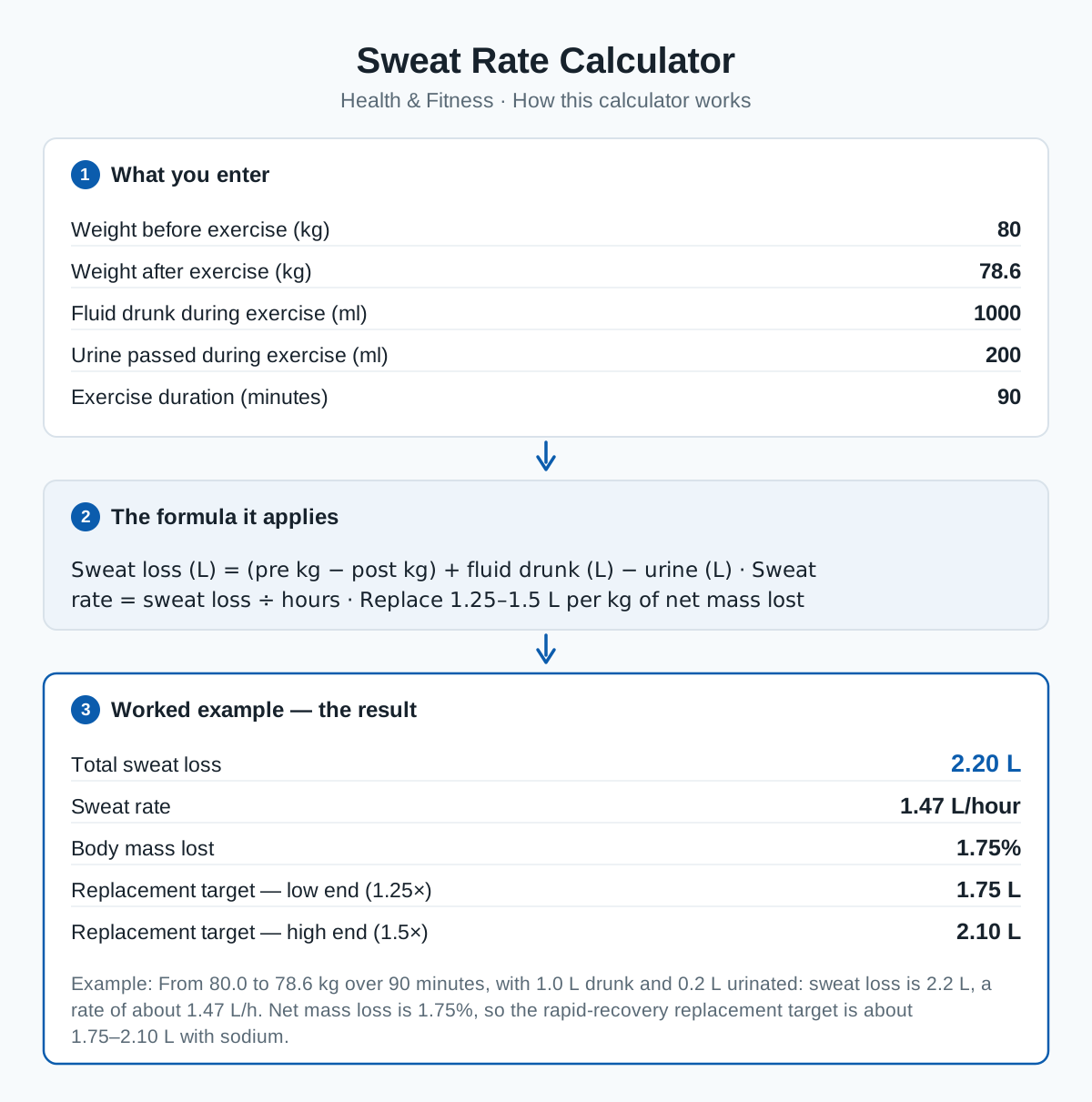
Sweat rate is the most personal number in hydration science: the same session can cost one athlete 0.5 litres per hour and another 2.5. The standard field method is the weigh-in/weigh-out: sweat loss = (pre-exercise weight − post-exercise weight) + fluid drunk − urine passed, with 1 kg of mass change equal to about 1 litre of fluid.
Knowing your rate tells you how much to drink during exercise to avoid drifting past about 2% body-mass loss — the point where performance and thermoregulation reliably suffer — and how much to replace afterwards. Sports-medicine guidance (ACSM/NATA) is to replace roughly 1.25–1.5 litres per kilogram of net body-mass lost, with sodium, when rapid recovery matters.
The formula
Worked example
From 80.0 to 78.6 kg over 90 minutes, with 1.0 L drunk and 0.2 L urinated: sweat loss is 2.2 L, a rate of about 1.47 L/h. Net mass loss is 1.75%, so the rapid-recovery replacement target is about 1.75–2.10 L with sodium.
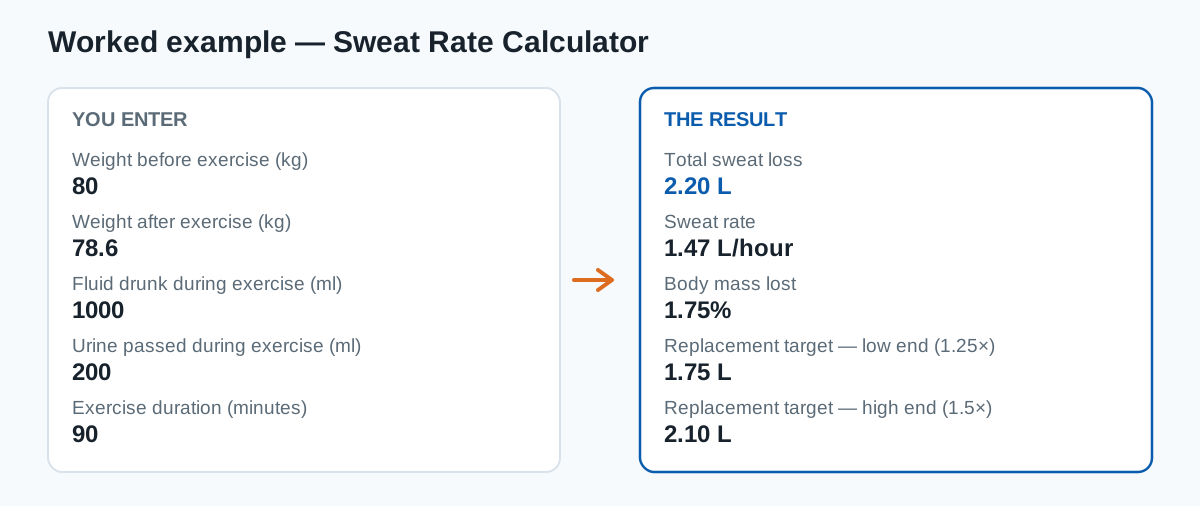
The example is pre-loaded in the result panel — press Calculate with your own numbers to replace it.
Frequently asked questions
How do I weigh myself properly for this?
Weigh in dry, minimal clothing after urinating, before the session; afterwards towel off all sweat, wear the same clothing, and weigh before eating or drinking anything else. Log everything you drank and any urine passed during the session.
What sweat rate is normal?
Roughly 0.3–2.5 L/h across athletes and conditions. Cool-weather easy training may be 0.5 L/h; hard summer sessions in heavy kit can exceed 2 L/h. Rates above ~2.5 L/h are rare but documented in elite athletes in extreme heat.
Should I drink to replace 100% during exercise?
Not necessarily — drinking to thirst performs well for most sessions under an hour. For long, hot events, a plan built on your measured rate that limits losses to under about 2% of body mass is the evidence-based middle ground; drinking far beyond sweat loss risks hyponatraemia.
Category: Health & Fitness calculators
Sources & methodology
Sweat loss = (pre − post body mass in kg) + fluid consumed (L) − urine output (L), treating 1 kg ≈ 1 L. Sweat rate = sweat loss ÷ duration in hours. Body-mass loss % uses the pre/post weights only. Replacement guidance follows the ACSM/NATA position of 1.25–1.5 L per kg of net body-mass lost when fast, complete recovery is the goal. The method ignores small respiratory and metabolic mass losses (typically under 0.1–0.2 kg/h), the accepted field-standard simplification.
- National Athletic Trainers' Association position statement — Fluid replacement for the physically active (J Athl Train, 2017)
- Baker LB — Sweating rate and sweat sodium concentration in athletes: methodology review (2017)
Content last reviewed by CalcHub Editorial.
Embed this calculator on your site
Free to use with attribution — paste the snippet below and the calculator appears on your page, with a link back to CalcHub.
Related calculators
Water Intake Calculator
Suggested daily water intake from body weight and exercise.
Total Body Water Calculator
Estimate your total body water in litres with the Watson equations.
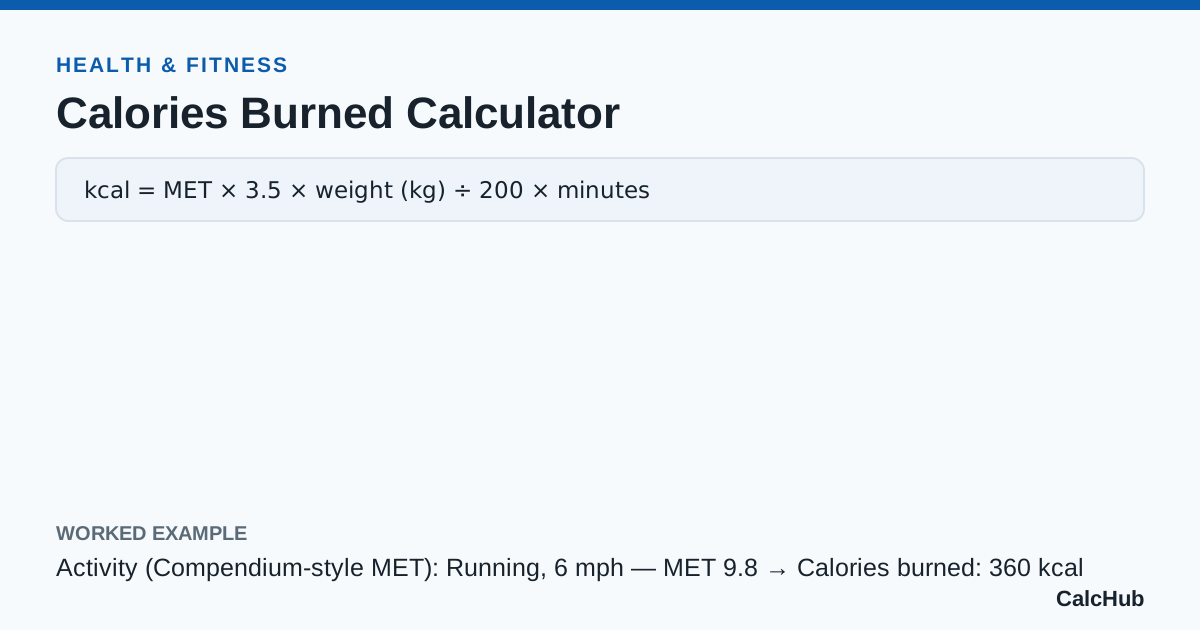
Calories Burned Calculator
Energy cost of common activities from MET values, weight and duration.
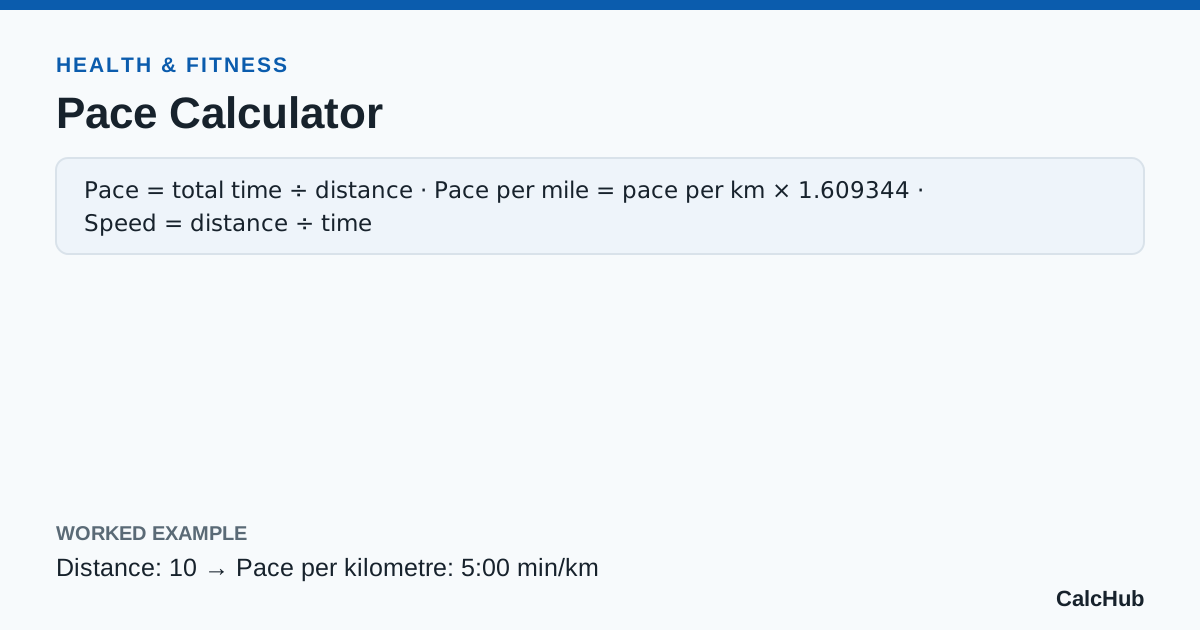
Pace Calculator
Running pace per kilometre and per mile, plus speed, from distance and time.