
Total Body Water Calculator
Estimate your total body water in litres with the Watson equations.
Quick answer
- Typical Watson estimates: around 55–60% of body weight for men and 48–53% for women — fat tissue is about 10% water, muscle about 75%.
- The percentage falls as body fat rises and as age increases, which is normal physiology, not dehydration.
- Your bioimpedance scale's 'water %' is calibrated against equations like Watson — expect agreement within a few percent, not exact matches.
- Worked example — Total body water: 45.9 L (full example below).
Total Body Water Calculator
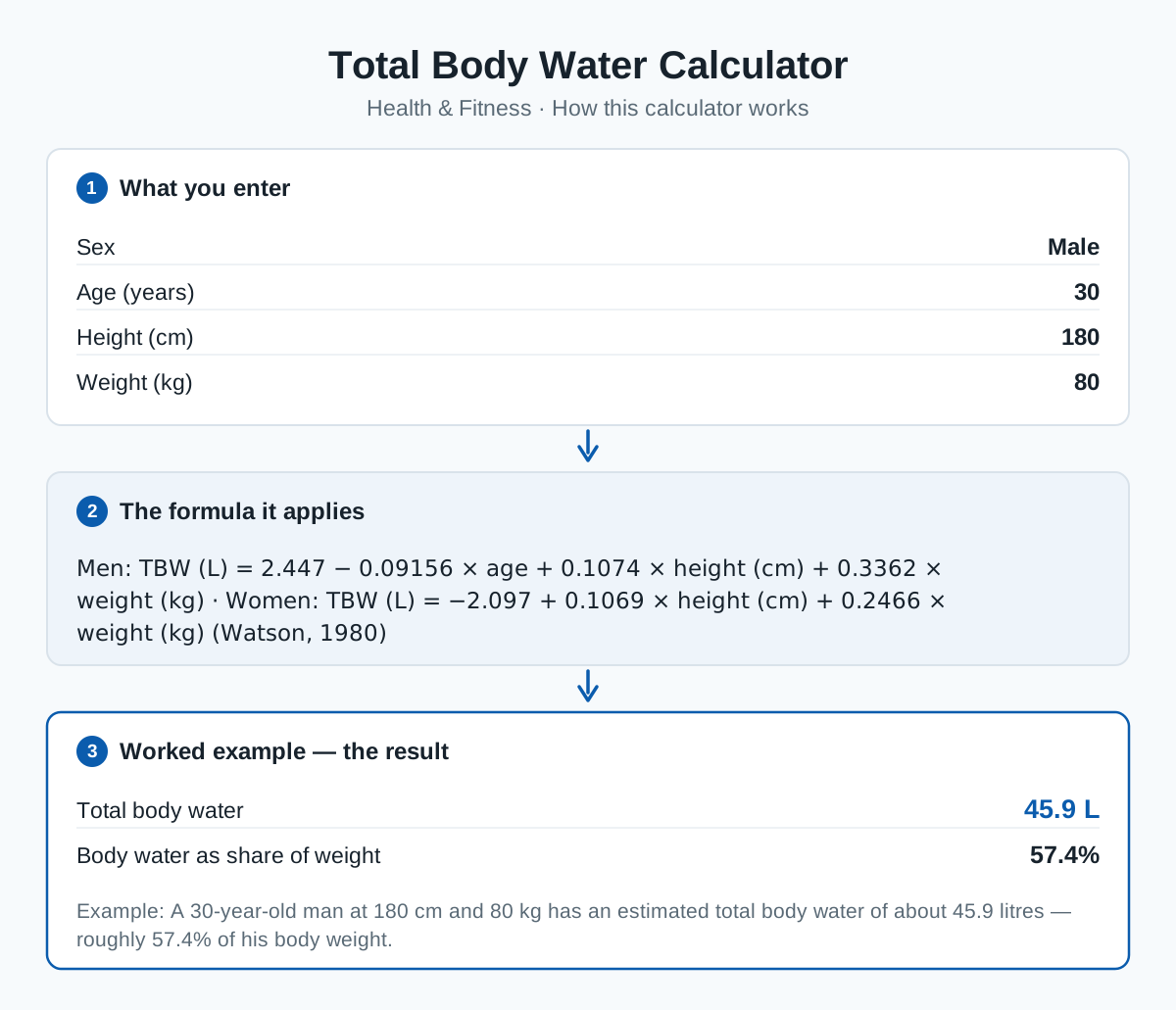
| Total body water | 45.9 L |
| Body water as share of weight | 57.4% |
A 30-year-old man at 180 cm and 80 kg has an estimated total body water of about 45.9 litres — roughly 57.4% of his body weight.
Roughly half to two-thirds of you is water — in blood, cells and the fluid between them. Total body water (TBW) matters for everything from interpreting bioimpedance scale readings to clinical fluid and dosing decisions, and the most widely used estimator is the set of Watson equations, derived in 1980 from isotope-dilution measurements in 723 people.
Watson predicts TBW from sex, age, height and weight: men — 2.447 − 0.09156 × age + 0.1074 × height (cm) + 0.3362 × weight (kg); women — −2.097 + 0.1069 × height + 0.2466 × weight (the female equation carries no age term). Muscle holds far more water than fat, so two people of the same weight can legitimately differ by several litres.
The formula
Worked example
A 30-year-old man at 180 cm and 80 kg has an estimated total body water of about 45.9 litres — roughly 57.4% of his body weight.
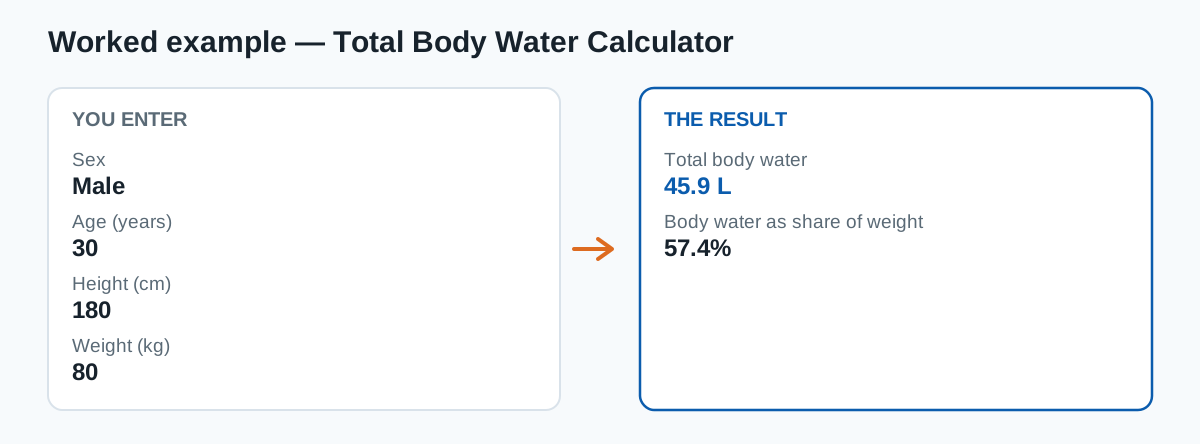
The example is pre-loaded in the result panel — press Calculate with your own numbers to replace it.
Frequently asked questions
Why does total body water fall with age?
Ageing replaces muscle with fat and shrinks cell mass; because muscle tissue is water-rich and fat is not, both total litres and the percentage of weight decline, even in a well-hydrated older adult.
Does a higher body-water percentage mean I am hydrated?
Not directly — TBW percentage mostly reflects body composition (more muscle, more water). Hydration status is about whether your current water matches your normal level, which a single TBW estimate cannot judge.
How much water should I drink a day?
That is a separate question about turnover, not volume — see our water intake calculator for daily drinking guidance based on weight and activity.
Category: Health & Fitness calculators
Sources & methodology
Watson, Watson & Batt (1980), fitted to isotope-dilution TBW in 723 subjects. Men's equation includes a small negative age coefficient; the published women's equation does not. For adults of average build the standard error is roughly ±3–4 L; obesity, oedema, amputation and elite muscularity move individuals outside the derivation population.
- Watson PE et al. — Total body water volumes for adult males and females estimated from simple anthropometric measurements (Am J Clin Nutr, 1980), via PMC review
- Watson equations — independent implementation and worked values
Content last reviewed by CalcHub Editorial.
Embed this calculator on your site
Free to use with attribution — paste the snippet below and the calculator appears on your page, with a link back to CalcHub.
Related calculators
Water Intake Calculator
Suggested daily water intake from body weight and exercise.
Sweat Rate Calculator
Work out your sweat rate from pre- and post-workout weights — and how much to drink back.
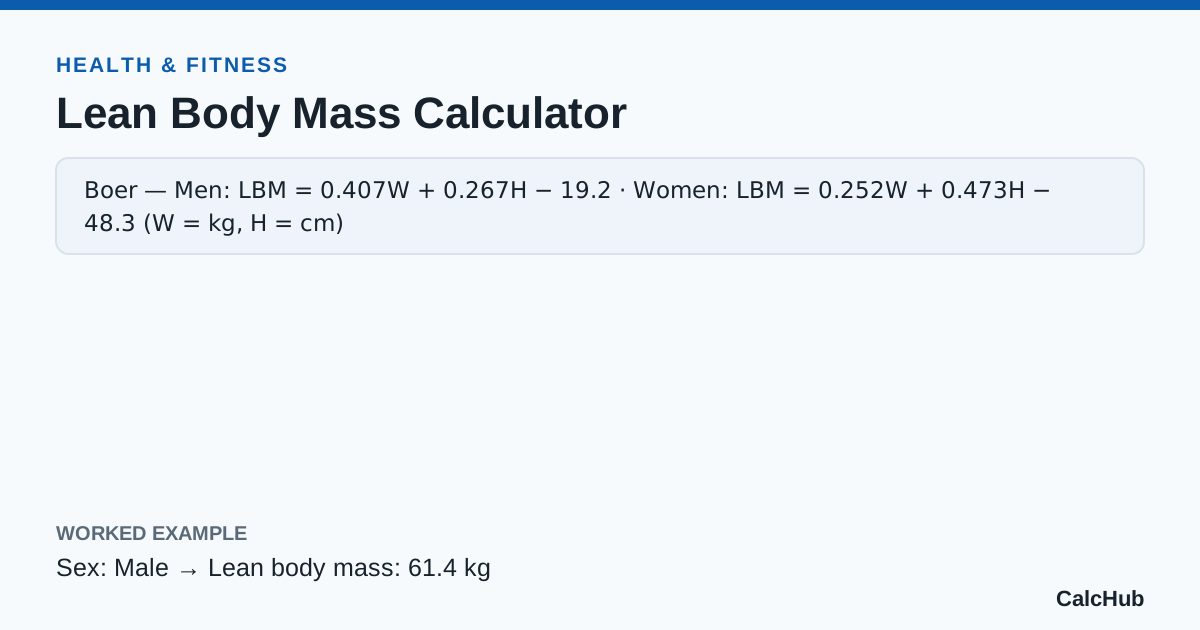
Lean Body Mass Calculator
Lean body mass from the Boer formula, with implied fat mass.
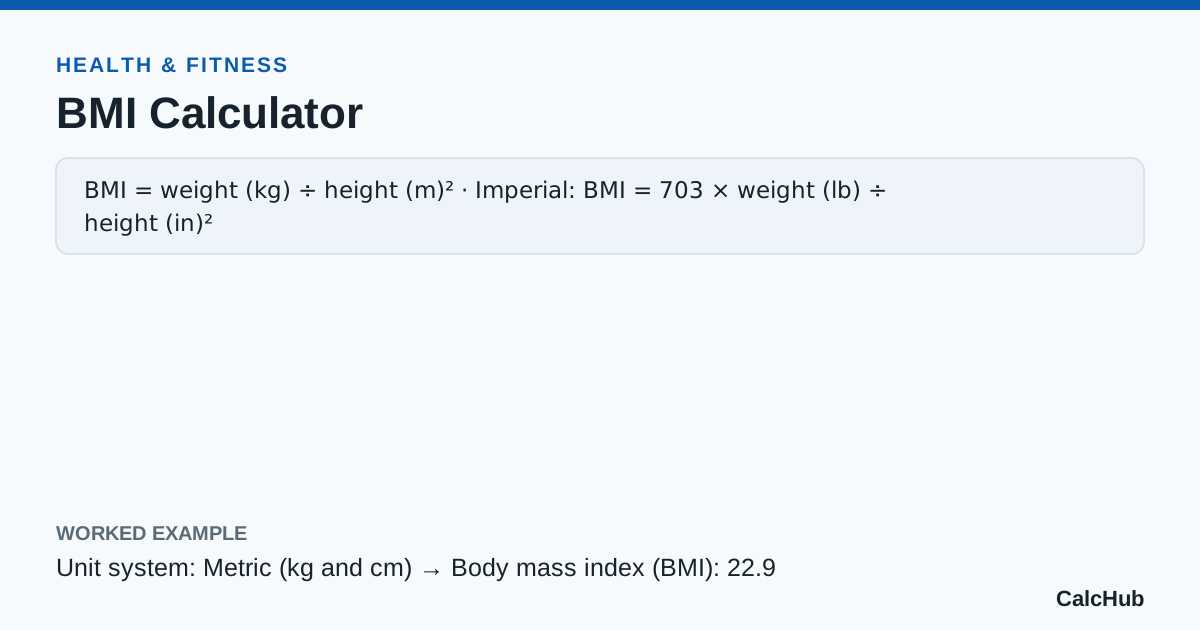
BMI Calculator
Body mass index from your weight and height, with the standard weight category.