
Relative Fat Mass Calculator
Body-fat estimate from just height and waist — the RFM method from Cedars-Sinai research.
Quick answer
- RFM needs no weight at all — just height and waist in the same unit, so it works when scales are unavailable or unreliable.
- Keep your waist under half your height (ratio below 0.5): the waist-to-height ratio shown alongside is itself a well-validated cardiometabolic risk marker.
- In the validation study RFM misclassified far fewer people than BMI — but for a competitive body-fat number, compare with the Navy circumference method or a DEXA scan.
- Worked example — Relative fat mass (estimated body fat): 22.1% (full example below).
Relative Fat Mass Calculator
| Relative fat mass (estimated body fat) | 22.1% |
| Waist-to-height ratio | 0.478 |
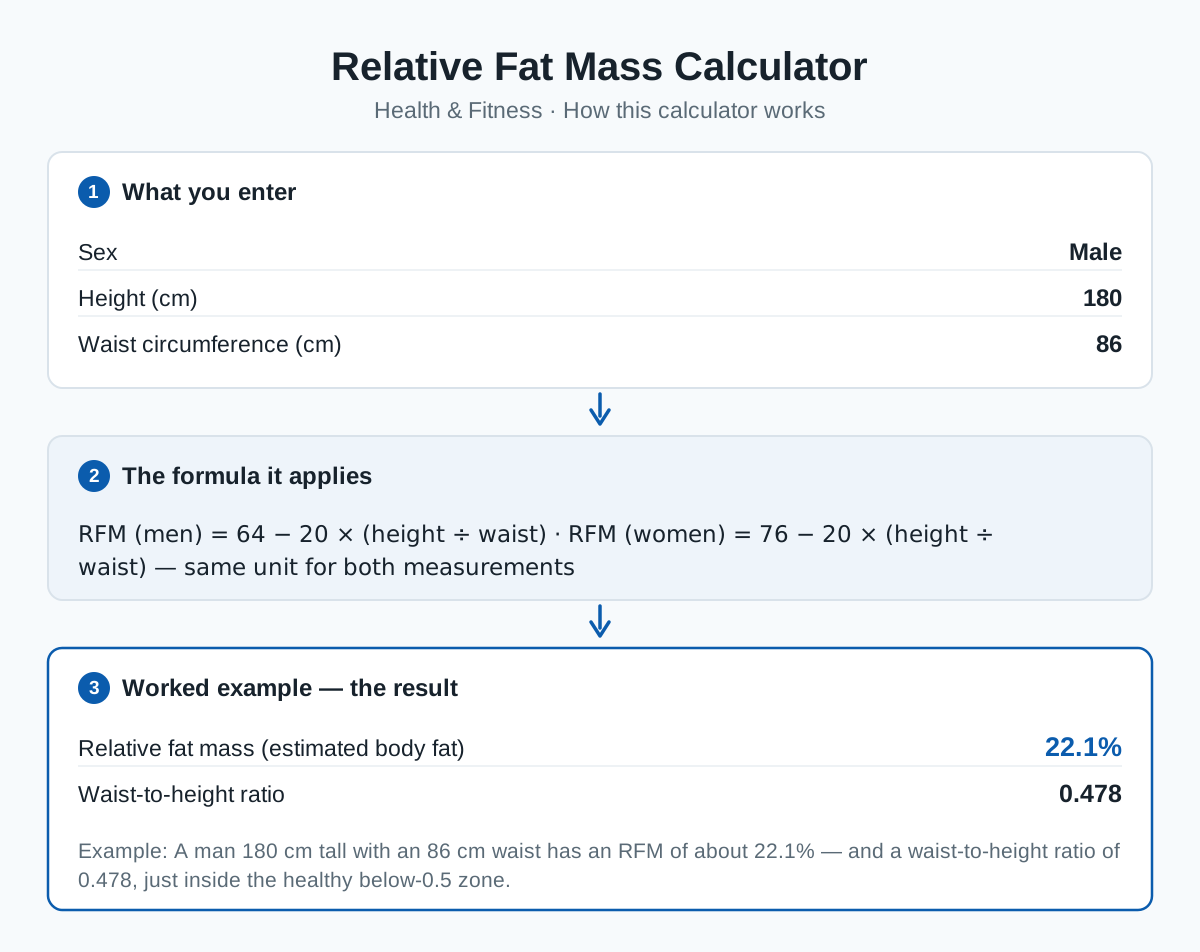
A man 180 cm tall with an 86 cm waist has an RFM of about 22.1% — and a waist-to-height ratio of 0.478, just inside the healthy below-0.5 zone.
Relative fat mass (RFM) estimates body-fat percentage from two tape measurements — height and waist circumference — with no scales, calipers or equations full of coefficients. It comes from a 2018 Cedars-Sinai study of 12,581 adults in Scientific Reports, where RFM predicted DXA-measured whole-body fat more accurately than BMI across the whole sample.
The equations are strikingly simple: RFM = 64 − 20 × (height ÷ waist) for men, and 76 − 20 × (height ÷ waist) for women, with height and waist in any consistent unit. Like every estimate, RFM describes populations better than individuals — unusual builds (very muscular, pregnant, significant abdominal swelling) can mislead it, and it does not replace a scan when precision matters.
The formula
Worked example
A man 180 cm tall with an 86 cm waist has an RFM of about 22.1% — and a waist-to-height ratio of 0.478, just inside the healthy below-0.5 zone.
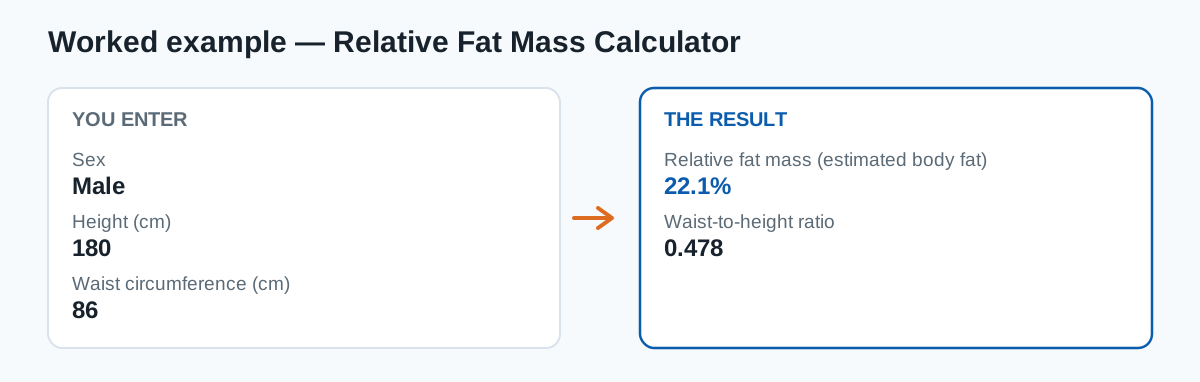
The example is pre-loaded in the result panel — press Calculate with your own numbers to replace it.
Frequently asked questions
How accurate is RFM compared with BMI?
In the NHANES validation, RFM predicted DXA body fat with less bias than BMI and correctly classified obesity in more participants — BMI misclassified a substantial share of men especially. RFM is still an estimate, with several percentage points of individual error.
Where exactly do I measure my waist?
At the level of the navel (the study's protocol), standing relaxed, tape snug but not compressing the skin, at the end of a normal exhale. Consistency matters more than the exact landmark when tracking change.
RFM vs the Navy body-fat method — which should I use?
The Navy method (our body fat calculator) uses neck and waist (plus hips for women) and tends to track lean, trained people better. RFM is simpler and was validated on a general population. If the two disagree by a lot, trust a scan over either.
Category: Health & Fitness calculators
Sources & methodology
RFM = 64 − 20 × (height ÷ waist circumference) for men and 76 − 20 × (height ÷ waist circumference) for women (Woolcott & Bergman, Scientific Reports 2018), validated against DXA in NHANES data. Both measurements must be in the same unit — the ratio makes the result unit-free. Pregnancy and conditions that change waist size independently of fat are outside the validated population.
- Woolcott OO, Bergman RN — Relative fat mass (RFM) as a new estimator of whole-body fat percentage (Scientific Reports, 2018)
- Relative Fat Mass — equations and background
Content last reviewed by CalcHub Editorial.
Embed this calculator on your site
Free to use with attribution — paste the snippet below and the calculator appears on your page, with a link back to CalcHub.
Related calculators
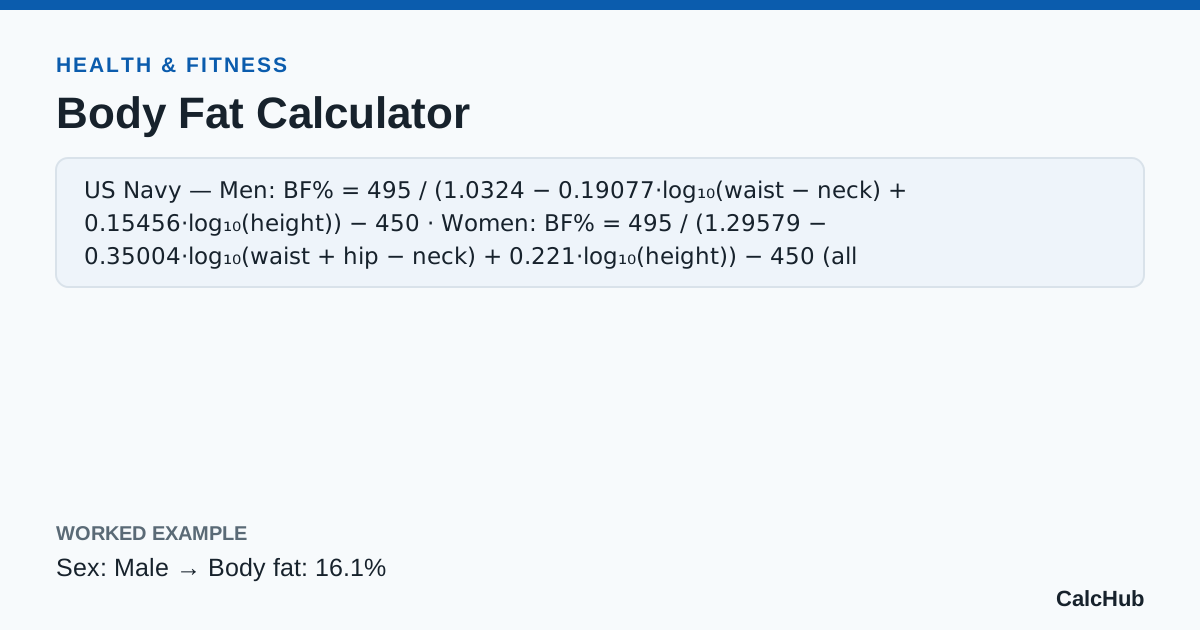
Body Fat Calculator
Estimate body fat percentage from tape measurements — the US Navy method.
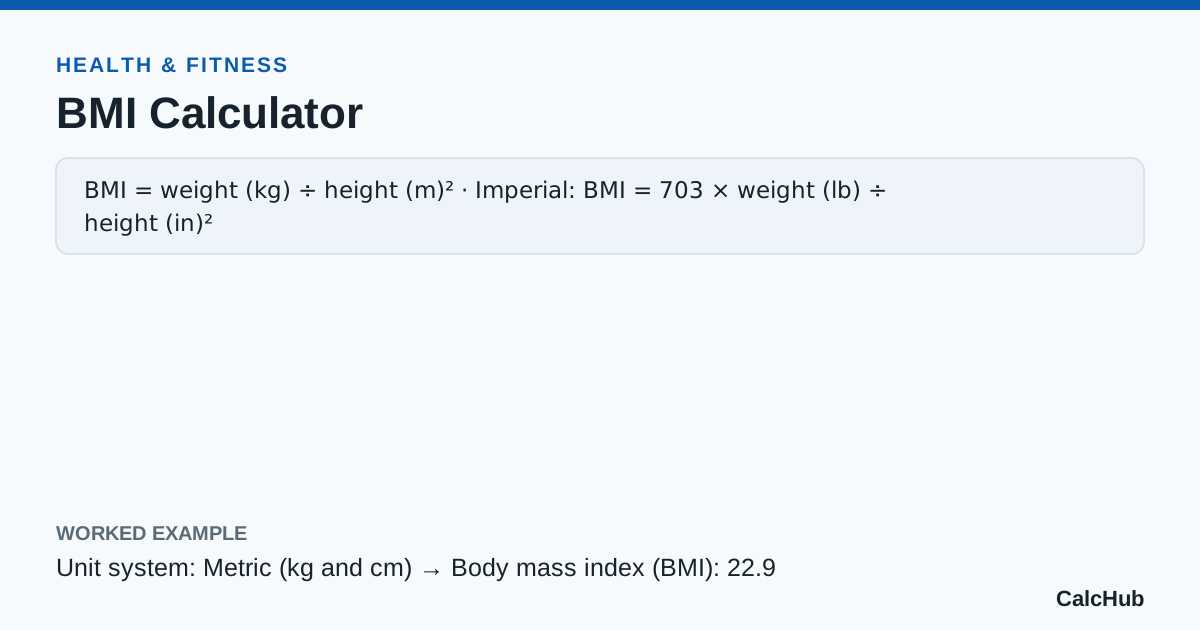
BMI Calculator
Body mass index from your weight and height, with the standard weight category.
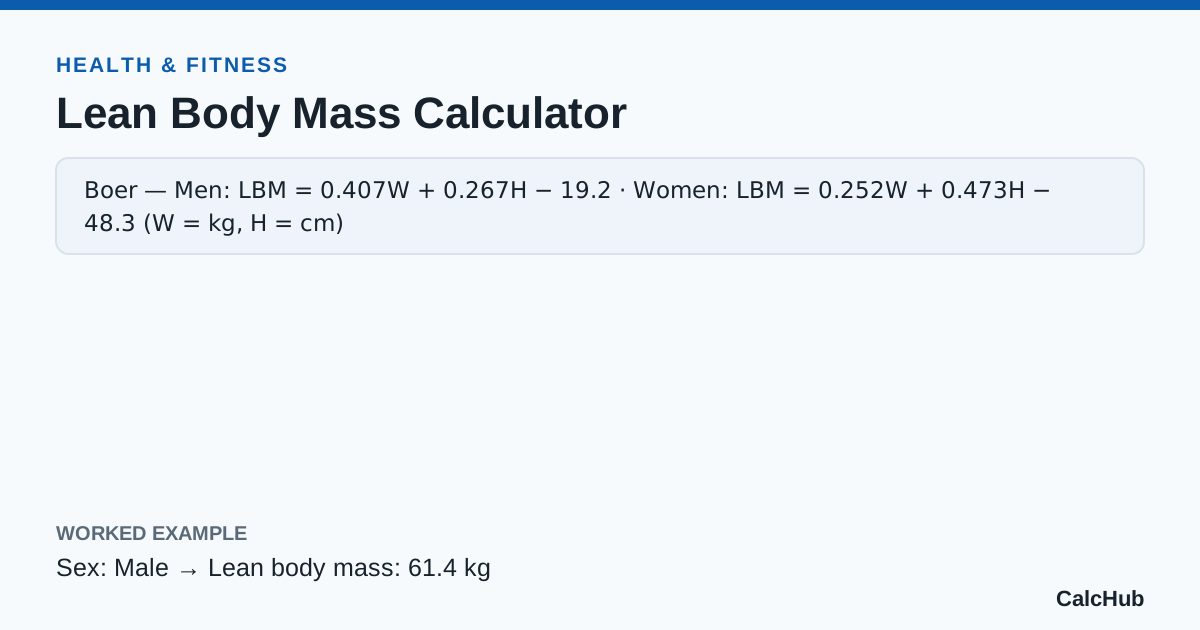
Lean Body Mass Calculator
Lean body mass from the Boer formula, with implied fat mass.
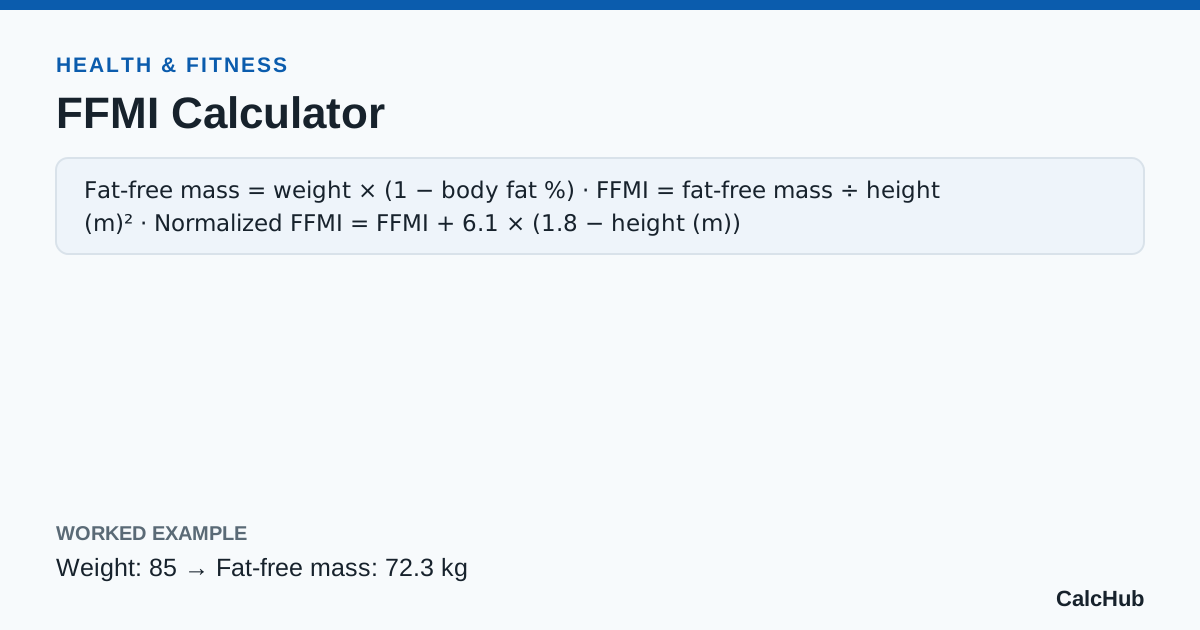
FFMI Calculator
Fat-free mass index and height-normalized FFMI from weight, height and body fat.