How to Calculate Weighted Grades (With a Worked Example)
In many classes, not every piece of work counts the same. A final project or a major test may be worth far more than a short quiz, so a simple average of your scores can give you the wrong picture of your grade. A weighted grade fixes that by giving each score an influence that matches how much of the course it represents. This guide shows you how to calculate it, how to find your grade partway through a course, and how to work out what you need on a final.
The direct answer
Multiply each score by its weight, add those products together, then divide by the total of the weights.
You can do this in seconds with our Weighted Grade Calculator — it accepts entries like "90,20; 85,30" (grade, weight pairs) and shows the working behind the result.
The formula
Weighted grade = Σ(score × weight) ÷ Σ(weights)
In plain words: Σ means "the sum of." So you add up every (score × weight) pair, and then divide by the sum of all the weights you used.
Dividing by the total weight is what makes the method flexible. Your weights do not have to add up to exactly 100 for the formula to work, because the division adjusts for whatever total you entered.
Step by step
- List each score with its weight. Write down every graded category or assignment and the weight your syllabus gives it.
- Multiply each score by its weight. Do this one item at a time and keep the results separate.
- Add the products together. This gives you the top number of the formula.
- Add the weights together. This gives you the bottom number.
- Divide. The result is your weighted grade.
Worked example
Suppose a course has three graded parts:
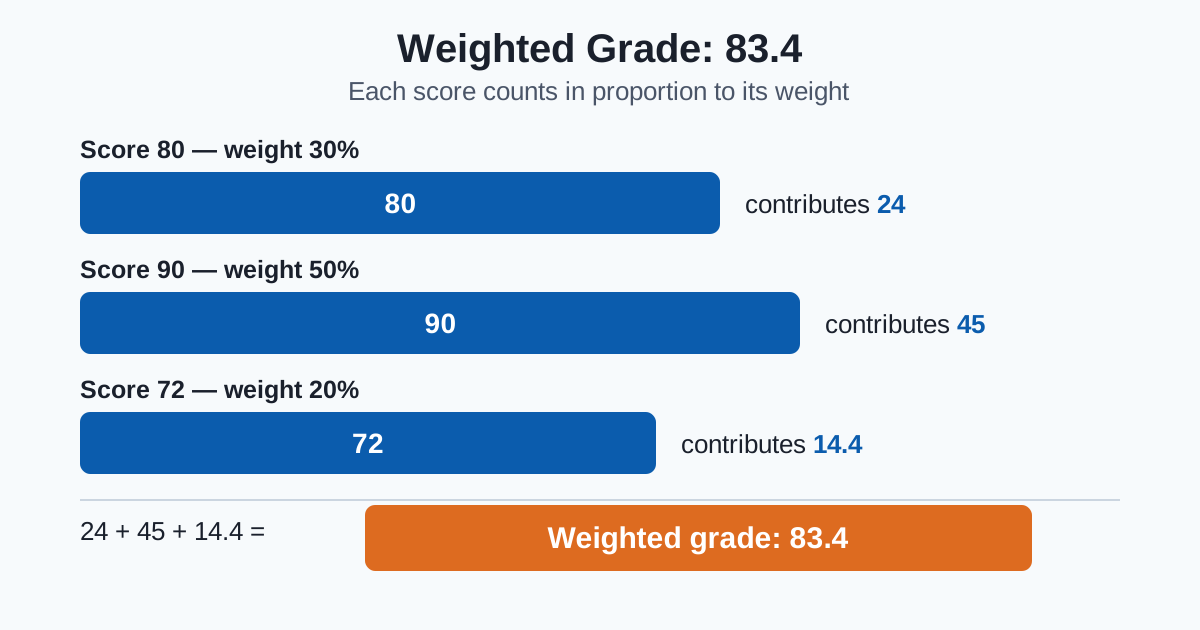
- A score of 80, weighted at 30%
- A score of 90, weighted at 50%
- A score of 72, weighted at 20%
Multiply each score by its weight (using the weight as a whole number):
- 80 × 30 = 2,400 — or, expressed as a share of the final grade, 80 at 30% contributes 24
- 90 × 50 = 4,500 — a contribution of 45
- 72 × 20 = 1,440 — a contribution of 14.4
Add the contributions:
24 + 45 + 14.4 = 83.4
Your weighted grade is 83.4.
Notice that the strongest score, 90, also carried the largest weight, 50%. That is why the result sits closer to 90 than a plain average of the three scores would.
| Score | Weight | Contribution |
|---|---|---|
| 80 | 30% | 24 |
| 90 | 50% | 45 |
| 72 | 20% | 14.4 |
| Total | 100% | 83.4 |
Finding your grade so far, before the course ends
Mid-course, some categories have no score yet. To find your grade based only on the work completed so far, use the same formula but divide by the weight you have entered so far — not by the full course weight.
For example:
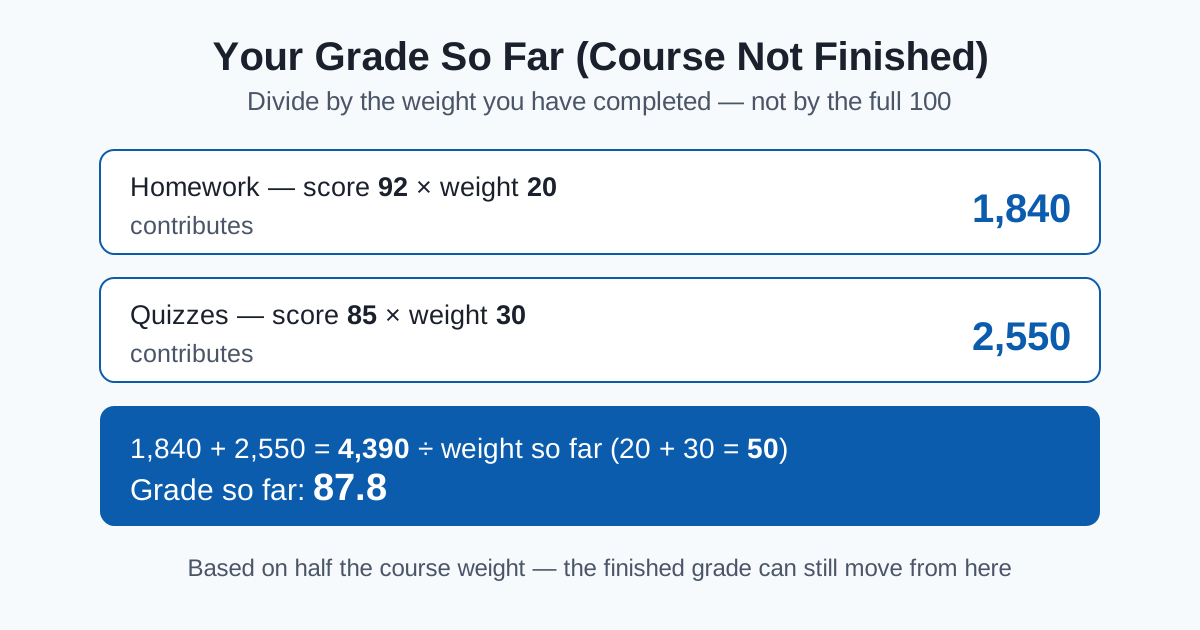
- Homework: 92, weight 20
- Quizzes: 85, weight 30
Multiply and add:
- 92 × 20 = 1,840
- 85 × 30 = 2,550
- Total: 1,840 + 2,550 = 4,390
The weight entered so far is 20 + 30 = 50, so:
4,390 ÷ 50 = 87.8
Your grade so far is 87.8, based on half of the course weight.
Points-based classes
Not every class uses weighted categories. In a points-based class, your grade is simply your total points earned divided by the total points possible.
For example, if you earned 630 points out of 700 possible:
630 ÷ 700 = 90%
No weights are needed here because each point already carries the same value.
What do I need on the final?
You can extend the same method to find the score you need on work that has not happened yet.
Continuing the example above, you have 87.8 banked over 50% of the course, and the final is worth the remaining 50%. To finish with a target of 90:
(90 − 87.8 × 0.5) ÷ 0.5 = 92.2
You would need 92.2% on the final to reach a 90 overall.
The logic is straightforward: 87.8 × 0.5 is the contribution your completed work will make to the final grade. Subtracting that from your target shows what the final still has to supply, and dividing by the final's weight, 0.5, converts that into the score required on the final itself.
For a dedicated walk-through with your own numbers, use our Final Grade Calculator and read what do I need on my final.
Common mistakes
Averaging category averages without weights. If you simply average your category scores, a small category counts as much as a large one. That can raise or lower your estimate compared with your real weighted grade.
Assuming the weights must total 100. They often do, but they do not have to. The formula divides by the sum of the weights you entered, so it normalizes the result automatically. This is also what makes the grade-so-far calculation work when only part of the course is complete.
Forgetting drop-lowest policies. Some courses drop your lowest quiz or assignment score. That changes the inputs — the dropped score should be removed, and the category average recalculated, before you apply the weights. Leaving it in will understate your grade.
Mixing up the score and the weight. In each pair, the score is how you performed and the weight is how much it counts. Swapping them produces a meaningless result, so label each number as you write it down.
FAQ
How do I calculate a weighted grade?
Multiply each score by its weight, add all of those products together, and divide by the sum of the weights. For example: 80 at 30% + 90 at 50% + 72 at 20% = 24 + 45 + 14.4 = 83.4.
What if my weights do not add up to 100?
That is fine. The formula divides by the total of the weights you actually entered, so the result is scaled correctly whether your weights total 100, 50, or another number.
How do I find my grade so far in an unfinished course?
Use only the categories you have scores for, and divide by the weight entered so far. Homework 92 (weight 20) and quizzes 85 (weight 30) give (1,840 + 2,550) ÷ 50 = 87.8.
How is a points-based grade different?
There are no category weights. You simply divide your total points earned by the total points possible — for example, 630 ÷ 700 = 90%.
How do I work out what I need on my final?
Take your target grade, subtract the contribution of your completed work (your grade so far multiplied by its share of the course), then divide by the final's weight. With 87.8 banked over 50% of the course and a final worth 50%, reaching 90 needs (90 − 87.8 × 0.5) ÷ 0.5 = 92.2% on the final.
How do I enter grades in the CalcHub calculator?
Type grade and weight pairs in the form "grade,weight", separated by semicolons — for example, "90,20; 85,30". The Weighted Grade Calculator then shows the full working, not just the answer.
Conclusion
A weighted grade is an average that respects how much each part of a course counts: multiply, add, and divide by the total weight. The same approach tells you your grade so far partway through a course and what you need on a final to reach a target.
Your next step: gather your scores and weights from your syllabus and enter them into the Weighted Grade Calculator to see your grade with the working shown. If your results feed into a longer-term average, see how to raise your GPA for what to focus on next. You can track that longer-term average directly with the GPA calculator. College Board BigFuture explains how letter grades convert to GPA points on a 4.0 scale, including how weighted systems differ.