How Many Bags of Concrete Do I Need? Bag Yields, Waste, and the Ready-Mix Crossover
The pour-day problem nobody wants
Concrete punishes under-ordering more than almost any other material. Run short of tiles and you pause the job. Run short of concrete in the middle of a pour and you can end up with a weak seam — a cold joint — where the first batch started to set before the rest arrived. Over-order by a lot and you are left hauling heavy bags back to the store.
So the question "how many bags do I need?" is really three questions: how much volume does the job need, how much does each bag actually produce, and how much extra should you allow for waste and surprises? This guide answers all three, with one fully worked slab example you can adapt to your own measurements. If your project starts with measuring the area itself, how to calculate square footage is a useful companion.
The direct answer
Work in this order:
- Volume = length × width × thickness, with every measurement in feet.
- Divide the volume by the yield of one bag to get the number of bags.
- Add 5–10% for waste, then round up to whole bags.
The bag yields used by our concrete calculator — and throughout this guide — are:
| Bag size | Yield per bag | Bags per cubic yard |
|---|---|---|
| 80 lb | 0.60 cu ft | 45 |
| 60 lb | 0.45 cu ft | 60 |
| 40 lb | 0.30 cu ft | 90 |
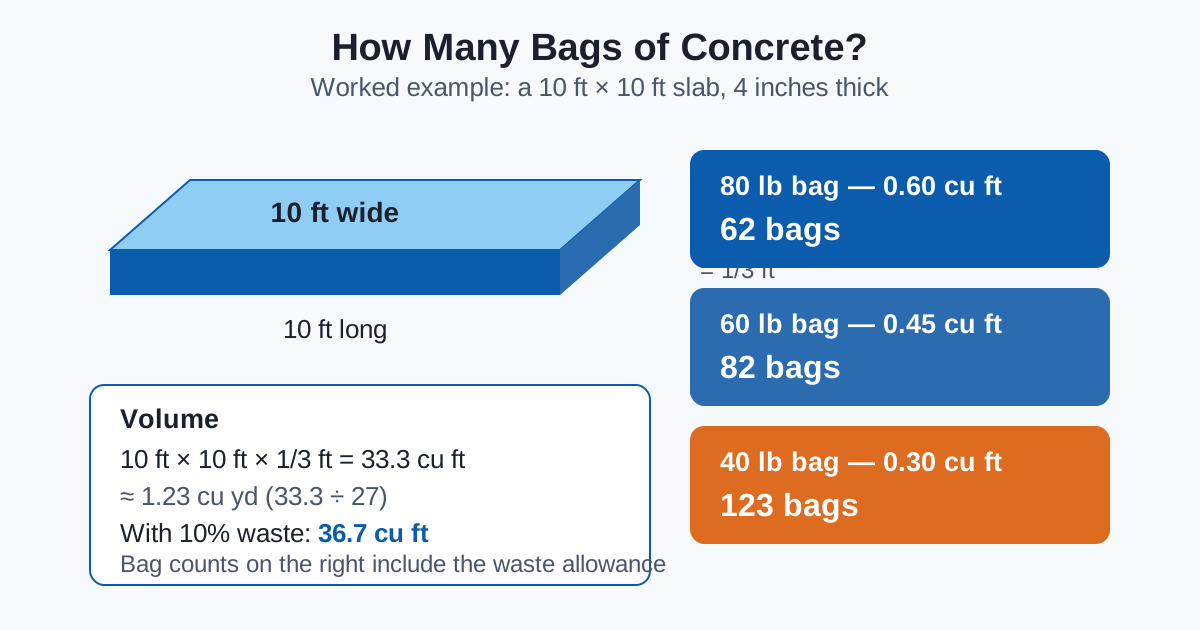
For the most common small project, a 10 × 10 ft slab, 4 inches thick, the answer with 10% waste included is 62 bags of 80 lb, 82 bags of 60 lb, or 123 bags of 40 lb. The full working is below so you can check it and adapt it.
Step by step
Step 1: Measure length and width in feet
Measure the full area to be covered. For a rectangle, that is simply length × width. (If the shape is not a simple rectangle, the square footage calculator can work out the area first.) A 10 ft × 10 ft slab covers 100 square feet — but square footage alone is not enough, because concrete is sold and mixed by volume, not by area.
Step 2: Convert thickness from inches to feet
This is the step people most often skip. Thickness must be in feet before you multiply:
- 4 inches = 4 ÷ 12 = 1/3 ft (about 0.333 ft)
Whatever thickness you plan, divide the inches by 12 first.
Step 3: Calculate the volume
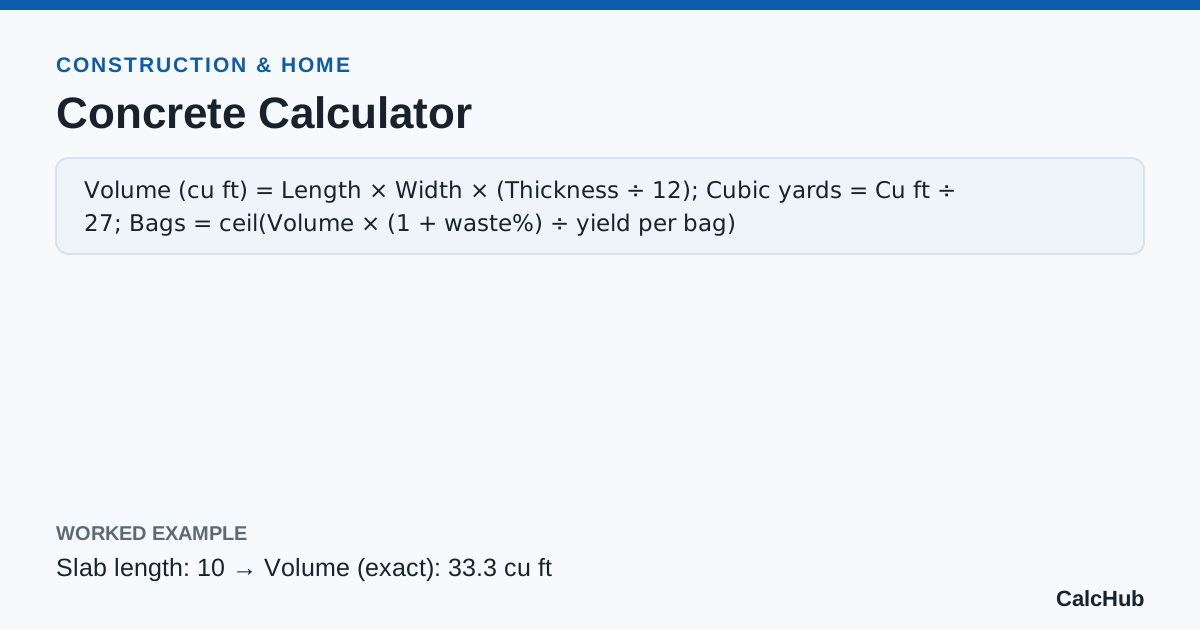
Volume = length × width × thickness (all in feet)
The result is in cubic feet. If you want it in cubic yards — the unit ready-mix is ordered in — divide cubic feet by 27. The cubic yard calculator handles that conversion if you are comparing a bagged job against a delivery.
Step 4: Divide by the bag yield
Take your volume and divide it by the yield for the bag size you plan to buy (0.60, 0.45, or 0.30 cu ft from the table above). Always round up — you cannot buy part of a bag, and a shortfall matters more than a spare bag.
Step 5: Add waste
Add 5–10% to the volume before the final bag count. Standard advice is in that range because real jobs lose concrete to uneven ground, spillage, over-excavation, and mix left in the wheelbarrow. Adding 10% is the cautious end of standard practice, and for a one-shot pour it is usually the sensible end.
Worked example: a 10 × 10 ft slab, 4 inches thick
Volume before waste:
10 ft × 10 ft × 1/3 ft = 33.3 cu ft, which is about 1.23 cu yd (33.3 ÷ 27).
Bags needed, before and after 10% waste:
| Bag size | Yield | Bags for 33.3 cu ft (no waste) | Bags for 36.7 cu ft (with 10% waste) |
|---|---|---|---|
| 80 lb | 0.60 cu ft | 56 | 62 |
| 60 lb | 0.45 cu ft | 75 | 82 |
| 40 lb | 0.30 cu ft | 112 | 123 |
The waste-adjusted volume is 33.3 × 1.10 = 36.7 cu ft. Notice that the smaller the bag, the more the count climbs: the same slab takes 62 of the largest bags or 123 of the smallest. Bag size does not change how much concrete the slab needs — it changes how many trips, lifts, and batches stand between you and a finished pour.
You can reproduce this example, or run your own measurements, in the concrete calculator.
Bags or ready-mix? The crossover point
Bagged concrete suits small jobs well: a few post holes, a small pad, a repair. But the bag count grows fast with area, and at some point mixing bag after bag stops being practical — not because of price, but because of sheer weight and effort.
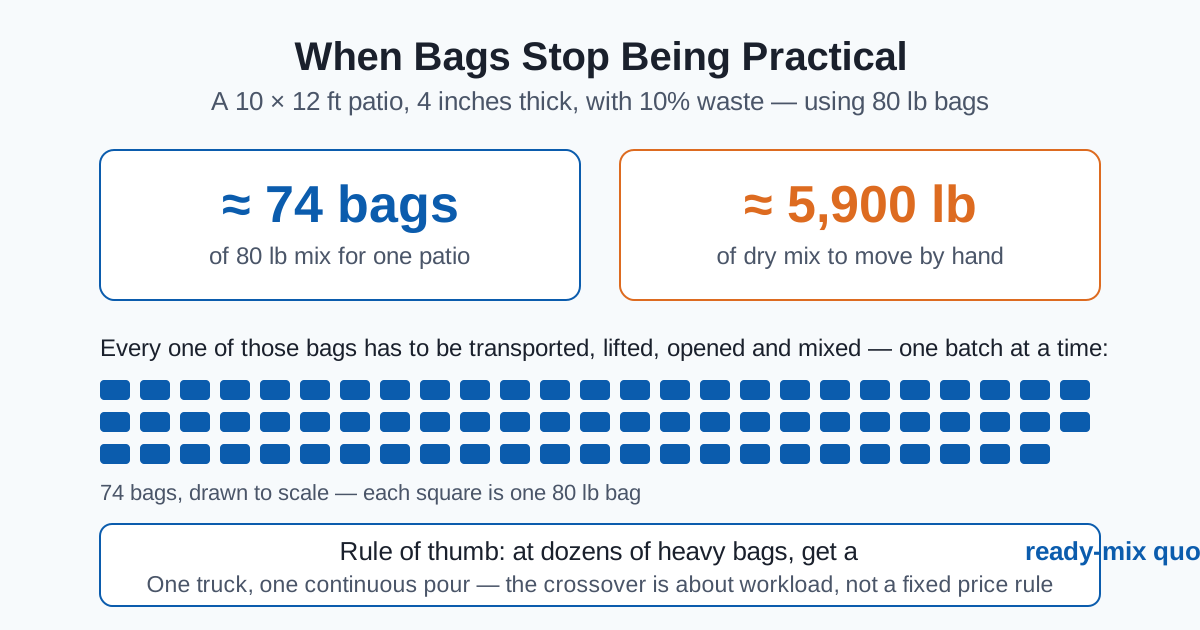
Here is a practical illustration. A 10 × 12 ft patio at 4 inches thick, with 10% waste, needs about 74 bags of 80 lb mix. That is roughly 5,900 lb of dry mix to transport, lift, open, and mix, one batch at a time, while the clock is running on the batches already placed.
As a practical rule of thumb — not a price claim — somewhere around this scale is where ready-mix delivery usually wins on effort: one truck, one continuous pour, no mixing marathon. Prices, minimum loads, and delivery fees vary widely by supplier and location, so treat the crossover as a question of workload and timing rather than a fixed cost rule. If your bag count is heading into the dozens of heavy bags, it is worth getting a ready-mix quote and comparing the total effort honestly before you commit to bags.
The same estimating discipline — measure carefully, add waste, round up — applies to other materials too. If your next project is a floor rather than a slab, see how many tiles do I need.
Common mistakes and limitations
Mistake 1: Mixing up cubic feet and cubic yards. There are 27 cubic feet in one cubic yard. If your volume is 33.3 cu ft and you order as if it were 33.3 cu yd, you are off by a factor of 27. Always note the unit next to every number as you work.
Mistake 2: Forgetting to convert thickness. Multiplying 10 × 10 × 4 using the thickness in inches gives a meaningless number that is 12 times too big. Convert first: 4 inches is 1/3 ft.
Mistake 3: Ordering exactly the computed amount. The raw calculation assumes a perfectly level base, no spillage, and nothing left in the mixer. Real sites are not perfect. Ordering the exact figure risks running short mid-pour, and a pause while fresh concrete waits can leave a cold joint — a plane of weakness where two batches did not bond as one. The 5–10% waste allowance exists precisely to protect the pour.
Mistake 4: Ignoring the yield printed on the actual bag. The yields in this guide (0.60, 0.45, and 0.30 cu ft) are the published figures our calculator uses, but manufacturers and mixes differ. Before a big order, check the yield printed on the specific bag you are buying and use that figure if it differs.
Limitation: this maths assumes a simple, even shape. Slabs of uniform thickness on a level base fit the formula exactly. Sloped ground, thickened edges, footings, or irregular shapes all add volume the simple length × width × thickness calculation will miss. For irregular jobs, break the area into simple rectangles, calculate each one, and add them together — and lean towards the 10% end of the waste range.
Frequently asked questions
How many bags of concrete do I need for a 10 × 10 slab?
At 4 inches thick, the slab needs 33.3 cu ft of concrete, or 36.7 cu ft with 10% waste added. That works out to 62 bags of 80 lb, 82 bags of 60 lb, or 123 bags of 40 lb, including the waste allowance. A different thickness changes the answer in direct proportion, so recalculate if your slab is not 4 inches thick.
How many bags of concrete are in a cubic yard?
It depends on bag size: about 45 bags of 80 lb, 60 bags of 60 lb, or 90 bags of 40 lb make one cubic yard. That is a quick way to sanity-check a bag count against a volume quoted in cubic yards — just remember to divide cubic feet by 27 to get cubic yards first.
Should I buy 80 lb, 60 lb, or 40 lb bags?
The concrete volume is the same either way; what changes is the number of bags and the weight of each lift. Larger bags mean fewer batches but heavier handling on every single one. Smaller bags are easier to lift but multiply the mixing work — 123 bags instead of 62 for the example slab. Choose based on what you can safely handle repeatedly, and on how many people are helping.
Why add 10% waste if my measurements are exact?
Because the job is never as exact as the measurements. Uneven sub-grade, slight over-digging, spillage, and residue in the mixer and barrow all consume concrete. Standard advice is 5–10%; the extra bags are cheap insurance against running short mid-pour and forming a cold joint, and unopened bags are far easier to deal with than a half-finished slab.
When should I switch from bags to ready-mix?
As a rule of thumb based on effort rather than price: when the job needs dozens of heavy bags — the 10 × 12 ft patio example needs about 74 bags of 80 lb, roughly 5,900 lb of dry mix — ready-mix delivery usually becomes the more practical option. Get a local quote for your volume in cubic yards and weigh it against the hauling and mixing work, since costs and minimums vary. The National Ready Mixed Concrete Association (NRMCA) is the industry body for ready-mix producers, and its checklist for ordering and scheduling ready-mixed concrete covers the details a supplier needs for a delivery.
Does a thicker slab need proportionally more bags?
Yes. Volume is length × width × thickness, so doubling the thickness doubles the volume and, with it, the bag count. That is why confirming your planned thickness — and converting it to feet correctly — matters more than any other single input.
Conclusion: measure, convert, add waste, then decide
Every bag calculation is the same chain: measure in feet, convert the thickness, multiply for volume, divide by the yield of your chosen bag, and add 5–10% before you round up. Do that, and the count you order will match the slab you planned — with a small buffer for the real world.
Your next step: enter your own length, width, and thickness into the concrete calculator to get the bag count for all three bag sizes at once. If the result runs to dozens of 80 lb bags, pause before ordering and price a ready-mix delivery for the same volume using the cubic yard calculator — at that scale, the easier pour is often the smarter one.